
 By Camille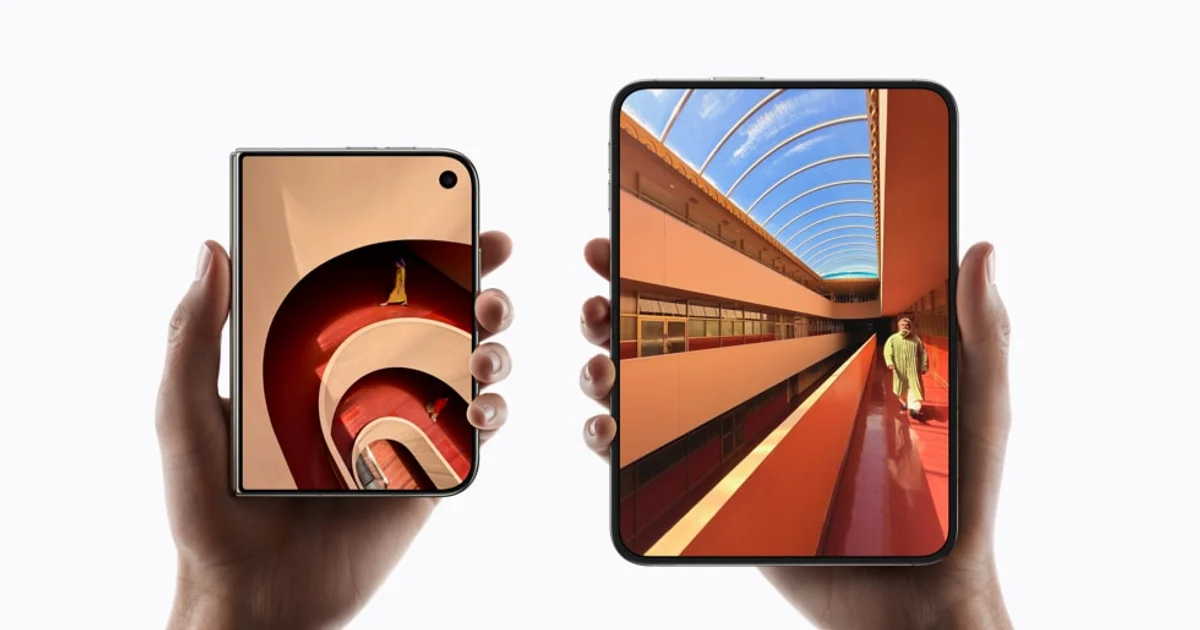
The first foldable iPhone is official. Apple unveiled iPhone Duo on September 9, with preorders opening October 16 and retail availability following on October 23.
Closed, the phone uses a 5.4-inch outer Super Retina XDR display. Open it and the inner panel measures 7.6 inches, making it Apple's largest iPhone display so far. Apple says that inner screen offers 50 percent more display area than iPhone 18 Pro Max.
Matching aspect ratios solve a surprisingly important problem
Both displays use the same aspect ratio. That sounds like an almost boring specification until an app has to move from one screen to the other. Instead of completely rebuilding its layout as the device unfolds, content can scale more proportionally between the two.
Both panels support ProMotion and Always On and are rated for up to 3,000 nits of outdoor peak brightness. The inner display adds a nano-texture treatment designed to cut reflections and make the crease less visually obvious.
Apple has also made unusual changes to the basic iPhone interface. Controls and navigation can move toward the sides of the display, the Dynamic Island has been reworked for the shape, and Split View finally brings two-app multitasking to iPhone.
Users can open two windows from the same app, save app pairs and switch layouts as the device changes orientation. Netflix, Zoom and Slack already have Duo-specific interfaces, while Apple Pencil USB-C support is due later this year.
The hinge has more than 100 parts, and the phone still gets IP68
The Duo uses a grade 5 titanium structure with a hinge assembled from more than 100 precision components. Apple says it supports the center of the display when fully opened while integrated magnets provide a secure closure.
Ceramic Shield protects the rear and Ceramic Shield 2 covers the outer screen. More unusually for a foldable, Apple rates the whole device IP68 for water and dust resistance.
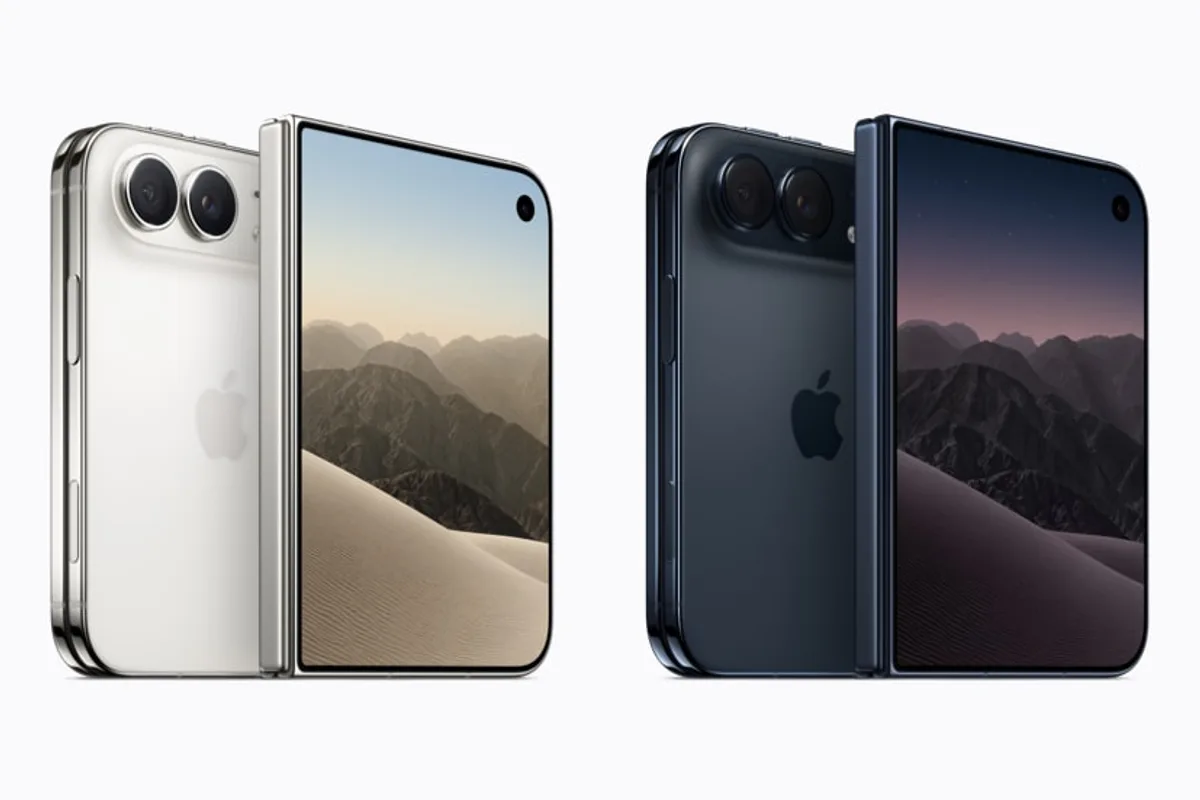
There is no Face ID. Touch ID moves into the side button instead, giving authentication a fixed physical location whether the Duo is open, folded or propped up on a surface. Apple Watch unlocking is supported as well.
Two batteries divide the problem across both halves
Rather than placing one battery into a single side of the chassis, Apple puts a battery in each half. Software balances the two packs so they behave as one power source.
Apple rates video playback at up to 31 hours using the inner display or 44 hours using the outer screen. With both displays used equally, the company claims up to 24 hours of general use per charge.
Wired charging can reach 50 percent in around 20 minutes. MagSafe or Qi2 wireless charging can reach the same level in roughly 30 minutes.
A20 Pro gets a vapor chamber because this iPhone is built for longer workloads
The Duo runs on the 2nm A20 Pro platform, with a six-core CPU, seven-core GPU and two 16-core Neural Engines. Apple claims up to 20 percent faster CPU performance than A19 Pro, up to 40 percent higher GPU performance and efficiency, and 50 percent more unified memory bandwidth.
A custom chip package connects the SoC directly to a vapor chamber. Apple says the design can deliver up to 35 percent better sustained performance than iPhone 17 Pro.
Those remain manufacturer numbers until retail hardware is tested, but sustained performance matters more on this form factor than on a conventional phone. A 7.6-inch screen, side-by-side apps and high-frame-rate gaming all encourage users to keep demanding workloads running for longer.
The camera system makes practical use of the second screen
The rear camera array combines a 48MP Fusion Main camera with a 48MP Fusion Ultra Wide. The Main camera includes sensor-shift stabilization and an optical-quality 2x mode, while the Ultra Wide handles macro photography.
The foldable design creates a few genuinely different workflows. The outer screen can show a live preview to the person being photographed while the photographer frames the shot from the other side. The Duo can also stand partially folded for FaceTime, video or time-lapse recording without a separate tripod.
Smart Take uses on-device AI to watch a scene and capture a shot when subjects are posing. Kid Cue can display animated Peanuts characters on the outer screen to attract a child's attention toward the cameras.
Apple's strongest argument may be that the software already feels intentional
Book-style foldables are not new. Samsung, Huawei and other manufacturers spent years solving the mechanical and software problems while Apple stayed out of the category.
That history changes the standard the Duo will be judged against. A rough first generation would be harder to excuse in 2026 than it would have been in 2019.
Apple's approach appears centered on reducing the number of moments where the fold becomes an inconvenience: matching screen ratios, fluid transitions, angle-aware layouts, app pairs and software already adapted by major developers. The hardware still has to survive daily folding, and the battery claims need independent testing.
iPhone Duo starts at $1,999 in the US with 256GB of storage and is also available in 512GB, 1TB and 2TB configurations. Preorders begin October 16 across more than 70 countries and regions, with availability on October 23.