
 By Adri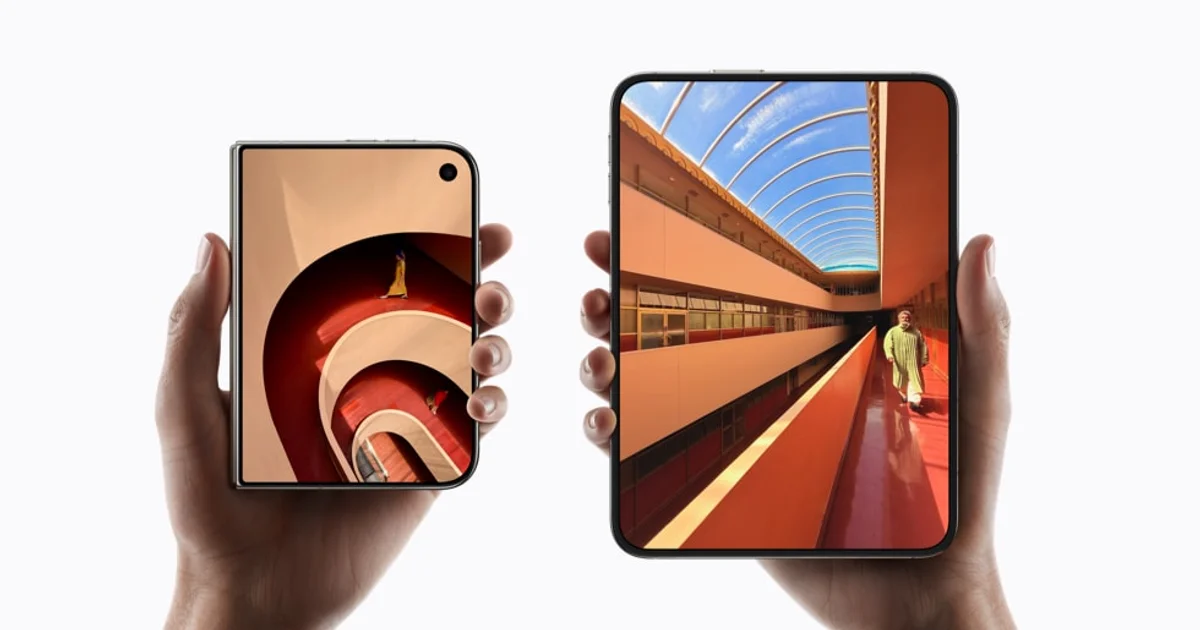
A 5.4-inch phone becomes a 7.6-inch canvas
The iPhone Duo uses a book-style design with a 5.4-inch Super Retina XDR display on the outside and a 7.6-inch inner display when opened. Apple calls the latter the largest display it has ever shipped on an iPhone.
Both panels use the same aspect ratio, reducing the amount of reflow required when an app moves from one display to the other. ProMotion, Always-On functionality and up to 3,000 nits of claimed outdoor peak brightness are supported on both screens.
The inner display adds a matte nano-texture layer designed to reduce glare and make the crease less visible. Early hands-on reports suggest the crease can still be seen under particular lighting and angles, which is a useful reminder that materials can disguise a fold more easily than they can repeal geometry.
The hinge contains more than 100 components
Apple says the precision hinge uses more than 100 parts. It supports the center of the panel when fully opened, while an integrated magnet array keeps the two halves securely closed.
The enclosure is built from grade 5 titanium, including a 3D-printed titanium hinge cover. Internal support ribs and ceramic-fiber inserts around antenna breaks add stiffness without simply filling the phone with more metal.
The finished device carries an IP68 rating for water and dust resistance. Dust resistance is particularly notable on a foldable because the moving hinge creates many more opportunities for particles to enter than on a conventional slab phone.
Face ID makes way for Touch ID
Apple has not included Face ID. Touch ID instead lives in the side button so authentication works whether the Duo is open or closed.
A FaceTime camera sits beneath the inner display and stays hidden when it is not active, while a Center Stage camera remains available on the outside.
It is a revealing compromise. Even on a $1,999 iPhone, internal volume is limited enough that Apple did not simply transplant every component from the Pro lineup.
A20 Pro is connected directly to a custom vapor chamber
The Duo uses the same A20 Pro as the iPhone 18 Pro family. Apple lists a six-core CPU, seven-core GPU and dual 16-core Neural Engine, with claimed gains of up to 20% in CPU performance, 40% in GPU performance and twice the AI compute capability of the previous generation.
Those are Apple’s figures. The packaging is arguably more interesting than the percentages: a new design connects A20 Pro directly to a custom vapor chamber intended to keep the chip running closer to peak performance during sustained workloads.
Apple claims up to 35% better sustained performance than iPhone 17 Pro. Independent testing will matter here, particularly because the Duo is only 5.2mm thick when open.
Two batteries, one power system
Apple fits a battery into each half of the device. Energy-management algorithms balance the two cells so the system treats them as one power source.
The company rates video playback at up to 31 hours on the inner display, 44 hours using the outer display and 24 hours when usage is split evenly between both.
Wired charging can reach 50% in about 20 minutes according to Apple, while MagSafe or Qi2 can reach the same level in roughly 30 minutes. The Duo is also eSIM-only worldwide.
iOS had to learn what happens when an iPhone has two sides
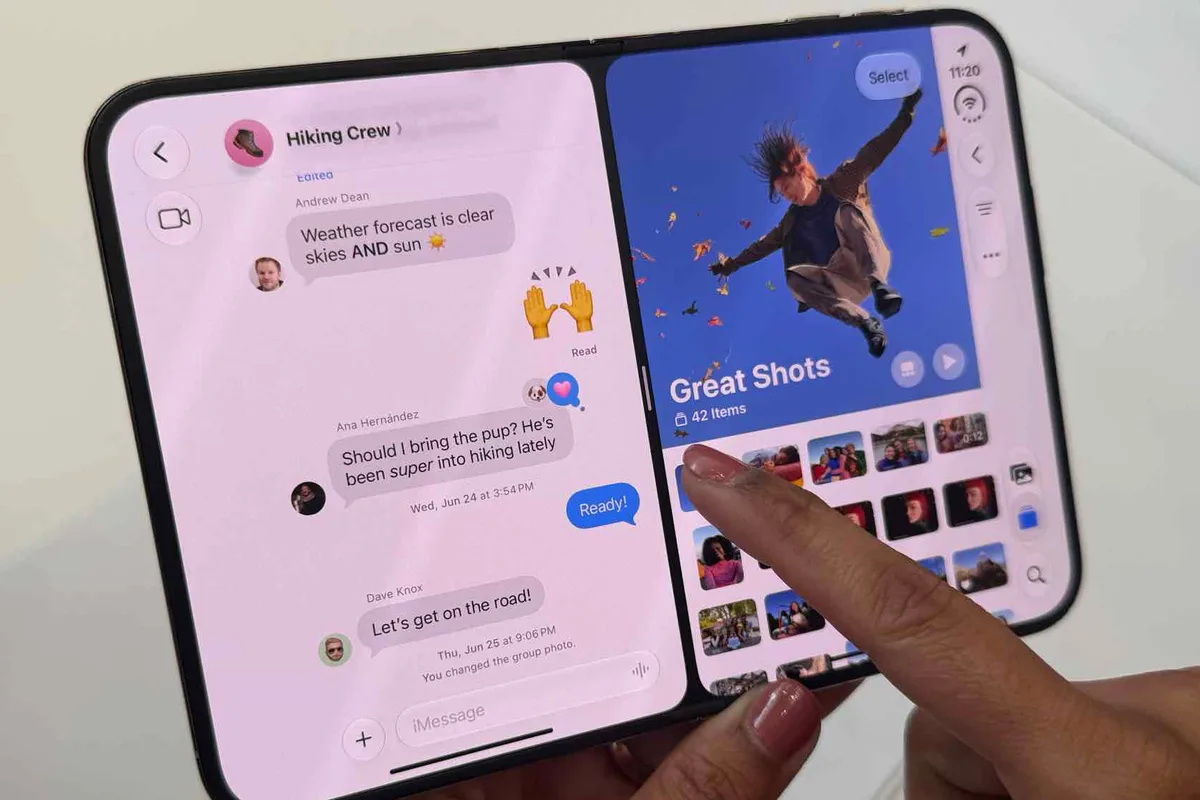
The hardware creates a software problem Apple has never previously needed to solve on an iPhone. iOS 27 adds Split View, allowing two apps to run next to each other for the first time on the platform.
Two windows from the same app can also be opened, such as two Safari pages. Controls move toward the sides of the interface to preserve vertical space, while the system reacts to device angle, rotation and which display is facing the user.
Apple says Netflix, Zoom and Slack already have foldable-specific layouts. App pairs can be saved and reopened together.
It is still a more conservative multitasking model than some Android foldables that can keep three or four apps visible. Apple is putting more emphasis on transitions and posture awareness than maximum window count in this first generation.
The fold changes how the cameras can be used
The rear system contains a 48MP Fusion Main camera with an optical-quality 2x crop and a 48MP Fusion Ultra Wide with macro support. There is no dedicated telephoto module like the one found on the iPhone 18 Pro.
The second screen creates other options. The rear cameras can be used for selfies while the outer panel acts as a viewfinder, and Duo Preview lets the person being photographed see the composition in real time.
The phone can also remain partially folded on a surface for hands-free shooting. Kid Cue goes one step further by showing Peanuts animations on the outer display to persuade children to look toward the camera.
Apple Pencil support comes later
Apple says USB-C Apple Pencil support will arrive later this year and work on either display for notes, drawing and document markup.
The iPhone Duo comes in star white and night sky with 256GB, 512GB, 1TB or 2TB of storage. U.S. pricing starts at $1,999, while Apple lists a €2,299 starting price in Germany.
Preorders begin October 16, followed by availability on October 23 in more than 70 countries and regions.
Apple is entering foldables several generations after Samsung and years after other Android manufacturers. Its first device is neither the thinnest nor the lightest in the category. What makes the launch technically interesting is that Apple has finally treated folding as a system problem: display, hinge, thermals, batteries and software all had to move together.