
 By Camille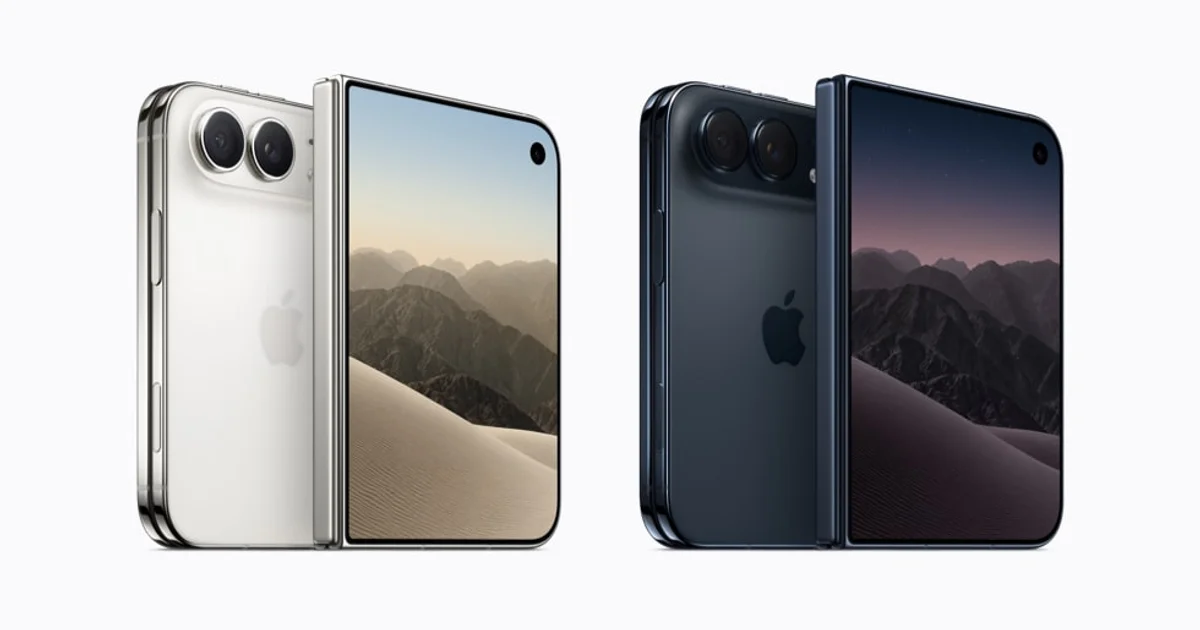
A 5.4-inch iPhone turns into a 7.6-inch one
Apple unveiled the iPhone Duo on September 9 as its first foldable smartphone.
Closed, it uses a 5.4-inch Super Retina XDR outer display.
Opening the device reveals a 7.6-inch Super Retina XDR panel, the largest display Apple has shipped on an iPhone.
Apple says the cover screen offers about 90% of the screen area of the iPhone 18 Pro, while the inner display is 50% larger than the iPhone 18 Pro Max panel.
That is an important design decision because the Duo is intended to remain usable as a normal one-handed phone without forcing the user to open it constantly.
Both screens use the same aspect ratio
Apple has matched the aspect ratios of the inner and outer displays.
That allows apps and content to scale more predictably as the phone changes state rather than requiring a completely different layout every time it opens.
Both displays support ProMotion, Always-On functionality and up to 3,000 nits of outdoor peak brightness.
The inner panel also gets an optional nano-texture finish intended to reduce reflections and make the center crease less visually obvious.
Apple Pencil USB-C support is scheduled to arrive later in the year.
Face ID gives way to side-button Touch ID
The Duo does not use Face ID as its primary biometric system.
Apple instead places Touch ID in the side button so authentication works consistently whether the device is open or closed.
The decision is unusual for a premium iPhone but mechanically sensible on a phone whose geometry changes.
A FaceTime camera sits beneath the inner display, while another front-facing camera remains available when the phone is closed.
The hinge contains more than 100 components
Apple says the precision hinge uses more than 100 individual components.
Its job is not simply to bend.
The mechanism supports the center of the flexible display when opened and works with an internal magnet array to create a secure closure.
The enclosure uses grade 5 titanium and a 3D-printed hinge cover.
Internal support ribs and ceramic-fiber inserts reinforce the frame around antenna splits.
Despite the additional mechanical openings required by the hinge, the phone carries an IP68 rating for water and dust resistance.
The flexible screen is a stack of polymer, glass and titanium
The inner display uses a scratch-resistant nano-textured polymer cover layer that Apple says is up to 40% stiffer than comparable materials used elsewhere in the industry.
High-strength glass sits above and below the flexible display panel.
Custom adhesives let the layers move slightly past one another while the phone bends, reducing concentrated stress.
A titanium plate adds reinforcement beneath the display.
None of those construction details can yet answer the most important durability question: how the panel and hinge will look after years of daily folding.
iOS finally gets two apps side by side on an iPhone
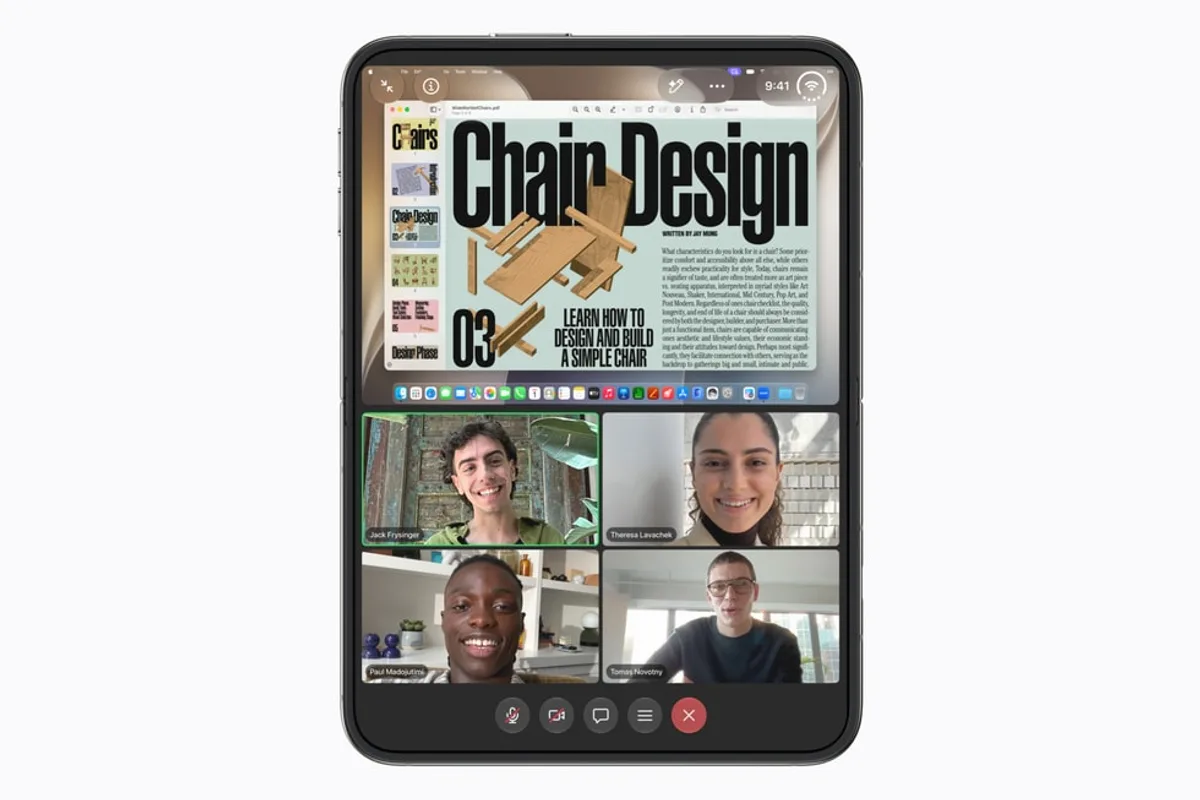
The most consequential software feature may be Split View.
iOS 27 allows two apps to run side by side on an iPhone for the first time.
Users can also open two windows from the same app, save app pairs and quickly swap one side of the layout without rebuilding the entire workspace.
Apple has moved interface elements such as navigation and Dock controls toward the edges to preserve more vertical space.
The Dynamic Island also changes orientation depending on how the Duo is being used.
Netflix, Zoom and Slack are among the third-party apps already adapted for the new layout.
A20 Pro has to drive two displays without throttling
The Duo uses the same A20 Pro silicon as the iPhone 18 Pro.
The chip is manufactured on a 2nm process and combines a six-core CPU, seven-core GPU and dual 16-core Neural Engines.
Apple claims the CPU is up to 20% faster than A19 Pro, while the GPU is up to 40% faster and more efficient.
Unified-memory bandwidth increases by 50%.
More relevant to a foldable, Apple claims up to 35% better sustained performance than iPhone 17 Pro.
A custom vapor chamber is attached directly to the chip package to move heat away during gaming, multitasking and local AI workloads.
There is one battery on each side
Apple fills both halves of the chassis with separate high-energy battery cells.
Software manages them as one power system.
The company rates video playback at up to 31 hours using the inner display and 44 hours when the outer display is used instead.
With mixed use across both screens, Apple claims about 24 hours per charge.
Wired fast charging reaches 50% in approximately 20 minutes.
MagSafe or Qi2 charging reaches the same level in roughly 30 minutes.
The Duo is eSIM-only everywhere
Apple has removed the physical SIM tray worldwide on this model.
The company says reclaiming that internal volume helps maximize battery capacity.
The new C2 modem handles cellular connectivity and supports mmWave in the US.
Apple's N1 networking chip adds Wi-Fi 7, Bluetooth 6 and Thread.
The decision will be almost invisible in regions where eSIM is already common and more restrictive in markets where physical SIM swapping remains normal.
Two 48MP cameras, but no long-range Pro telephoto
The main rear camera is a 48MP Fusion sensor with sensor-shift optical stabilization.
It also provides an optical-quality 2x crop.
The second rear module is a 48MP Fusion Ultra Wide with macro support.
Apple does not give the Duo the more elaborate long-range telephoto system found on its Pro models.
The foldable design compensates with different shooting modes.
The outer screen can show a live preview to the subject, and the rear cameras can be used for higher-quality selfies.
The main camera records up to 4K120 Dolby Vision.
The large screen also becomes a Siri AI surface
Siri AI can remain visible on one half of the inner display while the user works with an app on the other.
The assistant can use on-screen context and authorized personal information to answer questions or take actions.
A new Siri Camera mode allows it to interpret what the camera sees.
Some processing runs locally on A20 Pro, while more demanding requests can use Apple's Private Cloud Compute infrastructure.
$1,999 is only the starting point
The iPhone Duo will ship in 256GB, 512GB, 1TB and 2TB capacities.
US pricing starts at $1,999.
That makes it Apple's most expensive iPhone at entry level.
Preorders begin October 16 in more than 70 countries and regions, including the US, UK, France, Germany and Japan.
Availability begins October 23, followed by another 28 markets on October 30.
Apple is late to foldables, so software integration has to be the advantage
Foldable smartphones have existed for years and still represent a relatively small part of the global phone market.
Apple does not have novelty on its side.
Its advantage is control over nearly every layer of the product: silicon, operating system, display behavior, hinge mechanics and developer APIs.
That does not automatically make the Duo worth $1,999.
Durability, thickness, battery life and real app support still need to survive independent testing.
What Apple has changed immediately is the category's status. Foldables are no longer something the iPhone watches from the sidelines.