
 By Tsuky
Apple introduced iPhone 18 Pro and iPhone 18 Pro Max on September 9, with availability beginning September 18.
The new 48MP Fusion Main camera contains two of this generation's most interesting changes.
The first is straightforward photography hardware: the lens now has a physical variable aperture.
The second is about trust in the resulting image. Apple Reference Image creates an authenticated reference derived from signed sensor data.
The aperture physically moves inside the camera
Apple is not using aperture as a software metaphor here.
The Main camera contains six laser-cut blades controlled by a new rotor mechanism that physically changes the lens opening.
The camera can open as wide as f/1.48 in dark conditions and narrow to f/4 when greater depth of field is useful.
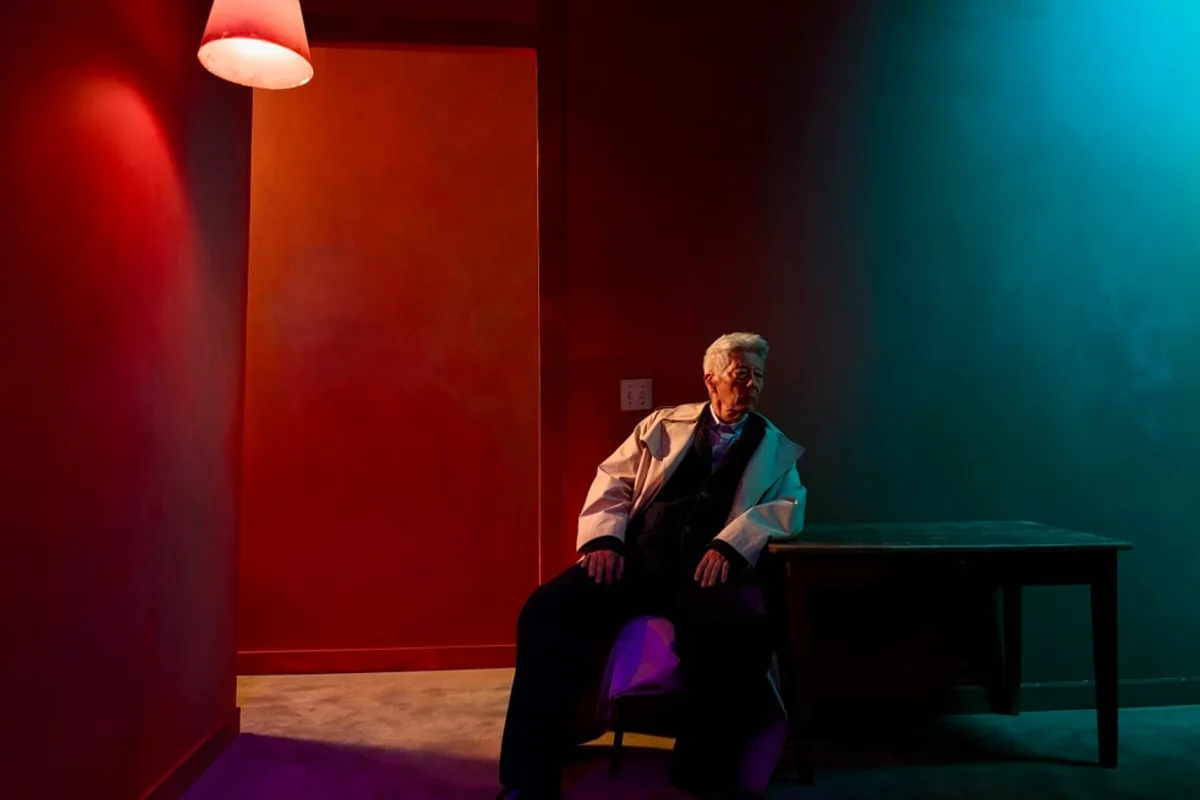
Apple provides four aperture settings directly in the Camera app and also exposes an API for developers that want finer control across the range in third-party software.
The phone can make those decisions automatically or let the photographer intervene through the new Pro controls.
f/1.48 is primarily about gathering more light
On a traditional camera, changing aperture controls both the amount of incoming light and depth of field.
The same physics applies to a smartphone, with one major qualification: its sensor and focal length are much smaller.
The dramatic optical background blur associated with large sensors and fast lenses is therefore much harder to create naturally on a phone.
The immediate value of f/1.48 is additional light in dark scenes.
The phone can use that larger opening to shorten exposure time, avoid pushing sensitivity as aggressively or give its computational photography pipeline cleaner input data.
f/4 solves the opposite problem
A wide aperture is not always desirable.
For a group portrait, Apple can narrow the Main camera to f/4 to increase the amount of the scene that appears in focus.
That makes it easier to keep people standing at different distances acceptably sharp.
The tradeoff is equally physical: a smaller opening admits less light.
In bright conditions that may be perfectly acceptable. In the dark, the iPhone has a much stronger reason to move back toward f/1.48.
Apple is finally exposing controls it normally prefers to manage for you
The new Pro controls add manual adjustment for aperture, shutter speed and white balance.
Photographers can also display a histogram to judge exposure.
That represents a subtle change in Apple's camera philosophy.
The iPhone built much of its photographic reputation around the idea that the best setting was the one users never needed to think about.
That automation remains, but the Pro models now more explicitly acknowledge that photographers sometimes want to disagree with the algorithm.
Reference Image starts from a completely different problem
Modern computational photography does much more than develop the light arriving on a sensor.
A smartphone combines exposures, reduces noise, locally changes brightness, adjusts color, reconstructs detail and can now remove or create visual elements with generative tools.
At the end of that pipeline, one question becomes increasingly difficult to answer from the final file alone: what did the camera actually see when the shutter was pressed?
Apple Reference Image is designed to provide a comparison point.
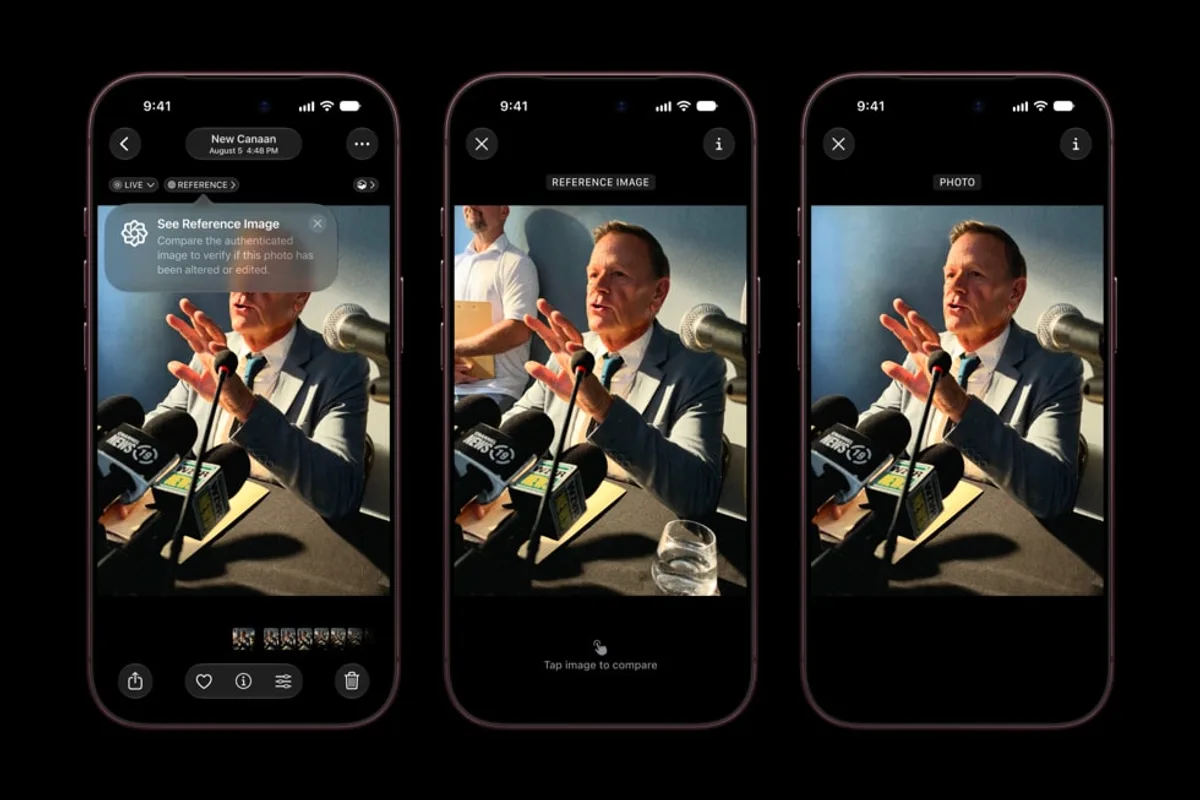
The new sensor signs what it sees
Apple says the Main camera's new sensor can sign every pixel it captures.
When the user enables Reference mode, the iPhone records that signed sensor data.
Private Cloud Compute then develops it into what Apple describes as an unalterable reference image.
That reference can be viewed beside the primary photograph in Photos.
The concept resembles a digital negative: it does not replace the edited photograph, but gives viewers an independent reference against which that photograph can be compared.
It is not a universal AI-image detector
That distinction is important.
Apple Reference Image can authenticate the intended capture process for a photograph taken in Reference mode on an iPhone 18 Pro model.
It cannot examine an arbitrary image found online and magically determine whether that picture represents reality.
A photograph without an Apple reference is not automatically fake.
An image taken by another camera has no reason to contain an Apple Reference Image.
The system therefore proves the existence of an authenticated reference for compatible captures rather than proving the falsity of everything without one.
A visual comparison can reveal what changed
Photos can display the reference beside the primary image so viewers can inspect whether elements have been altered.
That becomes especially useful with generative editing.
Removing a person, extending scenery or rebuilding part of a frame can produce a result that looks completely plausible.
The reference provides a much more concrete way to inspect the original state of the scene.
Apple is also providing APIs in iOS 27, iPadOS 27 and macOS 27 so third-party applications can display reference images.
That openness may determine how useful the system ultimately becomes.
A provenance mechanism trapped inside one Photos application would be considerably less valuable to journalists, editors, agencies and platforms that move images through several tools after capture.
Private Cloud Compute participates in a feature designed around trust
One detail deserves particular attention: creating the usable reference image involves Private Cloud Compute.
Apple is therefore not describing the complete process as purely local to the iPhone.
Its secured cloud infrastructure develops the signed sensor data into the reference asset.
Apple built Private Cloud Compute around the claim that data processed there is not exposed to Apple like information sent to a conventional cloud service.
For a mechanism that may be applied to sensitive photographs, the way that trust chain is documented, audited and understood by professional users will matter as much as the interface inside Photos.
Apple is adding SynthID too, but it solves a different part of the problem
Apple also plans support for the SynthID standard in a software update later this year.
The company says the marker will be included for most edited images depending on which edits have been applied.
Reference Image and SynthID therefore approach the same authenticity problem from different directions.
Reference Image preserves an authenticated version of the capture.
Metadata and watermarking attempt to signal that an image has been generated or modified with AI.
Combining multiple signals is considerably more realistic than relying on one detector that is somehow expected to recognize every synthetic image after it has been published and recompressed.
Reference capture will not launch in the European Union
Availability is not uniform.
Apple says Reference Image is an opt-in feature.
It will not be available at launch in China because of regulatory requirements.
In the European Union, iPhone 18 Pro models will not support Reference Image capture at launch.
Devices running iOS 27, iPadOS 27 and macOS 27 will still be able to develop and view existing reference images.
For a provenance feature whose value increases as more photographers can use it, that geographic fragmentation is an immediate limitation.
Provenance does not prevent manipulation — it makes manipulation easier to observe
Reference Image does not lock the final photograph.
Users can still edit it, change color, crop people out or apply generative tools.
That is the point.
Apple is not trying to prohibit editing. It is trying to preserve something that lets viewers look behind the edit.
For creative photography, the distinction may not matter at all. Heavy manipulation can be the intended artwork.
For journalistic, documentary or evidentiary imagery, the difference between capture and final result becomes far more important.
Cryptographic provenance still cannot prove that the scene itself was honest
Even a perfectly authenticated reference has a fundamental limitation.
It can faithfully show what the sensor saw.
It cannot guarantee that the scene in front of the sensor was not staged.
A document can be placed in a set, a screen can display false information, an event can be reenacted and framing can deliberately exclude essential context.
Technical provenance answers the question, “Does this file correspond to this capture?”
It does not automatically answer, “Does this scene tell the whole truth?”
That distinction will become essential if signed capture systems increasingly become part of media trust.
The iPhone is becoming more photographic and more suspicious of photography at the same time
The iPhone 18 Pro's two major camera ideas can almost look contradictory.
Variable aperture and Pro controls give photographers more freedom to produce exactly the image they want.
Reference Image simultaneously adds a layer intended to preserve what existed before some of those transformations.
That is probably the more realistic response to where mobile photography is going.
Capture and editing tools will continue becoming more powerful. Trying to prevent them from changing reality would be futile.
Preserving an inspectable record of the original capture is a more pragmatic approach.
The iPhone 18 Pro does not solve synthetic imagery.
It offers something narrower and potentially more useful: when a compatible photograph claims to show what happened in front of its camera, the phone can now preserve a witness against which that claim can be checked.