
 By Camille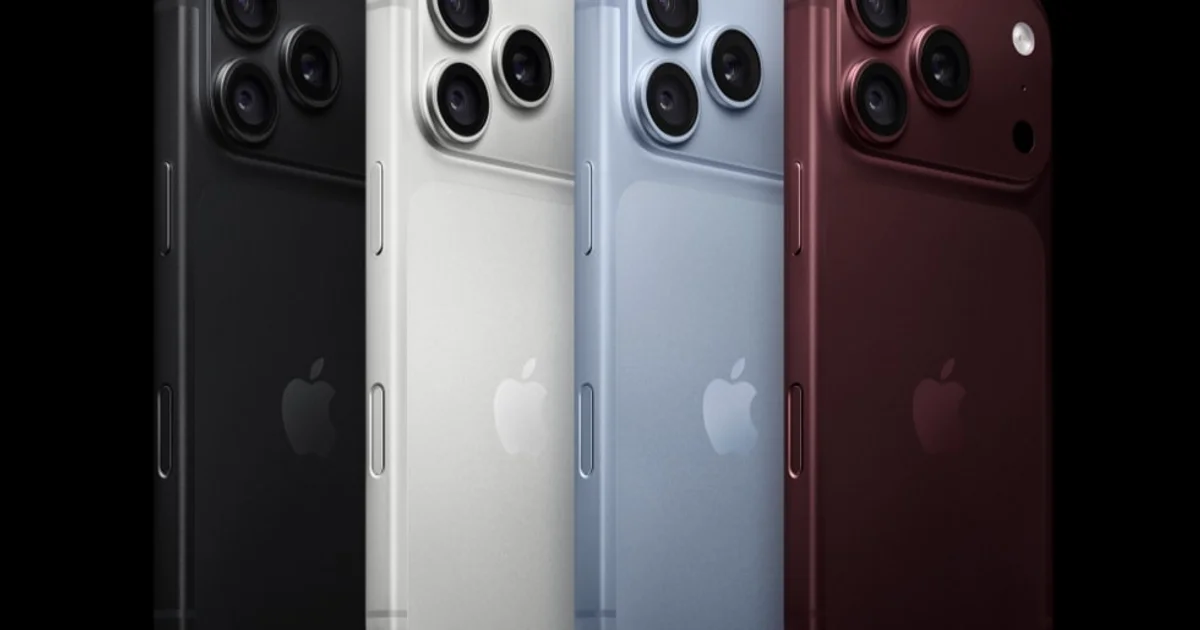
The variable aperture is a real mechanical diaphragm
Apple announced iPhone 18 Pro and iPhone 18 Pro Max on September 9.
Their new 48MP Fusion Main camera contains six laser-cut aperture blades controlled by a miniature rotor mechanism.
Those blades physically move to change both incoming light and optical depth of field.
This is not simply a software portrait effect described as an aperture setting.
The lens itself changes.
Four aperture positions can be selected manually
Apple exposes four manual stops directly inside the Camera app.
Hands-on demonstrations identify them as f/1.48, f/1.8, f/2.8 and f/4.
A wide f/1.48 opening gathers more light and produces shallower depth of field.
Closing the diaphragm toward f/4 sacrifices light but keeps a deeper part of the scene optically sharp.
That can be particularly useful for group photos where computational blur cannot substitute for getting every face physically in focus.
The phone can choose the aperture automatically too
Manual control is optional.
The camera can widen the lens in darker scenes and stop it down when additional depth of field is useful.
Apple is also exposing an API so third-party camera apps can interact with the variable-aperture system.
That potentially matters more to professional photo and video software than the four presets in Apple's own interface.
Camera finally gets much deeper Pro controls
Apple's new Pro controls interface exposes aperture alongside shutter speed and white balance.
A live histogram can also be displayed for exposure monitoring.
Those controls reduce the need for dedicated third-party apps when a photographer wants to leave Apple's automatic camera behavior behind.
The computational imaging pipeline remains active around those manual tools.
A20 Pro moves to a 2nm process
The other major hardware change sits beneath the camera system.
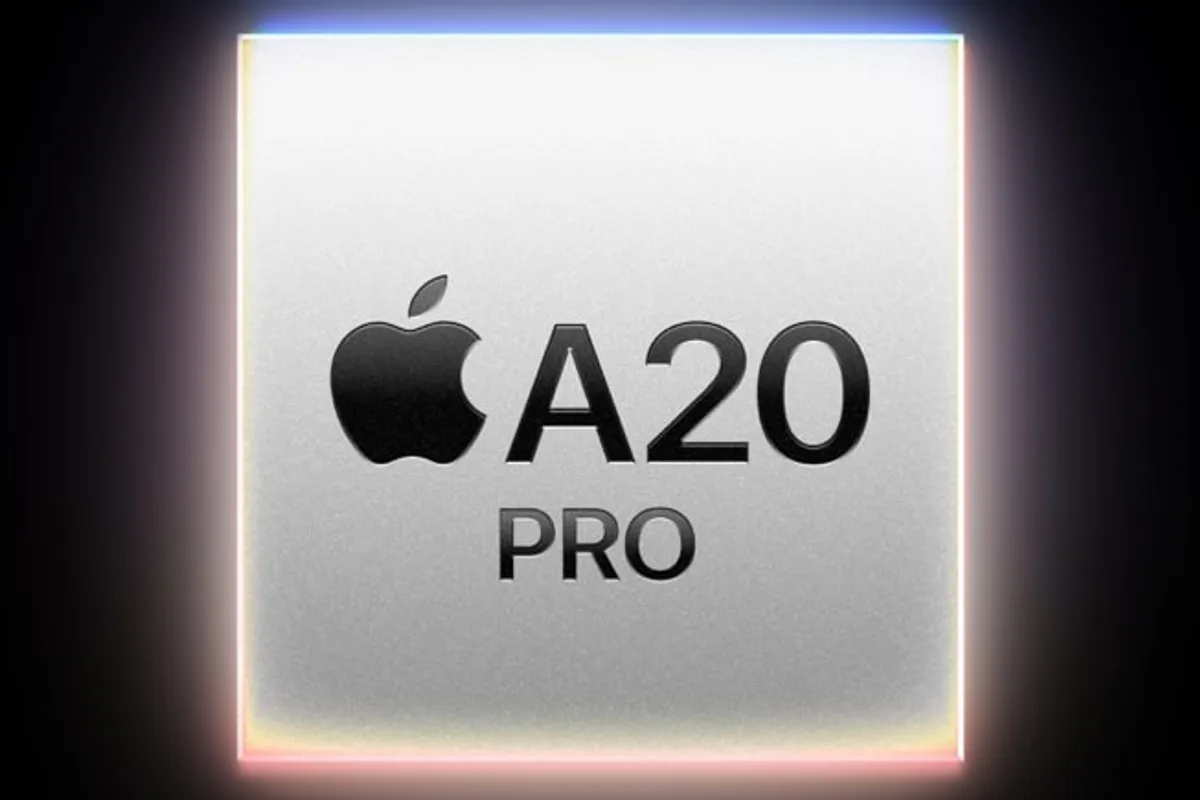
A20 Pro is manufactured on Apple's latest 2nm process technology.
It combines a six-core CPU with a seven-core GPU.
Apple also uses dual 16-core Neural Engines for 32 neural-processing cores in total.
The company claims twice the AI compute capability of A19 Pro in that part of the chip.
The most interesting chip number may be 50% more memory bandwidth
Apple says memory bandwidth increases by 50% over A19 Pro.
That matters because GPUs and local AI models are increasingly limited by how quickly data can reach their execution units.
More cores offer little benefit when those cores spend their time waiting for memory.
Language models also repeatedly stream large amounts of model data while generating tokens.
A 50% bandwidth increase does not imply every workload becomes 50% faster, but it attacks a bottleneck that is becoming more important every generation.
The GPU is up to 40% faster, but sustained performance is a separate 40%
Apple claims the new seven-core GPU delivers up to 40% more graphics performance than A19 Pro.
Separately, it advertises up to 40% higher sustained performance through the redesigned thermal system.
Those identical percentages describe different things.
One is the GPU architecture's peak generational uplift.
The other is about maintaining performance over time instead of reducing clocks as heat accumulates.
Apple changes the chip package to get heat out faster
A20 Pro uses packaging inspired by Apple's M-series processors.
The silicon die and memory sit side by side, removing memory from the direct thermal path between the processor and its cooling hardware.
That allows the chip to connect more directly to the vapor chamber.
It is an architectural change aimed at one of the fundamental problems in mobile performance: a fast processor is much less useful if it can only sustain its maximum clocks briefly.
The vapor chamber has three times more surface area
Apple has dramatically enlarged the cooling hardware introduced with the previous Pro generation.
The new vapor chamber has three times the surface area according to the company and uses updated materials.
Apple says the complete thermal redesign enables up to 40% higher sustained performance than iPhone 17 Pro.
That claim will need long-duration testing in games, video processing and local AI.
A short benchmark cannot demonstrate sustained performance.
2nm does not automatically mean one fixed efficiency gain
A smaller manufacturing node can provide greater transistor density, higher frequencies or lower power.
The chip designer decides how to spend those advantages.
Apple is using the 2nm transition across CPU, GPU, AI and battery efficiency simultaneously.
It would therefore be misleading to turn the process label itself into a universal battery-saving percentage.
Actual power draw still depends on clocks and workload.
Neural acceleration now appears inside the CPU as well
A20 Pro does not rely entirely on the dedicated Neural Engine for AI processing.
Apple says the six-core CPU now contains integrated Neural Accelerators.
The dual 16-core Neural Engine handles additional on-device models and computational-photography workloads.
That gives the system several execution paths for AI operations rather than forcing everything through one accelerator.
Apple still does not publish a single TOPS figure directly comparable with the marketing numbers commonly used for Qualcomm or MediaTek chips.
C2 cuts modem power consumption by 15%
Apple is continuing to replace external connectivity silicon with its own designs.
The new C2 cellular modem consumes 15% less energy than C1X according to Apple.
Upload speeds are also described as meaningfully faster.
In the US, C2 now supports mmWave.
Apple's N1 chip handles Wi-Fi 7, Bluetooth 6 and Thread connectivity.
Pro Max reaches a claimed 45 hours of video playback
Apple rates eSIM-only iPhone 18 Pro configurations for up to 36 hours of video playback.
The Pro Max reaches 45 hours.
Its physically larger battery contributes to what Apple calls the biggest battery-life increase it has delivered on an iPhone.
Those are controlled video-playback figures, not a promise of 45 hours of heavy mixed use.
Apple separately quotes up to 30 hours on Pro Max under a new usage model informed by real-world data.
Wired charging reaches 50% in around 15 minutes
Charging is faster as well.
With a sufficiently powerful adapter, iPhone 18 Pro can reach roughly 50% in 15 minutes.
Wireless charging reaches the same level in around 30 minutes.
Apple remains more conservative on peak charging power than several Android manufacturers, but the practical waiting time has still dropped significantly.
Reference Image creates a signed digital negative
The camera system also introduces a feature designed for an era of increasingly synthetic imagery.
Apple Reference Image captures signed sensor data when the photo is taken.
Private Cloud Compute then develops that data into what Apple describes as an unalterable reference image.
It can be viewed next to the edited photograph to help determine whether changes were made afterward.
Apple also supports image-authenticity metadata and plans compatibility with SynthID.
None of that proves that the context depicted by a genuine photo is truthful. It provides additional evidence about the image's technical provenance and editing history.
Dynamic Island gets smaller rather than disappearing
Apple still has not moved the entire Face ID system invisibly beneath the display.
The Dynamic Island is smaller, however, and can now show up to three Live Activities simultaneously.
Face ID remains the authentication system on both Pro models.
That contrasts with the foldable iPhone Duo, which uses side-mounted Touch ID instead.
The new Pro starts $100 higher
iPhone 18 Pro begins at $1,199 with 256GB of storage.
iPhone 18 Pro Max starts at $1,299.
Both can be configured with as much as 2TB.
The starting price is $100 higher than the equivalent previous-generation US model.
Preorders open September 12 and retail availability begins September 18.
It looks familiar because most of the redesign is underneath
Placed next to an iPhone 17 Pro, the new generation does not look radically different.
The display sizes remain familiar and the enclosure has not been completely redesigned.
The internal changes tell a different story.
A20 Pro moves to 2nm. Memory bandwidth rises by 50%. The die gets a more direct thermal path. The vapor chamber triples its surface area.
At the other end of the phone, six tiny mechanical blades start doing physically what software has increasingly tried to imitate.
iPhone 18 Pro is therefore not simply another faster iPhone. It shows where Apple has decided better computation can no longer substitute for better mechanics.