
 By Camille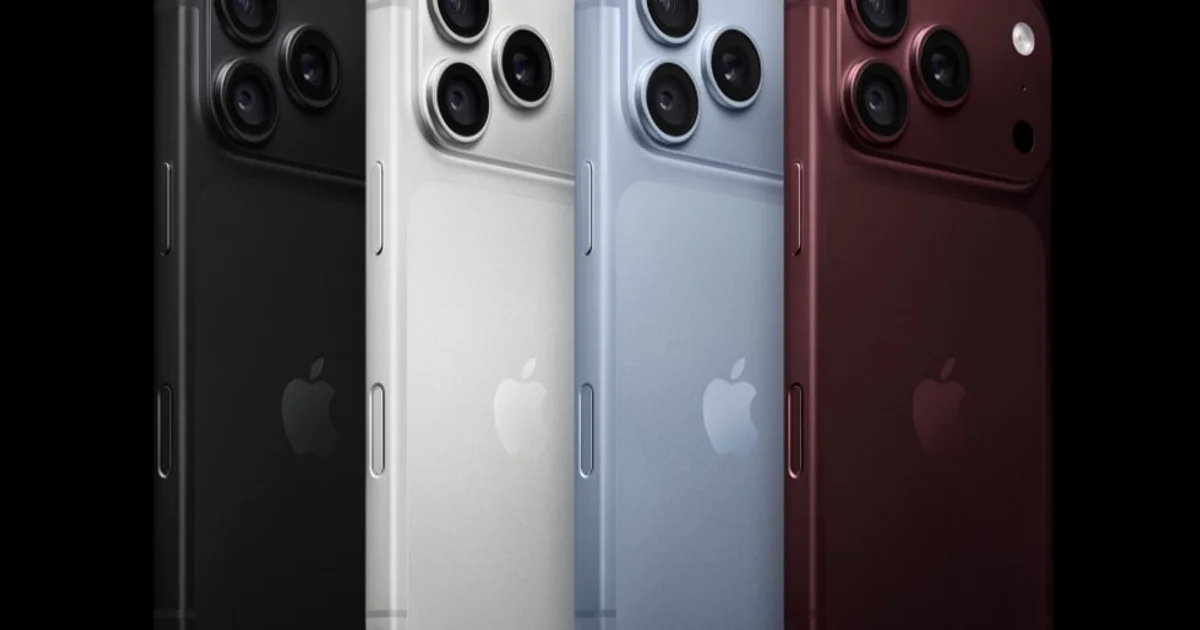
Six blades packed into a phone camera
The 48MP Fusion Main camera can now physically change its aperture. Apple uses six laser-cut blades controlled by a rotor mechanism. In automatic operation, the camera can open as wide as ƒ/1.48 to gather more light or narrow to ƒ/4 when additional depth of field is useful, such as keeping more people sharp in a group photograph.
Pro controls can expose that choice directly to the photographer. The native Camera app now provides manual aperture settings alongside controls including shutter speed and white balance, plus a histogram for checking exposure. Apple is also providing an API for developers that want to control the aperture range from third-party apps.
A post-launch iFixit teardown confirms just how mechanical the system is. The six tiny blades physically move to change the opening in front of the sensor. That precision also introduces a less glamorous consideration: an assembly containing moving blades is considerably more specialized to repair than a conventional fixed smartphone lens.
A major camera change can still produce minor differences
Variable aperture has clear optical uses. Opening the lens further can collect more light, while stopping it down increases depth of field and enables optical effects that computational photography does not reproduce in precisely the same way.
Smartphones, however, use small sensors and short focal lengths, so their depth-of-field behavior is very different from that of larger cameras. In its iPhone 18 Pro testing, The Verge found that the overall image-quality improvements associated with the variable aperture were generally marginal. The feature therefore offers more obvious value to photographers who know why they want to choose a particular aperture than to someone taking an automatic snapshot.
The iris is not working alone. Apple also pairs the camera with a new sensor and computational imaging pipeline, claiming better low-light results and more detailed images. Photographic Styles add texture and grain controls, while the redesigned Pro interface exposes more manual photographic settings.
A20 Pro moves to 2nm, with cooling redesigned around it
The other substantial change sits behind the cameras. A20 Pro is manufactured using a 2-nanometer process and, according to Apple, provides 50 percent more memory bandwidth than A19 Pro. It combines a six-core CPU, seven-core GPU, and two 16-core Neural Engines for 32 neural cores in total.
Apple claims the seven-core GPU can be up to 40 percent faster than A19 Pro. That figure is a manufacturer claim rather than a promise of a 40 percent improvement in every game or workload. Just as important for sustained use is the packaging around the chip: Apple places the silicon die alongside the memory and connects A20 Pro more directly to a redesigned vapor chamber.
Apple says that vapor chamber has three times the surface area of the system used in iPhone 17 Pro and enables up to 40 percent higher sustained performance. The qualification matters. Sustained gains will vary with workload duration, temperature, and the application being run.
C2 brings another core component in-house
The iPhone 18 Pro also introduces Apple's C2 cellular modem. Apple says it consumes 15 percent less energy than C1X while delivering meaningfully faster upload speeds, and it now supports mmWave in the United States.
An Apple-designed N1 chip handles Wi-Fi 7, Bluetooth 6, and Thread. Those changes are less visible than a moving camera aperture, but they are another sign of Apple's increasingly integrated hardware strategy: application processor, neural processing, wireless networking, and cellular connectivity are all moving deeper into Apple's own silicon stack.
The AI hardware is local, but Siri is still a software story
The dual 16-core Neural Engine is designed to accelerate on-device models as well as computational photography. The iPhone 18 Pro ships with iOS 27 and access to Siri AI in beta, with Apple highlighting personal-context understanding, onscreen awareness, and the ability to act on information across apps.
Those software capabilities should not be confused with raw A20 Pro hardware performance. Some experiences depend on iOS, Apple's services, and Private Cloud Compute rather than running exclusively on the Neural Engine. The useful measure of the new AI hardware is therefore what workloads it can execute locally, not simply how many features carry an AI label.
The iPhone 18 Pro starts at €1,479 in France
Apple began selling the iPhone 18 Pro on September 18. In France, the 6.3-inch model starts at €1,479 with 256GB of storage, while the 6.9-inch iPhone 18 Pro Max starts at €1,629. Both are offered in black, silver, glacier, and burgundy.
At that price, variable aperture is more striking as an engineering achievement than as an instant reason to replace a recent Pro model. Apple has managed to fit a genuine mechanical iris into a mainstream smartphone camera, and it provides photographers with controls that were previously missing. Early results also provide a useful reality check: moving six microscopic blades inside the lens does not make every photo look dramatically different.