
 By Camille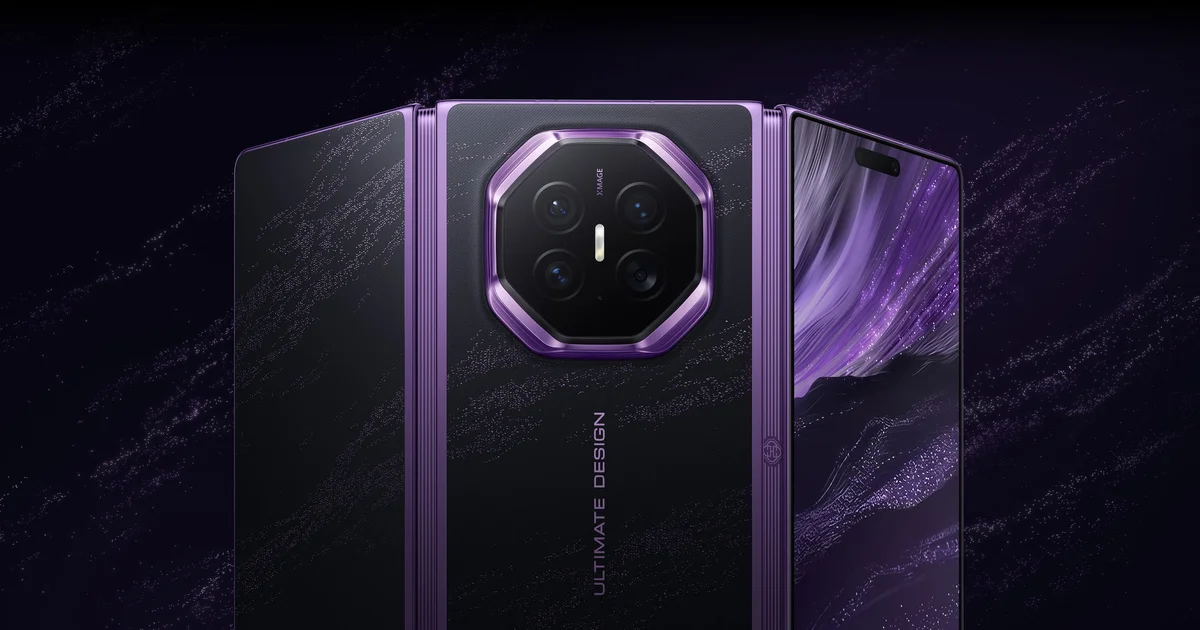
Huawei introduced the Mate XT 2 in China on September 7, with sales beginning September 12. Pricing starts at 19,999 yuan, roughly $3,000, and reaches 24,999 yuan for the most expensive configurations.
Huawei has not announced an international release plan yet.
The display no longer wraps around the outside
The original Mate XT used an accordion-like folding system. It was clever because one continuous panel could serve multiple configurations, but part of the flexible display remained exposed when the device was folded.
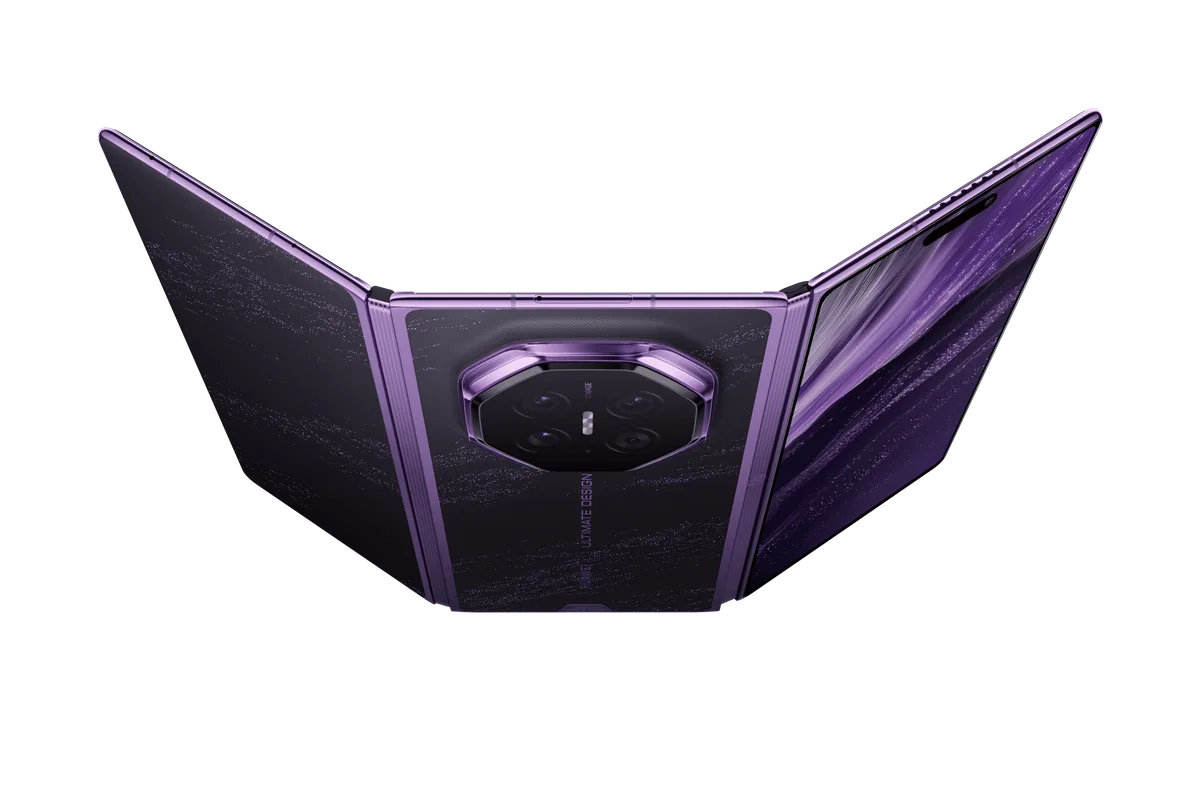
Mate XT 2 changes that architecture. Both folding sections now close inward around the 10.2-inch main OLED panel, while a separate 6.5-inch cover display handles normal phone use.
It is a less theatrical design and a much more reassuring one for a device that is supposed to survive pockets, bags and everyday accidents.
A 10.2-inch screen still fits into a 12.3 mm phone
Fully unfolded, the inner display measures 10.2 inches with a 2232 x 3184 resolution. The standard model uses LTPO refresh rates from 1Hz to 90Hz.
The dedicated 6.5-inch outer OLED runs at up to 120Hz and 2442 x 1140. Folded thickness is 12.3 mm, while Huawei lists the device at roughly 299 grams before the display surface layer and about 304 grams with it.
No one will mistake it for a lightweight phone.
The optional privacy display is more than a software trick
One configuration introduces Huawei's Lingdun privacy OLED. When privacy mode is enabled, the panel changes how its pixels emit light so the viewing angle becomes much narrower.
The user facing the display can continue reading it while people viewing from the side see significantly less. Huawei notes one physical limitation: the bottom edge near the USB port does not provide the same privacy effect.
The privacy version also supports a 120Hz maximum refresh rate on the inner display and is tied to higher-end memory configurations.
Kirin 9050 Pro arrives under very unusual constraints
Huawei is debuting the Kirin 9050 Pro in the XT 2. The company describes a tightly integrated approach across chip, operating system and cloud resources to improve performance and efficiency.
The chip is particularly significant because Huawei continues advancing domestic silicon while US export controls restrict its access to portions of the international semiconductor supply chain.
Independent benchmarks will matter more than launch-stage claims. Huawei says the platform can provide hardware-accelerated real-time ray tracing for workloads reaching 50 million triangles, but that figure comes from Huawei's own testing.
HarmonyOS 7 has enough room to behave differently
Mate XT 2 ships with HarmonyOS 7. The software can run three windows in parallel across the unfolded display, with independent volume controls and reusable window combinations.
Huawei also supports its M-Pen 3 Mini for annotations and creative work, although the stylus is not standard with every configuration.
This is where a tri-fold starts making more practical sense. Opened fully, the phone provides something close to a compact tablet workspace without asking the owner to carry another device.
Two hinges no longer mean minimal protection
Huawei's second-generation hinge system uses a synchronized linkage and dual-rail structure without conventional gears. The company claims hinge impact resistance has improved by 90%.
The flexible display uses ultra-thin glass with additional reinforced layers, and Huawei claims a 200% improvement in inner-display impact resistance. Those figures are internal laboratory comparisons rather than independent durability testing.
The more tangible specification is IP58 and IP59 protection under Huawei's listed test conditions, a notable rating for hardware containing two hinges and a large flexible panel.
The battery is large because it needs to be
Huawei fits a 5,600 mAh battery into the Mate XT 2. Wired charging reaches 66W with compatible Huawei hardware, while wireless charging goes up to 50W.
Connectivity includes Bluetooth 6.0, Wi-Fi 7 and eSIM. Chinese models also support Tiantong satellite calling, satellite paging and two-way Beidou satellite messaging under the relevant service conditions.
The camera system is still flagship-grade on paper
The main rear camera uses a 50MP RYYB sensor with optical stabilization and a physical variable aperture ranging from f/1.49 to f/4.0.
A 40MP RYYB ultrawide sits alongside a 50MP stabilized periscope telephoto with approximately 3.5x optical zoom. Huawei also advertises 7x optical-quality zoom and digital magnification up to 100x.
There are two 8MP front cameras, one associated with the cover screen and another with the inner display.
The price still keeps this firmly in experimental-luxury territory
At 19,999 yuan for the entry model, Mate XT 2 costs far more than a conventional Chinese flagship. The upper end reaches 24,999 yuan.
Huawei executive Richard Yu acknowledged at the launch that sharply higher memory costs made pricing difficult. The company is also packing a new processor, two hinges, two displays and unusually complex mechanical engineering into a device produced at much smaller scale than an ordinary slab phone.
That keeps the XT 2 firmly outside the mainstream. Huawei can afford to experiment from a position of strength, though: Reuters reports that the company controls roughly 68% of China's foldable smartphone market.
Apple has only just entered foldables. Huawei is already revising the compromises of its third phone that folds twice.