
 By Tsuky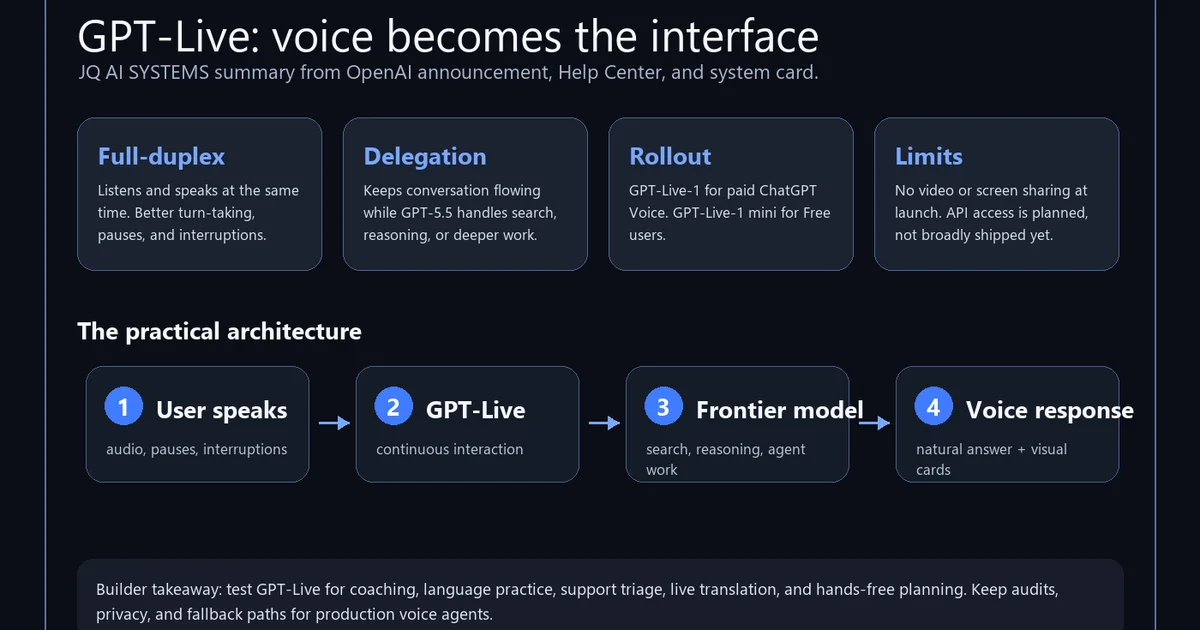
OpenAI made GPT-Live-1 generally available in its API on September 10. The model was previously introduced through ChatGPT Voice, but developers can now build their own applications around the same full-duplex interaction layer.
Full duplex means the model can listen and speak at the same time. A user can interrupt, hesitate, change direction or briefly acknowledge a response without forcing every conversation into a rigid sequence of separate listening and speaking turns.
The voice model does not have to be the reasoning model
Delegation is the architectural change that matters most. GPT-Live-1 can handle the live interaction while sending harder reasoning and tool calls to a backend model, external agent or developer-controlled system.
OpenAI uses GPT-6 Astra as one example for more demanding work, but the backend does not have to be the same model for every application or task.
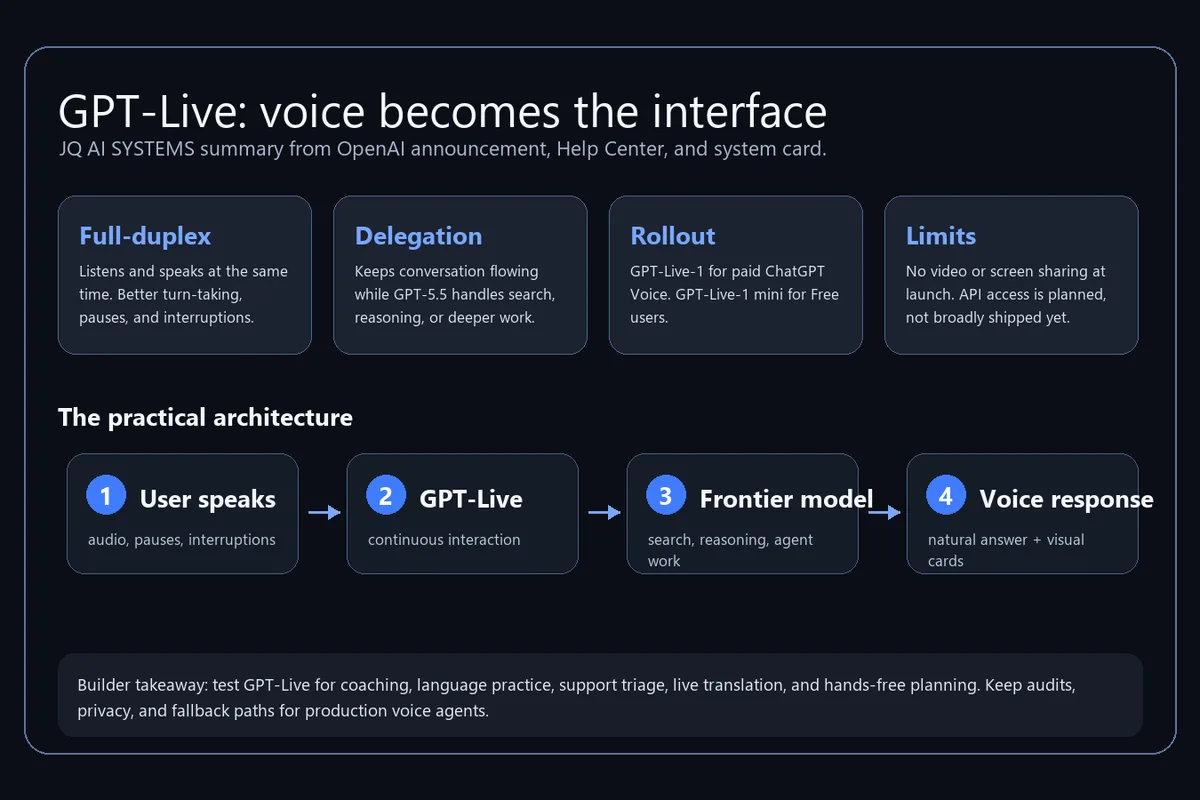
The conversation can remain active while delegated work continues. Interrupting GPT-Live-1's speech does not automatically cancel that backend task; the application remains responsible for durable state, permissions and cancellation behavior.
This is quite different from treating a voice agent as a fixed speech-to-text, language-model and text-to-speech chain. OpenAI is separating the component responsible for human conversational timing from the component responsible for depth.
Full Duplex Bench improves by 30 percentage points
OpenAI reports a 30-percentage-point improvement over GPT-Realtime-2.1 on Full Duplex Bench. The evaluation covers conversational behavior including interruptions, pauses, listener backchannels and turn-taking latency.
When GPT-Live-1 is paired with GPT-6 Astra at medium reasoning effort, OpenAI reports 83.6 percent pass@1 on Tau3, compared with 45.7 percent for GPT-Realtime-2.1 in its published comparison.
Tau3 includes spoken customer-service tasks in airline, retail and telecom scenarios. On TauBanking, which adds document retrieval and account tools, the GPT-Live-1 and Astra combination reaches 38.1 percent.
That banking score is a useful constraint on the marketing story. A voice system can become dramatically more natural without becoming universally reliable at complex operational work.
Five cents per minute is only the front-end bill
GPT-Live-1 voice sessions cost $0.05 per minute and are billed per second rather than rounded up to a whole minute.
An uninterrupted hour therefore costs $3 for the voice layer.
Backend model and tool usage are separate charges. A lightweight conversational application and an agent that repeatedly calls a frontier reasoning model, searches company systems and executes tools can therefore have very different total costs despite using the same GPT-Live-1 front end.
Telephony is a first-class target
OpenAI explicitly supports phone-based deployments, including reservations, customer support and ordering workflows.
GPT-Live-1 produces ASR transcripts and response text natively, includes stronger alphanumeric understanding and supports keyword biasing for vocabulary an application expects to hear.
Although it is not fundamentally a turn-based model, developers can still use built-in turn detection when their application needs explicit boundaries.
Speak reports almost 80 percent fewer unwanted interruptions
OpenAI has also published early customer results. Language-learning company Speak says GPT-Live-1 reduced interruptions during learner thinking pauses by almost 80 percent compared with its previous turn-based systems.
That metric gets closer to the practical reason full duplex matters. For a tutor, distinguishing a moment of thought from the end of a sentence is not cosmetic polish; it determines whether the system behaves like a patient listener or an overeager autocomplete.
Yelp says it is using the model in phone workflows involving reservations and food orders, while Cognition describes using it as a conversational layer around Devin for discussing and delegating engineering work.
More voices are useful, but the split architecture is the bigger story
GPT-Live-1 launches with an expanded voice selection including Quartz, Ripple, Vesper, Willow, Stone, Gleam, Meridian, Bossa, Tempo, Beacon, Delta and Cinder.
Developers can steer tone, pace and conversational style through system instructions. OpenAI also offers custom voice access for eligible customers through a separate approval process.
Those options make the product easier to customize, but they are not the fundamental change. GPT-Live-1 is being sold as a real-time interaction layer that can sit in front of whichever reasoning system a developer needs.
At five cents a minute, OpenAI is therefore selling more than speech generation. It is selling the part of an agent responsible for deciding when to listen, when to talk, when to tolerate silence and when to quietly hand the difficult work to something else.