
 By Adri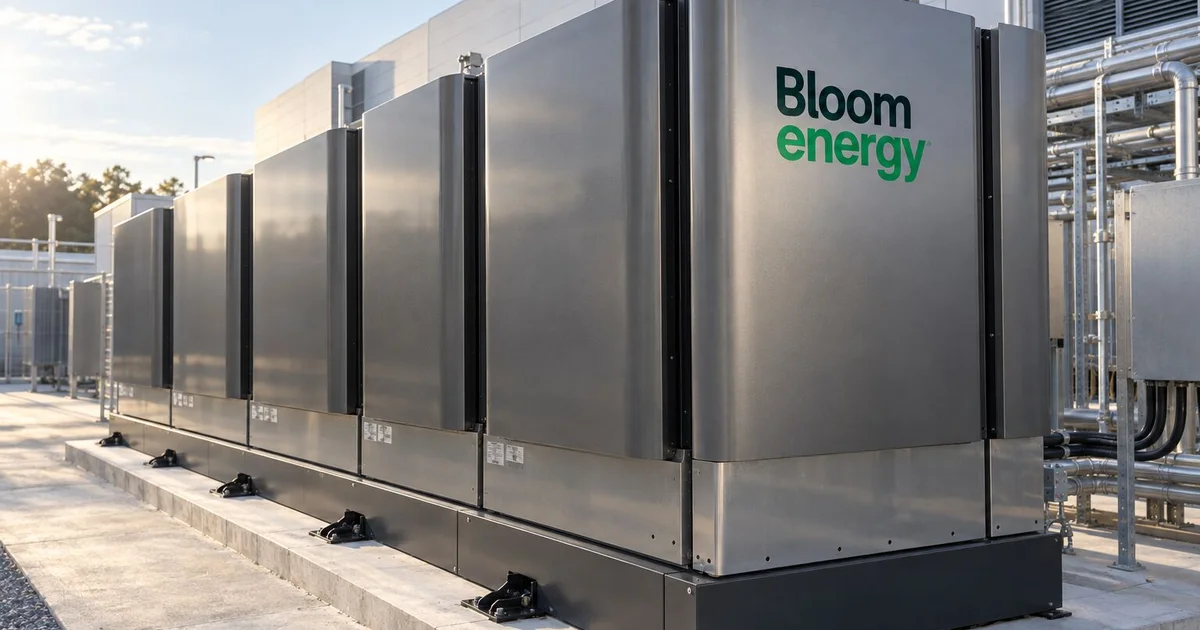
A modern AI data center is an expensive collection of equipment that cannot accomplish much without a continuous supply of electricity. The accelerators attract most of the attention. They determine how quickly models can be trained and how efficiently AI services can respond to users. Yet the performance of those chips means little if the operator cannot deliver adequate electrical capacity to the facility. Google's latest energy agreement illustrates how seriously large technology companies now take that constraint. On October 14, 2026, American Electric Power announced plans for a 702 MW power generation project near Cheyenne, Wyoming. AEP expects to invest approximately $4 billion, while Google has agreed to purchase electricity from the installation under a 20-year power purchase agreement. The technology supplier will be Bloom Energy, whose solid oxide fuel cells generate electricity through an electrochemical process rather than conventional fuel combustion.
An electricity purchase, not a Google-owned power plant
The financial structure is worth understanding. The project will be developed through Cheyenne Fuel Cell LLC, an entity approximately 92 percent owned and controlled by AEP. Funds advised by Basalt Infrastructure Partners hold the remaining interest. AEP is responsible for advancing the investment, while Google has agreed to purchase the electricity through a long-term commercial arrangement. That means the $4 billion figure should not be described as Google's direct construction budget. It is the estimated investment required for the AEP-backed generating facility. A power purchase agreement gives the developer visibility into future demand and provides the customer with a contractual route to securing electricity. Such arrangements are increasingly important for data-center operators, whose computing expansion depends on electrical infrastructure that may take years to develop. Google is not merely buying a commodity for immediate use. It is helping establish the commercial foundation for a generating asset intended to operate over decades.
The 702 MW facility is a future project
AEP plans to begin construction in 2026, with full operations expected by the end of 2028. Those milestones are targets, not evidence that the generating capacity is already available. The distinction matters because infrastructure announcements often combine confirmed commercial agreements with projects still awaiting construction and commissioning. The planned installation must progress through site preparation, equipment delivery, integration and operational testing before its full output can be delivered. Large fuel-cell projects can benefit from modular construction, but modularity does not eliminate the complexity of deploying hundreds of megawatts. The project also requires arrangements for fuel supply, electrical distribution and maintenance. For Google, the timeline reflects a basic challenge of AI expansion: the schedules for data centers and their power sources must be coordinated. A completed computing facility without enough electricity cannot operate at its intended capacity. Likewise, generating infrastructure built well ahead of its customer may create financial costs before full demand materializes.
What makes Bloom's fuel cells different?
Bloom Energy develops solid oxide fuel-cell systems designed for continuous electricity generation. Unlike a conventional gas turbine, a fuel cell does not rely on burning fuel to produce heat that drives a mechanical generator. Instead, it converts chemical energy into electricity through electrochemical reactions. Bloom's technology can use compatible fuels including natural gas, biogas and hydrogen. The process takes place within a system of ceramic cells operating at elevated temperatures. Individual fuel-cell stacks are integrated into larger modules, which can then form complete Energy Server installations. The modular architecture allows operators to assemble systems suited to different power requirements. Bloom markets these products for facilities that require continuous, dependable electricity, including data centers and industrial operations. The technology can operate in conjunction with the electrical grid or form part of certain microgrid configurations. Its potential advantages include efficient electrical conversion and relatively low emissions of some pollutants associated with conventional combustion. However, actual performance depends on fuel type, system configuration and operating conditions. AEP has not published independently measured efficiency figures for the completed Cheyenne installation, because that facility has not yet entered service.
No combustion does not mean zero carbon emissions
The environmental description of the project requires particular care. AEP emphasizes that the Bloom system produces electricity without directly combusting natural gas. That is technically meaningful, but it should not be interpreted as a promise of carbon-free power. When a fuel contains carbon, electrochemical conversion can still produce carbon dioxide. Natural gas also has emissions associated with production and transport, including possible methane leakage. The overall climate impact therefore depends on more than the absence of a flame. AEP says the project includes plans to integrate carbon-capture technology, with the objective of providing electricity with emissions approaching zero. That is a prospective design ambition. It is not evidence that the future facility has already demonstrated near-zero emissions. Key details remain necessary to assess the claim, including the actual fuel mix, the effectiveness of carbon capture and how recovered CO2 would be managed. The emissions impact of construction and upstream fuel supply would also need to be considered in a comprehensive assessment. Without those details, it would be misleading to call the project a completed carbon-neutral energy solution.
Google is securing power before demand becomes a problem
Electricity availability is becoming one of the most consequential factors in data-center location decisions. Large computing installations require substantial, reliable power. AI workloads can increase the amount of energy needed within individual server racks, while cooling and electrical support systems add further demands. Grid connections are not always available at the required scale or on the desired schedule. Utilities may need to construct new substations, upgrade transmission infrastructure or secure additional generation resources before serving a large customer. That process can take longer than ordering computer hardware. Technology companies are therefore increasingly willing to support dedicated generation projects or sign long-term power contracts. Fuel cells provide one potential option for meeting those needs. They are not automatically superior to grid power, renewable generation, conventional plants or storage systems in every location. Their value depends on economics, fuel supply, emissions requirements and the technical characteristics of the installation. In Wyoming, Google has chosen to participate in a project designed around its expected requirements in the Cheyenne area.
The Cheyenne development involves more than one energy agreement
The AEP announcement follows a separate electricity supply arrangement involving Black Hills Corporation. On October 6, Black Hills disclosed agreements effective September 30 for a planned Google data center near Cheyenne. Those arrangements include grid-connected supply and the management of other contracted electricity resources through a private microgrid structure. The broader energy plan reflects the unusually large requirements of the proposed computing campus. It is important not to combine every reported megawatt figure as though the announcements described a single identical facility. The 702 MW AEP project is a specific generating installation. Black Hills' figures describe a wider set of supply arrangements and service responsibilities. Their relationship will depend on the eventual electrical architecture and development schedule of the campus. What the announcements establish is that Google's Wyoming expansion has become a major energy infrastructure undertaking. Securing power is now part of the project's long-term development strategy rather than an administrative task left until construction is nearly complete.
Bloom Energy is becoming an AI infrastructure supplier
Bloom's role in the Wyoming project reflects growing interest in electricity generation that can be deployed close to large customers. The company has supplied fuel-cell systems for commercial and industrial facilities for years. Its technology has also been used in data-center environments, where continuous power availability is particularly valuable. Recent agreements involving major technology companies and cloud infrastructure providers have expanded its exposure to the AI market. The appeal is not that fuel cells somehow increase the computing performance of GPUs. Their contribution is to address the electrical constraints that can prevent those GPUs from being installed and operated. That puts power technology companies alongside networking, cooling and semiconductor suppliers in the broader infrastructure investment cycle. However, fuel cells remain one option among several. Large technology companies are also seeking electricity through renewable projects, nuclear generation, utility contracts and other arrangements. Different regions have different resources, regulations and grid conditions. Bloom's success will ultimately depend on whether its systems can provide dependable power at competitive costs while satisfying customers' environmental requirements.
Twenty-year contracts outlast several generations of AI hardware
The duration of Google's agreement reveals an interesting tension between energy infrastructure and computing technology. AI accelerators evolve rapidly. A data center may replace or substantially upgrade its computing hardware several times during the life of a major electrical installation. A generating facility, by contrast, is typically planned around a much longer investment horizon. A twenty-year power agreement therefore commits the customer and developer to assumptions that extend well beyond today's models and processors. Google cannot know exactly what its computing hardware will look like in the middle of the 2040s. It can, however, anticipate that large-scale computing will continue to require reliable power. The agreement is designed to reduce uncertainty around that fundamental requirement. For AEP, the commercial contract helps justify a substantial capital investment. For Google, it offers an approach to securing electrical supply that is not tied to any particular generation of GPUs. Whether the economics remain attractive throughout the agreement will depend on operating costs, electricity requirements and the contract's detailed terms.
The project's environmental case still needs evidence
Fuel-cell technology provides a different path to generating electricity from natural gas, but it does not automatically resolve the climate challenges associated with fossil fuels. The planned carbon-capture component could materially affect the project's emissions profile if it is implemented successfully. That outcome remains to be demonstrated. Future disclosures will need to clarify the capture technology, residual emissions and the handling of captured carbon dioxide. The cost of operating these systems also matters. An installation designed to produce lower-emission electricity must still deliver power at a price its customer is willing to pay. Google has broader environmental commitments and has pursued electricity arrangements involving renewable and nuclear power in other markets. The Wyoming agreement should be interpreted as part of a diversified energy strategy rather than evidence that the company is abandoning its other approaches. Different energy sources may perform complementary roles depending on location and infrastructure availability.
Several financial questions remain unanswered
The announcement identifies the investment estimate, generating capacity, ownership structure and planned operating timetable. It does not disclose every financial parameter needed to evaluate the project. The exact electricity purchase price under Google's contract is not publicly established in the reviewed materials. The eventual cost per megawatt-hour will depend on capital expenditure, financing, fuel prices and operating performance. Changes in construction costs or fuel markets could alter the economics before the facility reaches full operation. Likewise, the project's carbon-capture ambitions cannot be assigned a verified emissions benefit until the relevant systems and operating assumptions are documented. The planned end-2028 completion date remains subject to normal construction and commissioning risks. None of these uncertainties makes the agreement insignificant. They simply mean that a confirmed investment plan should not be confused with a completed plant whose technical and financial performance has already been measured.
AI's infrastructure race is expanding into electricity generation
The AEP-Google agreement highlights a shift in what it means to build computing capacity. Purchasing processors is no longer enough. Operators need electricity generation, transmission, cooling and reliable service arrangements at a scale that can support their planned installations. Those requirements create opportunities for energy companies, equipment manufacturers and infrastructure investors that have relatively little to do with developing AI models. Google's agreement secures a prospective 702 MW supply source through a twenty-year contract. AEP is committing significant capital to make that supply possible, while Bloom Energy provides the core generating technology. The commercial arrangement is real. The facility's final output, economics and environmental performance remain future questions. The next milestones will involve construction, commissioning and evidence of operational performance. For the wider technology industry, the message is clear: the ability to expand AI computing is increasingly determined by energy infrastructure as well as semiconductor availability. A faster accelerator creates little value if the data center cannot keep it powered.