
 By Adri

High-end hi-fi has a category of products that does more than improve an existing audio system. It pushes particular engineering principles to their limits, sometimes at a level of complexity that would be difficult to justify in everyday equipment. The Goldmund Mimesis Statement clearly belongs in that category. The Swiss manufacturer unveiled its new flagship analogue preamplifier on October 19. It does not use a single enclosure. It uses three. The first contains the preamplification circuitry and user controls. The other two house separate power supplies, one for the left channel and one for the right. Goldmund intends this physical separation to reduce interactions between circuits and minimize electrical noise affecting analogue audio signals. The objective sounds simple: preserve the music without adding unwanted changes. The implementation is far less straightforward. The Mimesis Statement combines symmetrical circuitry, custom voltage regulation and a newly developed volume-control system. With reported pricing far beyond the cost of most complete hi-fi systems, the product is intended for an extremely limited audience. Nevertheless, its engineering deserves attention beyond the luxury positioning. It provides an example of how far a manufacturer can go when controlling electrical noise becomes a central design priority.
Why does a preamplifier need three enclosures?
In a conventional hi-fi system, a preamplifier performs several tasks. It selects sources, adjusts volume and prepares the signal for a power amplifier. It does not directly provide the power needed to drive passive loudspeakers. That distinction matters. The Mimesis Statement is not an integrated amplifier capable of replacing an entire system's electronics. It sits between audio sources and power amplification. Its circuits handle relatively small electrical signals. Those signals can be affected by interference from other parts of the equipment. Power supplies are among the potential sources of unwanted noise. A manufacturer can address that through component selection, filtering or physical separation inside one chassis. Goldmund has taken a more elaborate approach. The power supplies are moved outside the preamplifier enclosure entirely. Each stereo channel receives its own external unit. The aim is to reduce interactions between the two channels and keep potentially disruptive components away from the audio circuitry. However, three boxes do not automatically guarantee better sound. Their effectiveness depends on the design and performance of the circuits inside them.
Dual-mono architecture taken to an extreme
Dual-mono generally describes an approach that separates the circuitry used by the left and right audio channels. In a stereo system, both channels operate simultaneously while retaining their own information. Unwanted interactions can contribute to crosstalk, where part of one channel's signal appears in the other. Manufacturers therefore attempt to maintain sufficient isolation. With the Mimesis Statement, Goldmund combines dedicated power supplies with a symmetrical internal design. The audio circuitry for the two channels is arranged separately. The manufacturer has also developed particular measures for heat dissipation and reducing interactions between circuit sections. Separation applies to the power architecture and selected parts of the signal path. The principle is coherent. Greater independence between channels can make certain interference mechanisms easier to control. However, final performance does not depend exclusively on physical separation. A well-designed compact preamplifier can already achieve excellent noise and crosstalk measurements. The real question is how much measurable improvement this elaborate architecture delivers over the best conventional alternatives.
New power supplies designed to suppress noise
Goldmund says it has developed a new generation of discretely regulated power supplies. In this context, discrete refers to the use of individual electronic components rather than relying exclusively on integrated regulator circuits. The company has added further voltage-regulation stages. The objective is to provide stable, low-noise power to the analogue audio circuitry. Imperfect supply regulation can introduce unwanted disturbances into certain amplification stages. Filtering and rejection of voltage variations therefore matter. But a more complicated regulation circuit is not automatically better. Its behavior at different frequencies, under changing loads and in different operating conditions must be examined. External power supplies also allow potentially noisy components to be placed farther from the audio circuits. On the Mimesis Statement, the two supply units form the lower part of the three-box assembly. The preamplifier itself sits above them in official promotional images. The construction is dramatic. What remains to be established is how much it reduces residual noise compared with a more compact, carefully designed alternative. Goldmund's published specifications are promising, but independent measurements are still necessary.
A new audio board and redesigned volume control
The project involves much more than relocating the power supplies. Goldmund says it has redesigned the Mimesis Statement's electronic architecture. A new audio board handles the analogue signal path. The volume-control system has also been redeveloped. That last component deserves particular attention. Adjusting volume in a preamplifier is not simply a matter of displaying a number on a screen. The circuit must attenuate the signal while maintaining appropriate balance between the left and right channels. Depending on its implementation, volume control can influence noise, distortion and adjustment accuracy. Sophisticated systems may aim for accurate channel matching even at low listening levels. The sources examined do not provide enough technical information to analyze Goldmund's complete implementation. However, the manufacturer emphasizes the distinction between control electronics and circuitry carrying the audio signal. That reveals the underlying objective: preventing user-interface electronics from unnecessarily interfering with the music. The principle is relevant. Its practical advantage depends on the measurements obtained under actual operating conditions.
Frequency response extends to 1.5MHz
Among the published specifications, frequency response is arguably the most striking. Goldmund quotes a bandwidth of 0.2Hz to 1.5MHz within plus or minus 3dB. An immediate clarification is necessary. Human hearing does not extend anywhere near 1.5MHz. The audible range is generally described as approximately 20Hz to 20kHz for a young listener, with the upper limit often declining with age. An electronic bandwidth extending far beyond that range does not mean listeners will hear the additional frequencies directly. For engineers, wide bandwidth can relate to certain objectives concerning the circuit's response to rapidly changing signals. However, it also requires careful control of stability and interactions with other equipment. Frequency-response range alone does not prove sound quality. Two preamplifiers can have very different bandwidth specifications while remaining difficult to distinguish in controlled listening conditions. Goldmund's figure primarily illustrates an ambitious engineering choice. Its audible relevance is a separate question.
What does 0.0002% distortion actually mean?
Goldmund reports total harmonic distortion plus noise, or THD+N, of 0.0002%. That result applies to a measurement from an unbalanced input to an unbalanced output. The company also quotes IMD+N of 0.0006% in the same configuration. The first measurement combines harmonic distortion components with noise. The second concerns intermodulation distortion products created when multiple frequencies are processed together. Both provide information about the electronic cleanliness of a preamplifier. Low values suggest that the circuitry adds relatively little unwanted content under the measurement conditions. However, these figures need careful interpretation. An extremely small percentage does not automatically establish a proportionate audible improvement. Test frequency, signal level, output load and measurement technique all matter. A result obtained in one configuration should not be generalized without caution to every input and output. Modern hi-fi already includes equipment capable of very low distortion and noise. A convincing technical comparison must therefore use equivalent measurement conditions.
More than 130dB signal-to-noise ratio
The manufacturer also claims a signal-to-noise ratio exceeding 130dB on its line input. The value rises above 138dB with A-weighted measurement. That final qualification matters. A-weighting changes the contribution of different frequencies to approximate selected aspects of human hearing sensitivity. Weighted and unweighted measurements do not describe exactly the same conditions. Their numbers should not be compared without accounting for the method. In principle, a high signal-to-noise ratio means the useful audio signal sits well above residual noise. That is desirable in a preamplifier. However, the overall audio system matters too. A noisy source or power amplifier does not become silent merely because the preamplifier is replaced. The behavior of the complete signal chain is more important than the isolated performance of one component. Goldmund is attempting to push the limits of its electronics. The practical significance of that progress still needs evaluation in real installations.
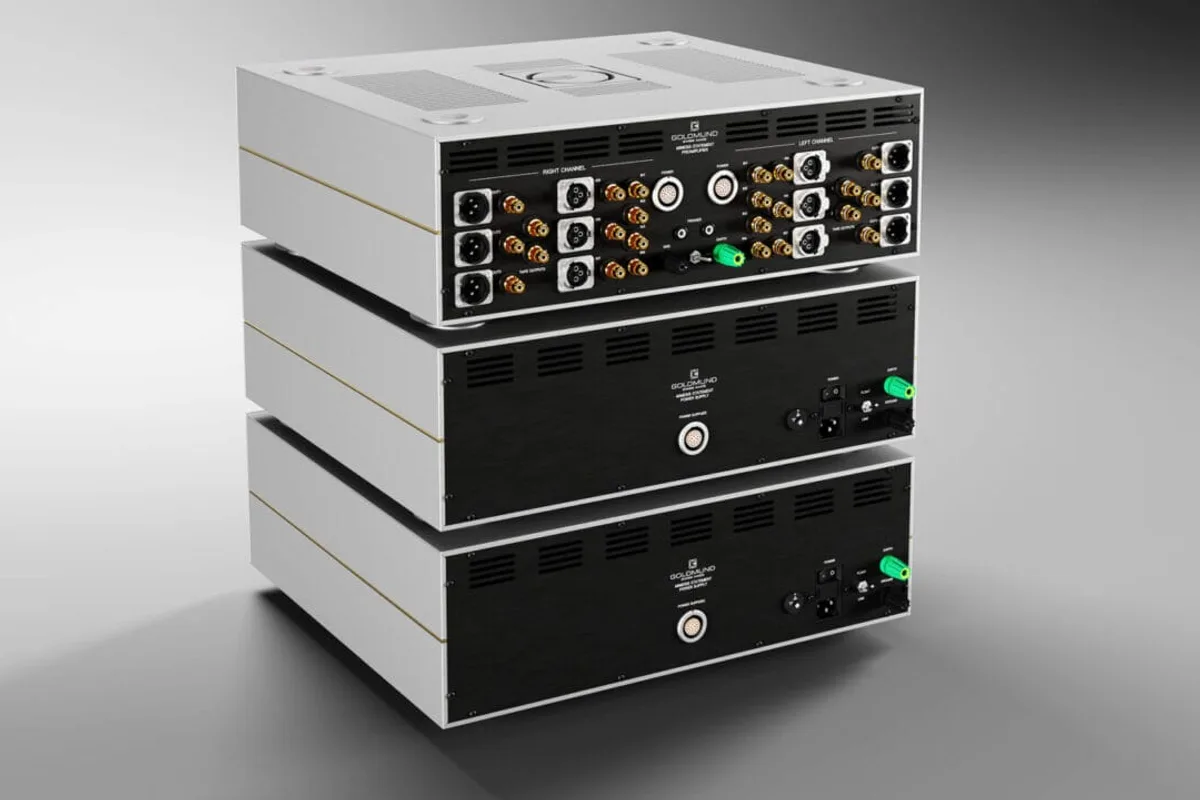
Connectivity is focused entirely on analogue audio
The Mimesis Statement is not intended to be an all-in-one audio component. It is an analogue preamplifier. What Hi-Fi? reports three balanced XLR inputs alongside multiple unbalanced RCA connections. The detailed accounting of RCA inputs varies depending on how alternative connections are counted. Some reporting describes seven unbalanced inputs, while StereoNET distinguishes four RCA inputs and three RCA alternatives associated with the balanced input arrangements. It would therefore be unwise to assume that ten completely independent sources can all be connected simultaneously. For outputs, specialist reporting describes three XLR and three RCA connections. Tape-related outputs are also mentioned. The goal is integration into complex analogue systems with multiple sources and power amplifiers. However, the examined sources do not describe an integrated digital-to-analogue converter in the Mimesis Statement. Using a streamer or digital player therefore requires an appropriate analogue output or an external DAC. A turntable similarly needs suitable phono amplification. This specialized design is aimed at enthusiasts who prefer choosing the components of their system separately.
Two 12V triggers simplify power-amplifier control
Goldmund has added two electrical trigger outputs. They switch between 0V and 12V. The idea is straightforward. When the preamplifier powers on or enters standby, it can send a control signal to compatible power amplifiers. That can simplify operating a system composed of several separate components. Instead of switching each device manually, the owner may synchronize certain functions. Goldmund refers to compatibility with amplifiers including the Telos 8800 and Telos 9800. In a system using two monoblock power amplifiers, the feature can be practical. It does not directly improve the acoustic performance of the preamplifier. It addresses convenience instead. Extremely high-end audio installations can include numerous chassis, sometimes placed in different parts of a room. Simplifying their activation has genuine value. Electrical compatibility should nevertheless be verified before connecting trigger systems from different devices.
Swiss industrial design that embraces complexity
The Mimesis Statement retains Goldmund's recognizable visual language. Its enclosures are substantial, geometric and finished predominantly in light-colored metal. The upper unit includes a glass-covered display and metal-finished controls. Two large rotary controls sit on either side of the central section. A thin recessed gold line runs across all three chassis. It creates a continuous visual identity between units that the electronic architecture deliberately separates. The result resembles a collectible design object more than a discreet component intended to disappear inside furniture. That is part of Goldmund's positioning. The company builds equipment whose mechanical construction, finish and appearance are important aspects of the product. However, the three-box configuration also creates practical demands. Owners need suitable support for the size and weight of the assembly. Cable routing, connector access and ventilation must be considered. Promotional images show the units stacked together. Final installation should follow the manufacturer's technical instructions rather than relying on the photographs alone.
How much does the Mimesis Statement cost?
Pricing places the Mimesis Statement far beyond the reach of the ordinary hi-fi buyer. What Hi-Fi? reports £220,000. StereoNET lists US$240,000 and £182,000. Those figures are not sufficiently consistent to establish one definitive UK price. They may reflect different markets or commercial conditions, but the examined sources do not explain the discrepancy precisely. No firmly corroborated official French retail price has been identified. It would therefore be misleading to convert one of the figures into euros and call it the official French price. What is clear is that Goldmund is targeting the highest end of the luxury audio market. And the published price concerns only the preamplifier. Power amplifiers, speakers and sources must be added. In its report from Goldmund's headquarters, What Hi-Fi? describes a demonstration system combining the Mimesis Statement, Telos 9800 amplifiers and Theia Passive loudspeakers. The total system cost reaches a level far beyond that of the preamplifier alone.
A press demonstration is not an independent review
Several specialist journalists attended the Geneva presentation. They were able to inspect the design and listen to a complete Goldmund system. That is useful for understanding the engineers' intentions. However, a manufacturer-organized demonstration is not equivalent to an exhaustive independent comparison. Listening conditions are chosen around a particular system. Speakers, room acoustics and other components strongly influence the result. What Hi-Fi? also noted that the demonstration room was not completely finished at the time of its visit. Its journalist avoided making definitive judgments before testing under more controlled conditions. That caution is justified. To establish what the Mimesis Statement actually contributes, its performance needs to be compared against other high-quality preamplifiers. It would also be useful to examine whether listeners can reliably identify differences when playback levels are correctly matched. The published figures demonstrate substantial engineering ambition. They do not prove that every listener will hear an improvement.
Can extreme luxury pricing be justified by measurements alone?
The Mimesis Statement raises a recurring question in ultra-high-end audio. At what point do measurable improvements become too small to explain the majority of a product's price? Goldmund's specifications are impressive on paper. However, they belong to a field where other modern electronics can already achieve exceptionally low noise and distortion. Any additional audible advantage is therefore not automatically proportional to the cost. That does not make the Goldmund's design meaningless. Construction quality, mechanical precision and electrical stability can be legitimate engineering goals. Prestige, finish and exclusivity also influence purchasing decisions in this market. The difficulty arises when those different factors are treated as equivalent. A more elaborate architecture has a cost. Refined manufacturing has a cost too. But neither automatically proves that a product reproduces music with audibly greater fidelity than a substantially cheaper alternative. Keeping that distinction clear allows the engineering to be appreciated without treating the price as proof of acoustic superiority.
Goldmund continues its pursuit of transparency
For decades, Goldmund has emphasized accurate signal reproduction. The Mimesis Statement follows that philosophy. Rather than deliberately introducing a warm or dramatic sonic character, the manufacturer says it wants to minimize changes introduced by the electronics. That objective informs the external power supplies, dedicated audio board and redesigned volume management. The many technical decisions follow a consistent approach. The product is intended to minimize interference between different circuits and maintain stable operating conditions. The reported bandwidth, noise and distortion specifications are consistent with that ambition. But the performance claims still need independent testing. Sonic transparency is a demanding engineering objective. It is not determined simply by the number of boxes or the rarity of the components. Ultimately, it depends on how faithfully the complete system reproduces the original signal.
An extraordinary engineering object with an audible case still to prove
The Goldmund Mimesis Statement is unusual even within high-end audio. It uses three enclosures for functions that many preamplifiers perform inside one. Its independent power supplies and symmetrical circuitry reflect a determined effort to control electrical interactions. Its noise and distortion figures are ambitious. Its design is unmistakably luxurious. And its price restricts it to a very small group of buyers. Goldmund has produced something that attracts attention through both its architecture and physical presence. Yet the most interesting question remains unanswered. Will this complexity create an audible difference compared with other already excellent preamplifiers? Controlled comparisons and rigorous measurements will be needed to establish that. The Mimesis Statement does not have to become a universal recommendation to be technically interesting. It demonstrates how Goldmund currently interprets uncompromising analogue hi-fi. The next step is determining where exceptional electronic design ends, demonstrable acoustic benefit begins and luxury positioning takes over. At this price level, that distinction is anything but trivial.