
 By Adri
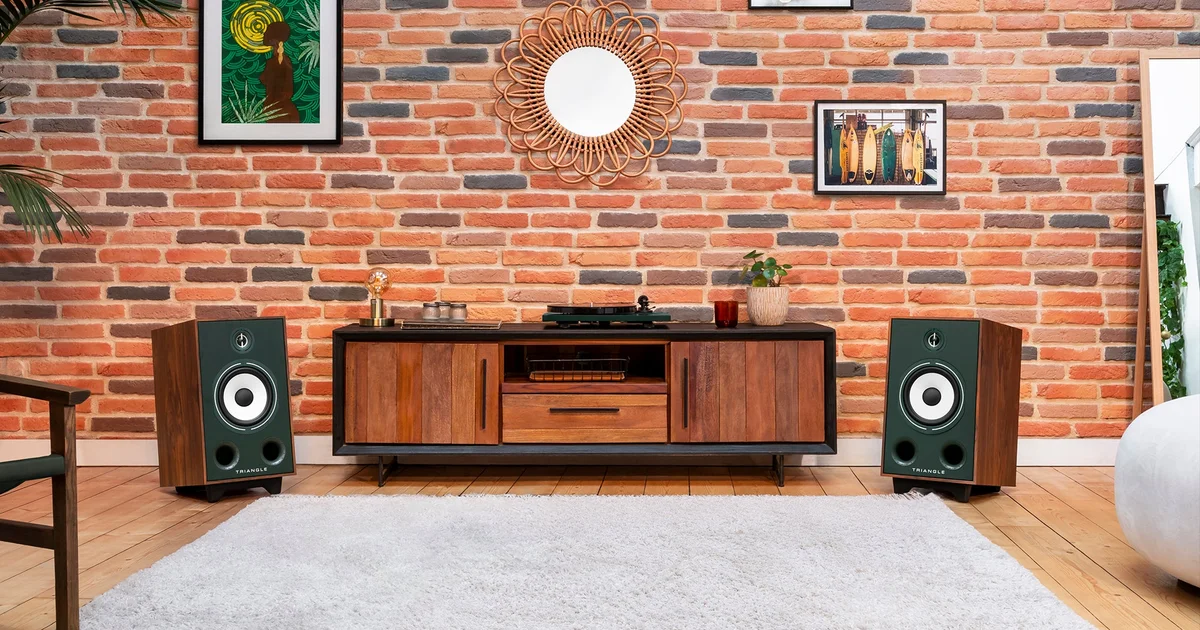
In the 1970s and 1980s, a pair of hi-fi speakers could occupy a considerable amount of space in a living room. Cabinets were broad, drivers were clearly visible and wood finishes were part of the furniture. Over time, much of domestic hi-fi shifted toward slim floorstanding speakers or smaller standmount models. Triangle is reviving another format. The French manufacturer introduced the Borea BR05 on October 19, 2026. It is a two-way bookshelf speaker built around a 21cm mid/bass driver. The speaker is available immediately at a recommended retail price of €749 per pair. Its styling is openly inspired by large vintage loudspeakers. However, Triangle has not simply placed modern drivers inside an old-fashioned box. The BR05 uses a newly developed driver, reinforced cabinetry and systems intended to reduce vibrations and improve low-frequency control. It sits between the compact bookshelf products in the Borea range and the company's conventional floorstanding speakers. That makes it an interesting option for listeners who want a traditional stereo setup. They will need to give it more space than the word bookshelf might suggest.
Why does a 21cm driver matter?
The central component of the Borea BR05 is its 21cm mid/bass driver. That is notably larger than the drivers found in many conventional bookshelf loudspeakers. The difference is not merely visual. Reproducing low frequencies requires a speaker to move air. The surface area of the cone therefore matters, alongside its excursion and cabinet design. A larger diaphragm can displace more air for a given excursion. That can help produce greater low-frequency output. However, diameter alone does not determine sound quality. Cone rigidity, motor design, suspension and enclosure tuning all have important effects. Triangle says the BR05 driver was developed specifically for this speaker. Interestingly, the manufacturer emphasizes that the objective was not simply to produce more bass. Its engineering work also focused on midrange reproduction, including voices and instruments. That priority makes sense in a two-way loudspeaker. The large driver must reproduce a substantial part of the audible spectrum before handing over to the tweeter.
Natural cellulose remains part of Triangle's acoustic identity
Triangle uses natural cellulose pulp for the BR05's new driver cone. The material has long been associated with the manufacturer's sound. It may appear less dramatic than carbon fiber or some advanced composite diaphragms. However, cellulose offers useful characteristics for loudspeaker design. Its mass, stiffness and damping can be adjusted through material composition and manufacturing techniques. The result depends on the exact formulation and geometry. For the BR05, Triangle says the cone has no surface coating. Its profile and dust cap have been optimized to balance impact and precision. The manufacturer also says parts of the driver's structure draw on development work from the larger Borea BR10. An open basket allows airflow around the voice coil. A copper demodulation ring has been added to the motor system. Such components can help reduce certain electromagnetic variations and distortion mechanisms. Triangle claims improved control of the driver. Independent response and distortion measurements will be needed to establish the effectiveness of these design choices.
A 25mm EFS tweeter handles high frequencies
The BR05's second driver is an EFS tweeter. EFS stands for Efficient Flow System. The design uses a 25mm fabric dome with a phase-control element. Its job is to reproduce high frequencies. Triangle already uses this tweeter approach elsewhere in the Borea family. The company emphasizes controlled and consistent sound dispersion. That matters in a real living room. A loudspeaker should not be judged solely by its frequency response directly in front of the drivers. It also radiates sound toward walls, floors and ceilings. Those reflections contribute to what a listener eventually hears. Consistent directivity can help produce a coherent soundstage. The BR05 has a specified crossover frequency of 1,700Hz. That means the two drivers divide reproduction around that part of the spectrum, according to the characteristics of the crossover network. Pairing a relatively large mid/bass driver with a tweeter requires careful attention to dispersion and integration. Triangle says it has optimized that transition. Full on-axis and off-axis measurements will be necessary to understand the resulting behavior.
Two front-facing bass-reflex ports
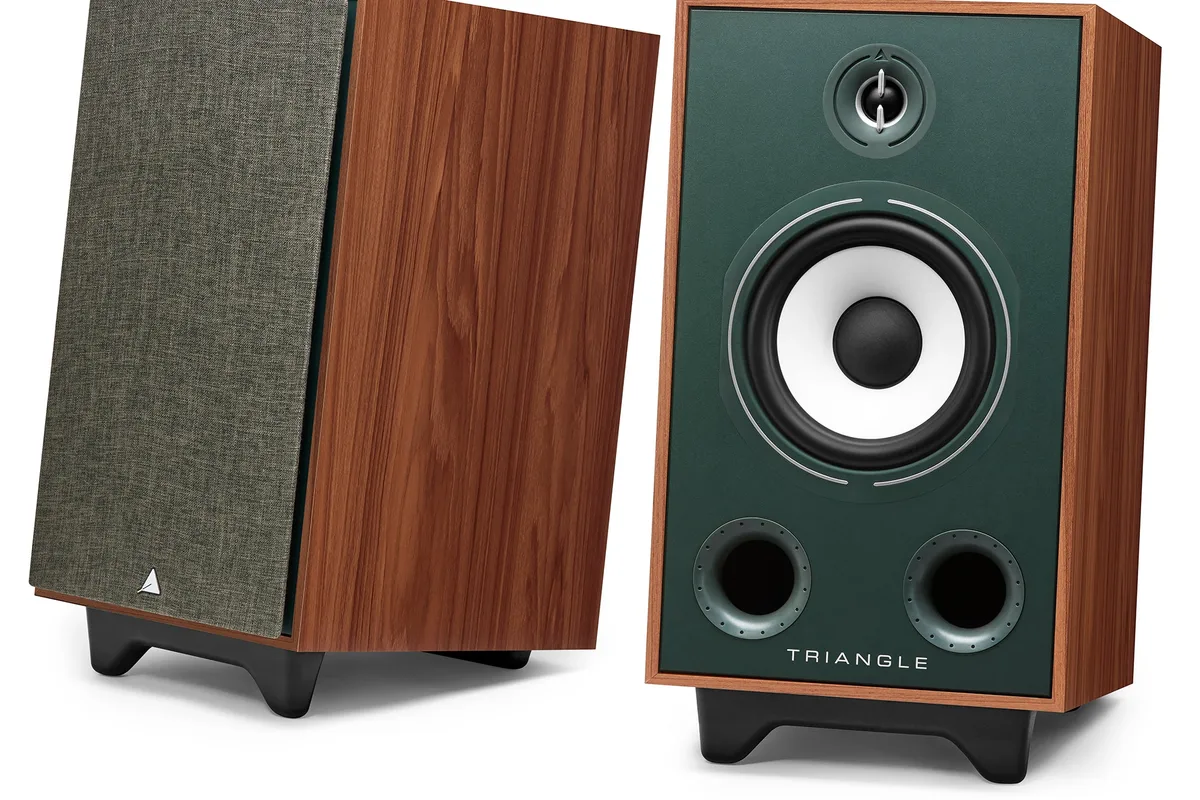
The Borea BR05 uses a bass-reflex enclosure with two ports on its front panel. These openings contribute to the loudspeaker's low-frequency tuning. Their behavior depends on the relationship between the air volume inside the cabinet and the dimensions of the ports. Triangle has chosen two openings to distribute airflow. The stated objective is to reduce air velocity and turbulence when the speaker operates at higher levels. The front-facing arrangement also has a practical benefit. Compared with a cabinet whose port exits at the rear, the BR05 does not need exactly the same rear clearance simply to allow air to move through the port. However, that does not mean the speaker can be pushed against any wall without acoustic consequences. Low frequencies interact strongly with room boundaries. Nearby walls and corners can increase certain frequencies or create resonances. Port position and overall room interaction are different considerations. A front-ported design may make some placements easier. It does not eliminate the need to position the speakers carefully.
A reinforced cabinet weighing 14.6kg
The dimensions of the BR05 help explain its weight. Each speaker weighs 14.6kg. A pair therefore exceeds 29kg before adding an amplifier or any other equipment. Triangle uses high-density MDF panels reaching 21mm in thickness. The cabinet also includes internal reinforcements and a vibration-control system called DVAS. The objective is to reduce unwanted enclosure movement while the drivers are operating. A vibrating cabinet can produce sound of its own. Depending on frequency and amplitude, this may color the overall reproduction. The manufacturer attempts to control that behavior through rigidity and damping. The design sounds substantial on paper. It also explains why the BR05 is not a lightweight speaker that can be moved casually. Without its base, it measures 300mm wide, 490mm high and 345mm deep. Anyone considering a shelf installation should check the furniture's dimensions and load capacity. An ordinary bookshelf may not be deep or strong enough to support such a substantial speaker safely.
A bookshelf speaker designed to sit almost at floor level
The term bookshelf speaker is slightly misleading in this case. The BR05 is closer in size to traditional large monitoring-style loudspeakers than compact desktop models. Triangle offers two installation options. The first uses the bases included with the speakers. They allow the cabinets to sit near floor level while tilting upward toward the listening position. This arrangement recalls vintage hi-fi systems placed relatively low in living rooms. The second option uses the S03 stands, sold separately. These raise the speakers and provide an angle of approximately eight degrees. Both arrangements are designed to orient the drivers toward the listener. The angle matters when the tweeter sits significantly above or below ear level. Tilting the cabinet helps align its acoustic axis with someone seated on a sofa or chair. The best choice depends on furniture, seating height and available listening distance. A speaker installed on a suitable stand may behave differently from one placed inside an enclosed bookshelf.
A claimed 42Hz low-frequency response: is a subwoofer necessary?
Triangle specifies a frequency response of 42Hz to 22,000Hz, within a tolerance of plus or minus 3dB. That suggests relatively extended bass performance for a bookshelf speaker. However, the 42Hz figure does not mean the BR05 reproduces every low frequency at the same level. It also does not describe the response that will be heard in a particular room. Room acoustics can reinforce some frequencies and reduce others. Speaker placement and listening position may produce substantial changes. For rock, jazz, vocals and many acoustic recordings, a speaker of this size may provide enough bass without an additional subwoofer. That is a possible use case, not an independently verified listening result. Fans of electronic music with very deep bass or demanding movie soundtracks may have different requirements. A dedicated subwoofer can still be worthwhile when reproduction of the lowest frequencies is important. The BR05 should not be described as a universal replacement for every floorstanding speaker or subwoofer system.
What amplifier will the BR05 need?
The Borea BR05 is a passive loudspeaker. It does not include a built-in amplifier, Bluetooth receiver or network streamer. Users will need a suitable amplifier and a source of music. Triangle specifies 90dB sensitivity and a nominal impedance of 8 ohms. The manufacturer also reports a minimum impedance of 4.7 ohms. Its recommended amplifier power range is 25 to 130 watts. Those figures suggest that the BR05 does not necessarily require an unusually powerful amplifier. However, the appropriate choice depends on listening volume, room size and the amplifier's ability to deliver current. An unsuitable amplifier may clip if pushed beyond its capabilities. It is also important not to confuse power handling with built-in power. The speaker's 120W power-handling specification does not mean it contains a 120W amplifier. A double terminal arrangement supports bi-wiring and bi-amplification configurations. A conventional stereo connection to a compatible amplifier remains an option for ordinary setups.
Where does €749 place the BR05 in Triangle's range?
The BR05 is available for a recommended retail price of €749 per pair. That places it above the smaller Borea bookshelf models. It also sits below several of the company's floorstanding loudspeakers. HomeCineSolutions notes that the BR04 was priced around €549 per pair and the BR08 around €1,099 per pair when the new model was announced. Those figures may change, but they clarify the positioning. Triangle is offering an intermediate format. Buyers no longer need to choose only between a small bookshelf speaker and a conventional tower. The BR05 offers a larger driver and substantial enclosure without adopting a tall floorstanding design. However, total system cost depends on equipment the buyer already owns. For someone with a suitable stereo amplifier, the speakers may represent most of the purchase. Otherwise, an amplifier, speaker cables and possibly a network streamer must be added. Optional S03 stands introduce another potential expense. A meaningful price comparison should therefore examine the complete system rather than the speaker pair alone.
Five finishes make the retro styling part of the appeal
Triangle offers the Borea BR05 in five finishes. The choices are Chestnut, Green, Frosted White, Light Oak and Black Ash. Wood-inspired cabinet surfaces are paired with contrasting front panels. The trim around the drivers adds to the vintage identity. Magnetic fabric grilles allow the drivers to be concealed when a more discreet appearance is preferred. Owners do not have to choose permanently between an exposed technical look and a more furniture-friendly presentation. The styling clearly recalls older hi-fi products. However, the BR05 is not intended to disappear into a room like a compact connected speaker. It is a large, visible piece of equipment. That may appeal to enthusiasts who appreciate traditional audio hardware. It may also make the product difficult to accommodate in a small home. The cabinet dimensions, finishes and support arrangement deserve as much consideration as the acoustic specifications.
What independent tests need to establish
Triangle's announcement provides a detailed technical description. It is not a substitute for an independent review. The first question concerns bass performance. A 21cm driver offers interesting potential, but actual response and port noise at higher volumes need to be measured. The second concerns midrange reproduction. Triangle places particular emphasis on voices and instrumental tone. The large driver's behavior near the crossover frequency will therefore be important. Third, dispersion deserves attention. A loudspeaker with a large mid/bass driver needs a coherent transition to its tweeter. On-axis and off-axis measurements can reveal how effectively that has been achieved. Distortion, sensitivity and power handling should also be evaluated. Finally, listening in different rooms would provide a better understanding of placement constraints. The design, price and technical specifications already establish the BR05's market position. They do not yet prove that it sounds better than similarly priced competitors.
A vintage alternative to conventional floorstanding speakers
The Borea BR05 is built around a straightforward idea: bring the character of traditional large hi-fi speakers into a relatively accessible product range. Its 21cm driver, dual front ports and reinforced cabinet reflect genuine acoustic design decisions. Vintage styling is not its only selling point. Triangle promises full-bodied sound and controlled bass. Those claims still need independent listening and measurement. For owners who already have a suitable amplifier, the BR05 may be an interesting alternative to smaller bookshelf speakers and compact towers. Its €749-per-pair price fits that middle position, although it does not establish superior value on its own. Physical size will likely be the decisive issue for many buyers. At 14.6kg per cabinet and 30cm wide, the speaker demands a carefully chosen location. It is not intended for people seeking a small, self-contained wireless system. However, it could appeal to traditional stereo enthusiasts who want their audio equipment to remain a visible part of the room. The return of vintage styling in hi-fi is not only about recreating old appearances. With the BR05, Triangle is also revisiting a loudspeaker format whose practical and acoustic strengths are worth examining again.