
 By Adri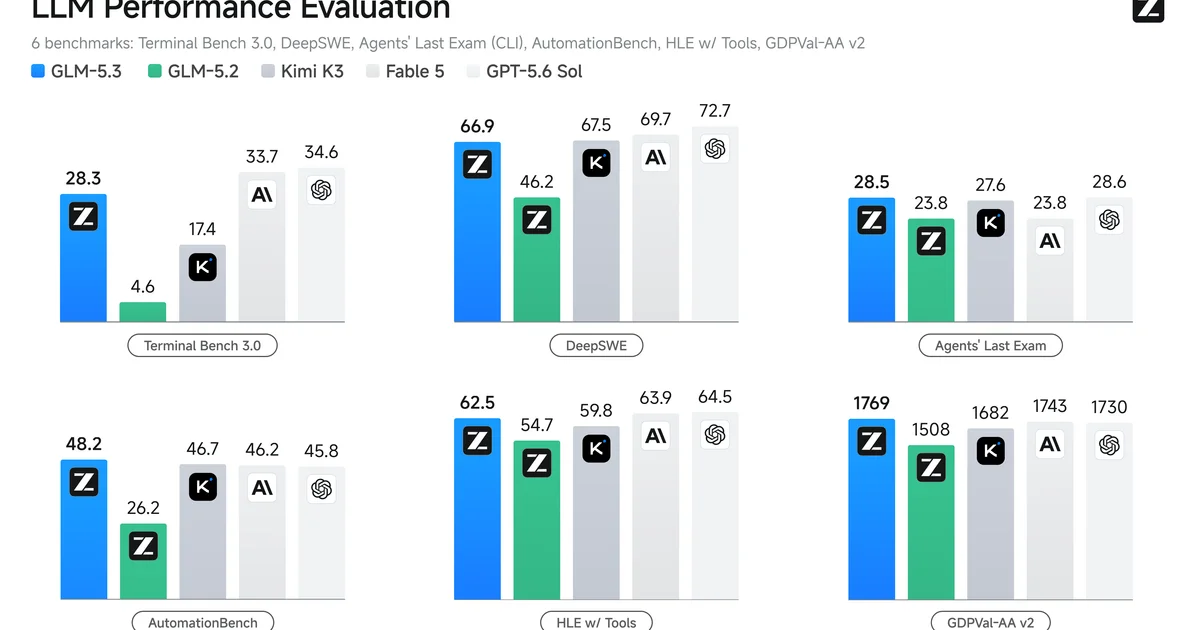
GLM-5.3-Flash is the first natively multimodal member of Z.ai's GLM-5 family. It has 320 billion total parameters but activates 18 billion of them at a time, and its weights have been released under the MIT License.
The model can work with text, images and video and supports context lengths of up to one million tokens. Z.ai redesigned parts of the architecture around the cost of serving that much context, combining sparse and linear attention with an indexing technique called IndexPool.
Ox Alpha was an infrastructure experiment too
Z.ai says it placed the model anonymously on OpenRouter and OpenCode to collect feedback without its name shaping user expectations. Ox Alpha quickly became one of the most heavily used models of the week.
All of that traffic was handled by Chinese-developed AI accelerators. Z.ai's own technical post describes a production deployment operating across tens of thousands of domestic chips, connected through a serving stack specifically optimized for the hardware.
A more precise figure comes from the Global Times. Citing technical material provided by Zhipu AI, the newspaper reports that the inference service ran on a cluster containing more than 100,000 domestically produced chips. Z.ai has not publicly identified the individual chip suppliers or models.
Software is compensating for hardware constraints
The company's account is notable for acknowledging where those accelerators remain difficult to use. Memory capacity and bandwidth become major constraints when a model has to handle context windows approaching one million tokens.
Z.ai built around those limitations rather than pretending they do not exist. Its stack includes intra-node tensor parallelism, W8A8 quantization, multiple KV-cache formats and an Encode-Prefill-Decode architecture that schedules the different stages of inference independently.
According to Z.ai, those optimizations improved end-to-end serving performance by roughly three times compared with its initial baseline on the same hardware.
The company now claims hardware efficiency and per-token cost comparable to mainstream Nvidia GPUs. That figure should be treated as Z.ai's production claim rather than an independent head-to-head audit of the complete clusters.
Flash is designed to need less compute in the first place
The model architecture does part of the work. GLM-5.3-Flash has 320 billion parameters in total but activates only 18 billion per token. Z.ai also cut the layer count dramatically compared with GLM-4.5, from 92 to 45.
Against the larger GLM-5.3 architecture, Z.ai reports three times less attention compute and a 4.4-fold reduction in KV-cache size. Those are not particularly glamorous specifications, but they matter when the objective is cheap inference at high request volumes.
On Artificial Analysis' Intelligence Index, GLM-5.3-Flash scores 57. Z.ai highlights that this puts it alongside Claude Opus 4.8 on that aggregate measure. Individual workloads are much less tidy: its published DeepSWE v1.1 result is 63.4 against 58.0 for Opus 4.8, while NL2Repo gives Opus a sizable lead at 69.7 versus 56.3.
Low pricing is part of the architecture story
The standard API price is listed at $0.15 per million input tokens and $0.50 per million output tokens, before its temporary launch discount. Z.ai positions that at roughly one tenth of the price of GLM-5.3.
The weights are also available from Z.ai's official Hugging Face repository under the MIT License. The company currently lists SGLang, vLLM and TokenSpeed among the supported inference frameworks.
That makes GLM-5.3-Flash two launches at once. One is another competitive open multimodal model. The other is an attempt to demonstrate that Chinese accelerators, paired with enough systems engineering and enough scale, can carry a frontier-class inference workload without Nvidia hardware. Z.ai still has not disclosed which chips made up the reported 100,000-plus accelerator cluster.