
 By Tsuky
Google released Gemini 3.8 Live and Gemini 3.8 Live Extended Thinking on September 15. Both are native speech-to-speech models intended for real-time voice products rather than simple cascades built from separate speech recognition, language and text-to-speech systems.
Gemini 3.8 Live is the scale and cost-oriented option. Extended Thinking is aimed at more complex workflows, where an agent may need several reasoning steps, external functions and asynchronous operations before the task is finished.
Tool calls no longer have to become dead air
The models support asynchronous function calling. An agent can start an API or tool request in the background while continuing to stream audio to the user.
That addresses one of the most obvious weaknesses of conventional voice-agent pipelines. Many systems understand a request, disappear while an external operation completes and then resume the conversation once the result arrives.
Extended Thinking can keep multi-step reasoning active at the same time. It may acknowledge the request immediately and narrate useful progress while longer work continues in the background.
Language switching happens automatically across 97 supported languages
Gemini 3.8 Live can automatically detect transitions between 97 supported languages during the same conversation. Google is also emphasizing consistent accents and multilingual handling without requiring manual switching.
Another improvement is less glamorous but potentially more valuable in production: alphanumeric precision. Google specifically calls out confirmation codes, claim numbers and technical data.
A voice agent that sounds natural but gets a policy number wrong is still a bad enterprise tool.
Near-real-time visual grounding is supported as well, allowing the conversation to incorporate live visual input rather than treating voice as an isolated channel.
Extended Thinking posts an 82.6 speech-to-speech score
Google reports an 82.6 score for Gemini 3.8 Live Extended Thinking on Artificial Analysis' Speech to Speech Quality Index. It also records 68.6 percent on τ-Voice, 35.1 percent on Sierra's τ-Voice-banking benchmark and 97.7 percent on Big Bench Audio.
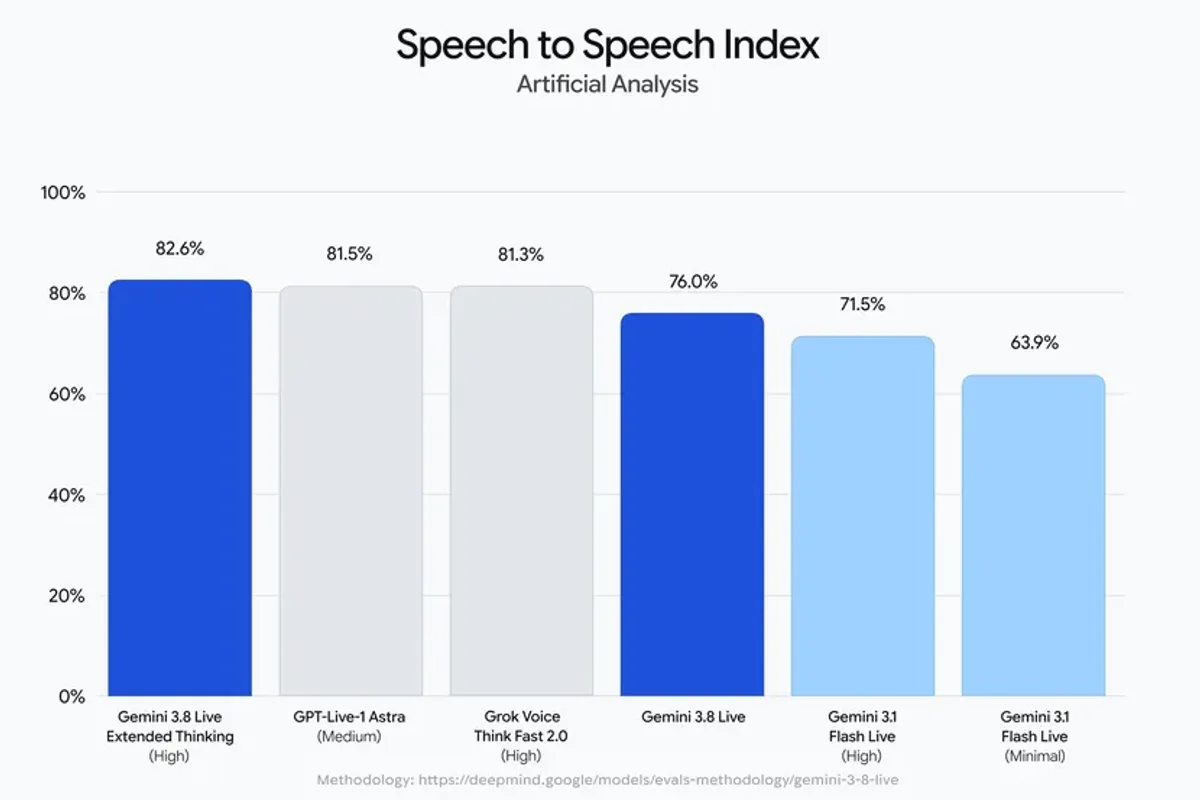
The banking result is probably the useful reality check. Even a model leading broader voice benchmarks still fails a substantial share of difficult, procedural, tool-heavy customer service tasks.
The standard Gemini 3.8 Live model takes second place in Speech Agent Arena according to the results highlighted by Google.
Audio input is estimated at half a cent per minute
Google lists estimated pricing of $0.005 per minute for audio input and $0.018 per minute for audio output. The estimate is based on token pricing of $3 per million input tokens and $12 per million output tokens.
Extended Thinking can introduce additional reasoning-token costs, while video, documents and other inputs add their own usage. A basic voice interface and a multimodal agent running several background jobs therefore have very different cost profiles despite using the same family of models.
Google wants native audio to replace more of the cascade
Traditional voice stacks often combine automatic speech recognition, a language model and text-to-speech as separate stages. That architecture is flexible, but every boundary can introduce latency and another opportunity for context to be lost.
Gemini 3.8 Live keeps more of the listening, reasoning and speaking loop inside a native audio model. External tools still matter whenever an agent needs real data or actions; the difference is that calling them no longer has to freeze the user interface.
Both models are available through the Gemini API and Google AI Studio. Google also lists integrations with platforms including Agora, Fishjam, LiveKit, LangChain, Pipecat, Vercel and Vision Agents for developers that do not want to build the real-time media transport layer themselves.
The rollout is already reaching consumer and Workspace products
Gemini 3.8 Live is rolling out through Search Live and is available in private preview in Gemini Enterprise. Extended Thinking is reaching Gemini Live, as well as Docs, Gmail and Keep for eligible Google AI subscribers.
Google says all generated audio from its AI products carries an imperceptible SynthID watermark so that machine-generated speech can later be detected.
Voice used to be mostly an interface sitting in front of a text model. The more interesting change here is behind that interface: listening, looking, reasoning and using tools at the same time without asking the user to sit through the silence.