 By Tsuky
Google released Gemini 3.8 Flash on September 2, only three weeks after introducing Gemini 3.7 Flash. It is the company's third Flash launch in a six-week stretch.
Unlike a limited experimental preview, gemini-3.8-flash is already listed as generally available for production through the Gemini API. Google is positioning it around long-horizon software engineering, autonomous agents and complex enterprise workflows.
The sticker price is unchanged until January
Through December 31, Google charges $0.75 per million input tokens and $3.75 per million output tokens. Those are the same introductory rates attached to Gemini 3.7 Flash.
The permanent price begins January 1, 2027: $1.50 per million input tokens and $7.50 per million output tokens.
There is an important difference between token price and task price, though.
Google deliberately made 3.8 more willing to think
For difficult work, Gemini 3.8 Flash can execute additional reasoning steps, invoke tools iteratively and check intermediate results before finishing.
Google describes this behavior as greater diligence. It also warns that the model may consume more tokens, particularly at higher reasoning settings.
Developers can choose low, medium or high thinking levels, with medium used by default. Lower settings trade some of that additional reasoning for reduced token overhead and latency.
Google is not pretending every workload needs the new behavior. Its own migration guidance says efficiency-first applications can continue using Gemini 3.7 Flash.
The context window remains enormous
Gemini 3.8 Flash supports 1,048,576 input tokens and up to 65,536 output tokens. It accepts text, images, video, audio and PDFs as input.
Built-in capabilities include function calling, code execution, file search, Search grounding, Google Maps grounding, structured output and URL context. Computer Use is available in preview.
That collection matters more for agent workloads than another point on a static question-answer benchmark. A useful agent needs somewhere to act.
Long-horizon coding is Google's headline benchmark
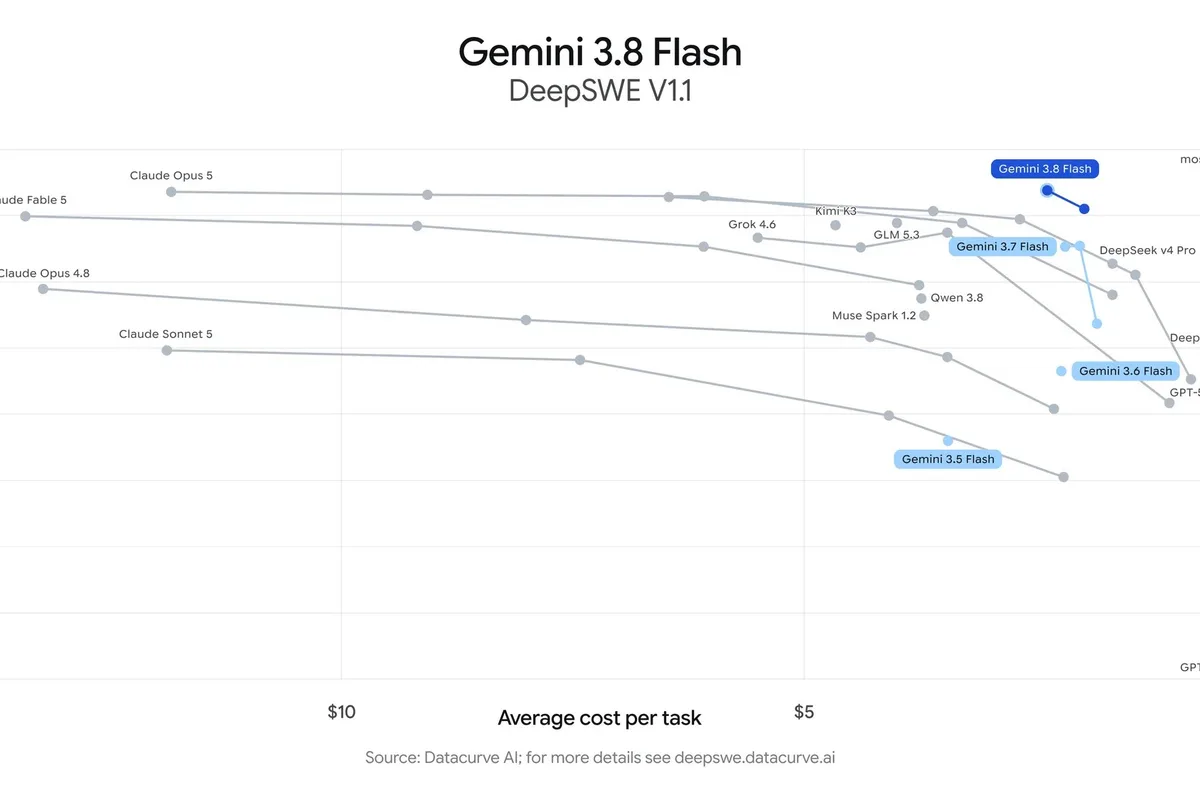
Google puts particular emphasis on DeepSWE v1.1, which evaluates extended software-engineering work rather than short coding prompts. Its published results place Gemini 3.8 Flash at 73.7%, compared with 65.3% for 3.7 Flash.
Google says the new Flash model beats most larger frontier models on that evaluation while operating at a fraction of their cost.
Those numbers still need the usual benchmark caution. A controlled software-engineering suite does not reproduce every repository, toolchain, dependency failure or ambiguous human requirement an agent will encounter in production.
On HLE-Verified, Google reports 54.9% for 3.8 Flash versus 53.6% for its predecessor. The company also highlights improvements in finance, legal work, computer use and long-context reasoning.
Agents make token efficiency harder to judge
The shift toward agentic workloads complicates the old model-comparison habit of looking at dollars per million tokens and benchmark scores.
An autonomous workflow can generate many model calls while planning, reading files, executing code, checking failures and retrying. A slightly more expensive reasoning path can still be cheaper if it prevents repeated failed loops. The reverse is equally possible.
That makes completed-task cost and reliability more useful than the API rate by itself.
Google is releasing Flash models faster than teams can benchmark them
Gemini 3.7 Flash arrived on August 13, three weeks after 3.6 Flash. Now 3.8 is already the current production model.
Rapid iteration is useful when each release genuinely improves difficult workflows. It also creates migration overhead for teams that need to evaluate regressions, update prompts, retest tool calling and establish new cost baselines before changing a production agent.
Google continues to support 3.7 Flash, so there is no requirement to migrate simply because a newer model exists.
3.8 Flash is available now
Developers can use Gemini 3.8 Flash through Google AI Studio, the Gemini API and Antigravity, while enterprise customers can access it through Gemini Enterprise.
Google has also rolled the model into the Gemini app for Google AI Pro and Ultra users, AI Mode in Search and Gemini in Google Sheets.
The interesting comparison will not be whether Gemini 3.8 Flash can think longer. Google has already told developers that it does. The question is whether that extra work reduces failed agent loops enough to justify the additional tokens it may consume.