 By Adri
Ethereum currently lists Glamsterdam as being tested on devnets. The next scheduled milestone is the Sepolia fork on September 28, 2026, while mainnet deployment is still targeted for Q4 without a confirmed activation date.
That distinction matters. The upgrade is close enough for application and infrastructure developers to start treating compatibility work seriously, but not close enough to pretend the final mainnet schedule is settled.
Block building moves deeper into the protocol
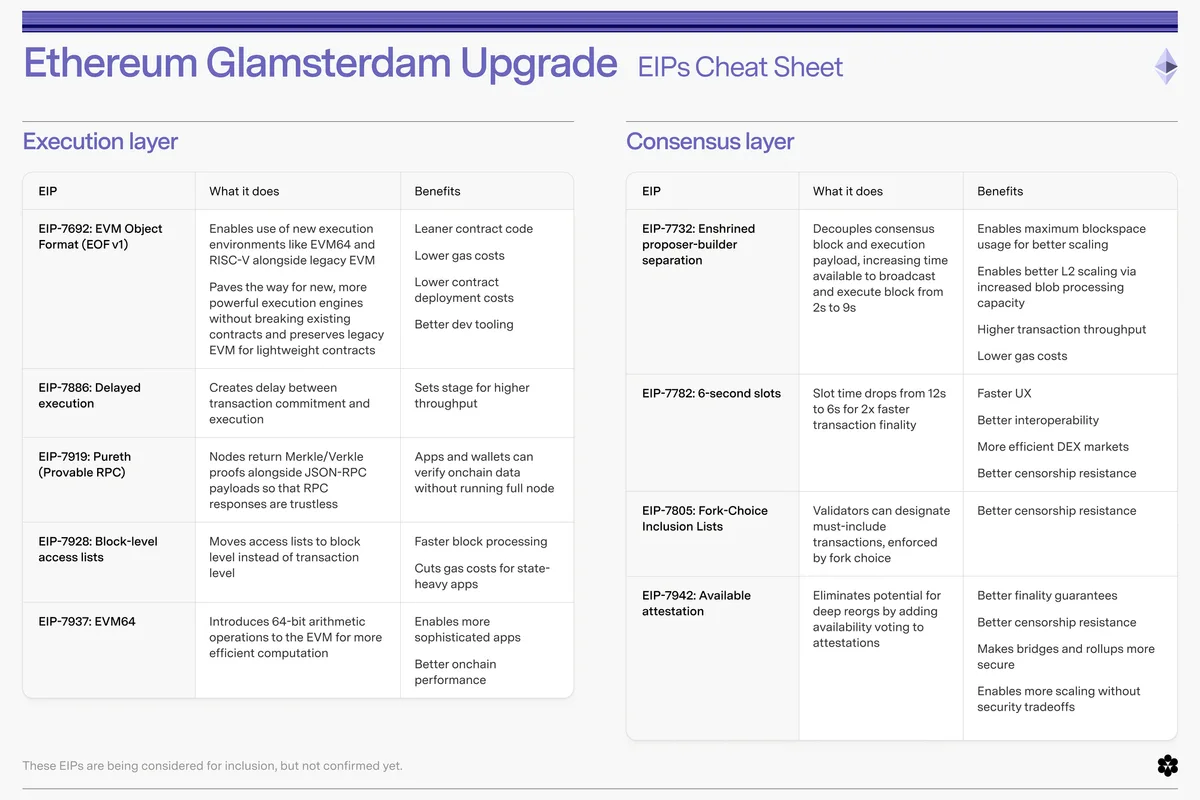
EIP-7732, better known as Enshrined Proposer-Builder Separation or ePBS, is one of Glamsterdam's headline changes. Ethereum already has a practical separation between proposers and specialized block builders, but part of that relationship currently relies on middleware and off-protocol relays.
ePBS brings that exchange into Ethereum itself. Consensus blocks and execution payloads receive separate timing mechanics, reducing the pressure created by the current validation hot path.
Ethereum's roadmap documentation says the effective payload propagation window can grow from roughly two seconds to about nine. For raw scaling work, that is the interesting part. More time to move data through the network gives developers room to increase payload capacity without simply tightening hardware deadlines until nodes start dropping out.
Block-Level Access Lists are the parallelization groundwork
Ethereum execution is still fundamentally constrained by sequential state access. A node often has to execute a transaction before it knows every account or storage location that transaction will touch.
Block-Level Access Lists, introduced through EIP-7928, provide that information at block level. Nodes gain an upfront map of state dependencies and resulting changes, making it possible to identify work that does not conflict and perform more reads in parallel.
Glamsterdam does not magically turn the EVM into a fully parallel execution engine on day one. BALs are infrastructure for getting there. They also open the door to faster synchronization techniques because nodes can consume final state information without recreating every step merely to discover which pieces of state changed.
Cheaper ETH transfers, more realistic state costs
Gas repricing is where the upgrade becomes slightly less intuitive. Some operations get cheaper. Others become more expensive because their old prices no longer reflect what nodes actually have to do.
EIP-2780 reduces intrinsic transaction gas. Ethereum estimates that a basic ETH transfer between existing accounts can become up to 71% cheaper. Transfers that create a previously nonexistent account still carry an additional cost because they permanently expand network state.
EIP-8037 and EIP-8038 move in the opposite direction for state creation and state-access operations. The purpose is not to manufacture higher fees. It is to stop underpricing database work that becomes increasingly expensive as Ethereum's state grows.
An Ethereum Foundation analysis published on August 24 replayed historical mainnet transactions using the new pricing schedule. It found a small set of smart contracts that depend on assumptions the repricing changes. Most contracts were unaffected, and many flagged cases can be addressed by increasing the gas limit supplied to the affected call.
Platåberget exists so developers can break things now
The temporary Platåberget testnet gives developers a stable environment for testing post-Glamsterdam behavior before the fork reaches Sepolia and other longer-lived test networks.
There is a specific warning attached to it: software that assumes a hardcoded maximum gas limit may fail. The Ethereum Foundation explicitly points to wallets, indexers and gas estimators as examples. That is the kind of compatibility bug that is much nicer to discover on a temporary testnet.
Regular ETH holders do not need to convert their coins or perform a special migration. Ethereum's own guidance is explicit on this point: balances remain unchanged, and anyone asking users to “upgrade” ETH for the fork is running a scam.
Node operators and validators will need supported execution and consensus client releases before mainnet activation. Glamsterdam changes both sides of the stack.
September 28 is the date to watch
Sepolia is scheduled to adopt Glamsterdam on September 28. Assuming testing keeps moving forward, mainnet remains targeted for the fourth quarter of 2026, with the exact activation date still unconfirmed.
Ethereum already lists Hegotá after Glamsterdam on its roadmap for 2027. Protocol development is not exactly entering a quiet period.