
 By Camille
Each ear cup contains two drivers
EarFun officially released Wave Pro X on September 3 after previewing it earlier in 2026.
It costs $129.99 in the US and €149.99 through EarFun's European store.
The headphone's defining feature is what EarFun calls DCAA, or Dual-Coaxial Acoustic Architecture.
A 40mm DLC dynamic driver handles the lower portion of the spectrum while a separate 10mm LCP unit is used for higher frequencies.
Both drivers sit around the same acoustic axis.
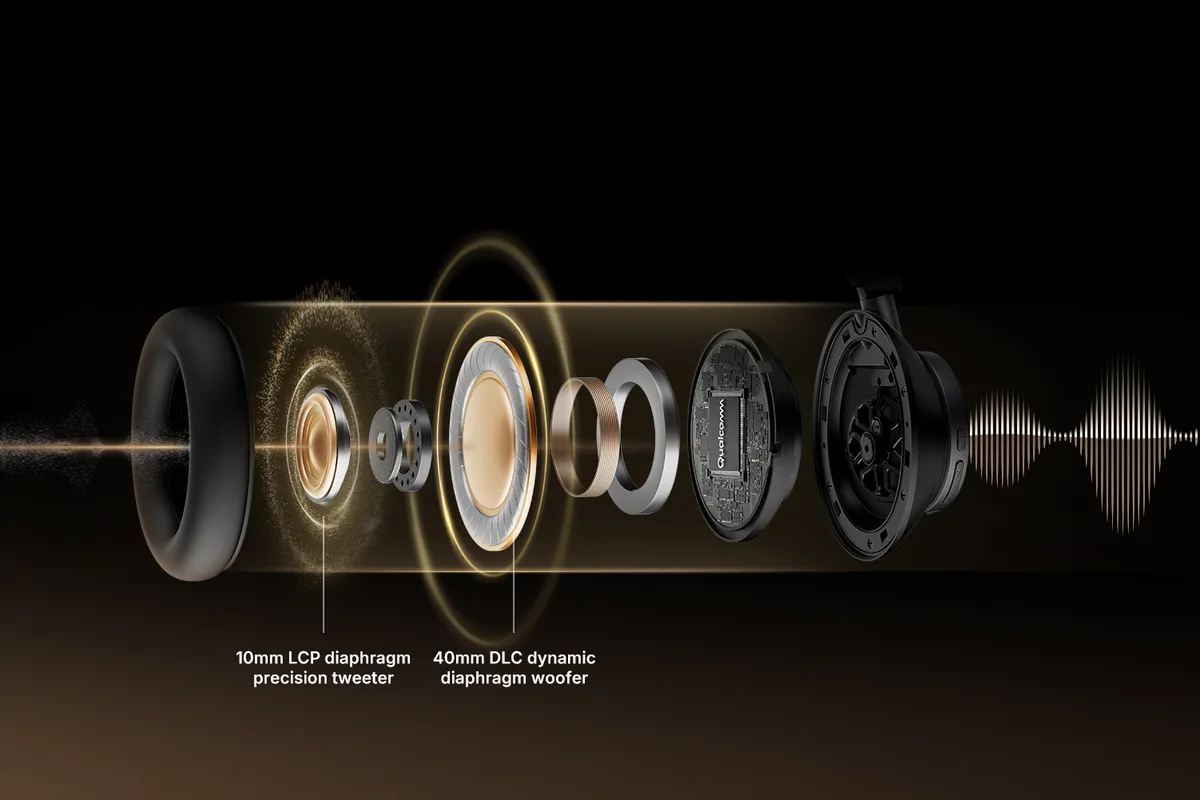
Coaxial alignment is designed to stop two drivers fighting each other
Adding another driver does not automatically improve a headphone.
Two acoustic sources positioned separately can reach the listener with different phase and directivity behavior.
EarFun attempts to reduce that problem by aligning both diaphragms around a common acoustic center.
The concept resembles coaxial loudspeakers where a tweeter and woofer share the same axis.
The crossover and acoustic tuning still determine whether that arrangement actually sounds coherent.
A digital crossover manages the handoff
The two drivers are not simply fed the same full-range signal.
Digital processing routes different frequency regions between the 40mm and 10mm units.
EarFun describes the synchronization as AI-driven and says it is intended to preserve phase alignment through complex material.
The useful engineering here is the active digital crossover and its control over the two drivers.
There is no need to imagine a large generative model running inside the headphones for that to be valuable.
Qualcomm QCC3095 enables much of the feature list
Wave Pro X is built around Qualcomm's QCC3095, part of the Snapdragon S3 Gen 1 Sound Platform.
It handles wireless connectivity, codecs, audio processing and noise cancellation.
The platform brings Bluetooth 6.0, LE Audio, Auracast and several aptX variants.
Google Fast Pair and two-device Multipoint Connection are supported as well.
For someone constantly moving between a laptop and phone, multipoint may be more useful every day than the Hi-Res logo printed on the box.
aptX Lossless requires the right source device
Codec support includes aptX, aptX Adaptive, aptX Lossless, LC3, LDAC and SBC.
That is a broad list for a €149.99 headphone.
aptX Lossless can provide bit-perfect 16-bit/44.1kHz PCM under compatible Snapdragon Sound conditions.
It does not make every Android phone a lossless source automatically.
The phone has to support the appropriate Qualcomm technology and the wireless link must be capable of sustaining the required data rate.
LDAC provides a more broadly available Android option
LDAC matters because support is much more widespread across Android devices.
It does not operate losslessly in every configuration and can change bitrate depending on settings and radio conditions.
It still provides a high-resolution wireless route without requiring the full aptX Lossless ecosystem.
iPhone users will not get either LDAC or aptX Lossless over Bluetooth.
They can use Apple's supported Bluetooth path or switch to wired audio instead.
USB-C also works as a digital audio connection
The USB port can carry audio directly from a compatible phone, tablet or computer.
That provides a wired digital path without Bluetooth compression.
A conventional 3.5mm analog input is available too.
Those options are useful with aircraft entertainment systems, handheld devices and computers that may not support the preferred wireless codec.
ANC keeps working over USB and AUX
EarFun does not disable the headphone's active electronics simply because a cable is attached.
Hybrid ANC remains available over both USB and 3.5mm connections.
That is a practical advantage during travel.
A passenger can plug into an aircraft seat while keeping active noise cancellation instead of choosing between the wired source and a quiet cabin.
Eight microphones serve both ANC and calls
Wave Pro X contains an eight-microphone array.
External and internal microphones provide feed-forward and feedback information for Hybrid ANC.
The same overall microphone system is used to isolate the wearer's voice and suppress surrounding noise during calls.
EarFun specifically targets difficult conditions such as traffic, crowded spaces and wind.
The ANC algorithm can adjust up to 800 times per second
QuietSmart 3.5 is designed to adapt rather than hold one fixed cancellation profile.
EarFun says the system analyzes conditions and updates its behavior as many as 800 times per second.
That lets it react differently to a loud train and a quiet office.
The figure represents processing frequency, not 800 distinct audible levels of noise cancellation.
Independent measurements will still determine how close the actual suppression comes to flagship Sony, Bose or Sonos designs.
At €149.99, it does not need to beat Bose at every frequency
Price changes the standard by which the ANC should be judged.
A €450 headset has little room for merely adequate noise cancellation.
Wave Pro X can remain compelling at €149.99 even if its ANC falls short of the category leaders, provided the overall system is strong.
Noise cancellation here is only one part of a package that also includes codecs, extreme battery life and unusually complete wired support.
The final retail battery figure is 90 hours
Early CES material associated Wave Pro X with claims reaching 100 hours.
EarFun's current retail specification is more conservative and specific.
Playback reaches up to 90 hours with ANC off and up to 50 hours with ANC on.
Actual runtime varies with volume, codec and feature use.
Even the lower figure is enough for several days of travel without searching for a charger.
Fifteen minutes of charging adds up to ten hours
The internal battery is rated at 800mAh.
A complete recharge takes around two hours.
Fast charging provides up to ten hours from fifteen minutes connected to power.
That also makes the headline 90-hour figure less critical in practice.
Even after forgetting to charge for several days, a short top-up can restore enough runtime for a full working day.
259 grams is relatively light for this class
Wave Pro X weighs 259 grams.
That is significantly lighter than several premium wireless headphones that cross the 300g mark.
The ear cups use a shape based around ear geometry and are angled by roughly 12 degrees.
A fabric-covered headband and protein-leather cushions complete the design.
Long-term comfort will still depend on clamp force, heat and individual head shape.
The headphones actually fold for travel
The hinges allow the ear cups to fold inward.
A protective carrying case is included.
That sounds ordinary, but several expensive modern headphones only rotate flat and occupy substantially more bag space.
A genuinely folding design fits well with a product that also emphasizes multi-day travel battery life.
Auracast is more than another Bluetooth badge
Auracast allows a compatible source to broadcast one audio stream to multiple nearby receivers.
The model is closer to a small local digital radio broadcast than a traditional one-to-one Bluetooth pairing.
Several people can potentially listen to the same compatible source without sharing a cable or repeatedly pairing each receiver.
Public venues can also provide accessible audio broadcasts as the ecosystem expands.
The immediate usefulness still depends on how many phones, televisions and public systems actually support Auracast.
Multipoint is more immediately useful today
Two Bluetooth devices can remain connected at once.
A listener can watch a video on a laptop and take an incoming call on a phone without manually re-pairing.
That kind of convenience affects every ordinary workday.
It may matter more to many owners than a high-resolution codec they only use with selected music and hardware.
Game Mode reduces wireless latency
EarFun Audio includes an extremely low latency Game Mode.
Its purpose is to keep sound closer to on-screen action during games and video.
A dedicated proprietary 2.4GHz gaming headset can still offer a more predictable low-latency path for competitive use.
For phones, tablets and ordinary Bluetooth devices, the mode expands Wave Pro X beyond music and travel.
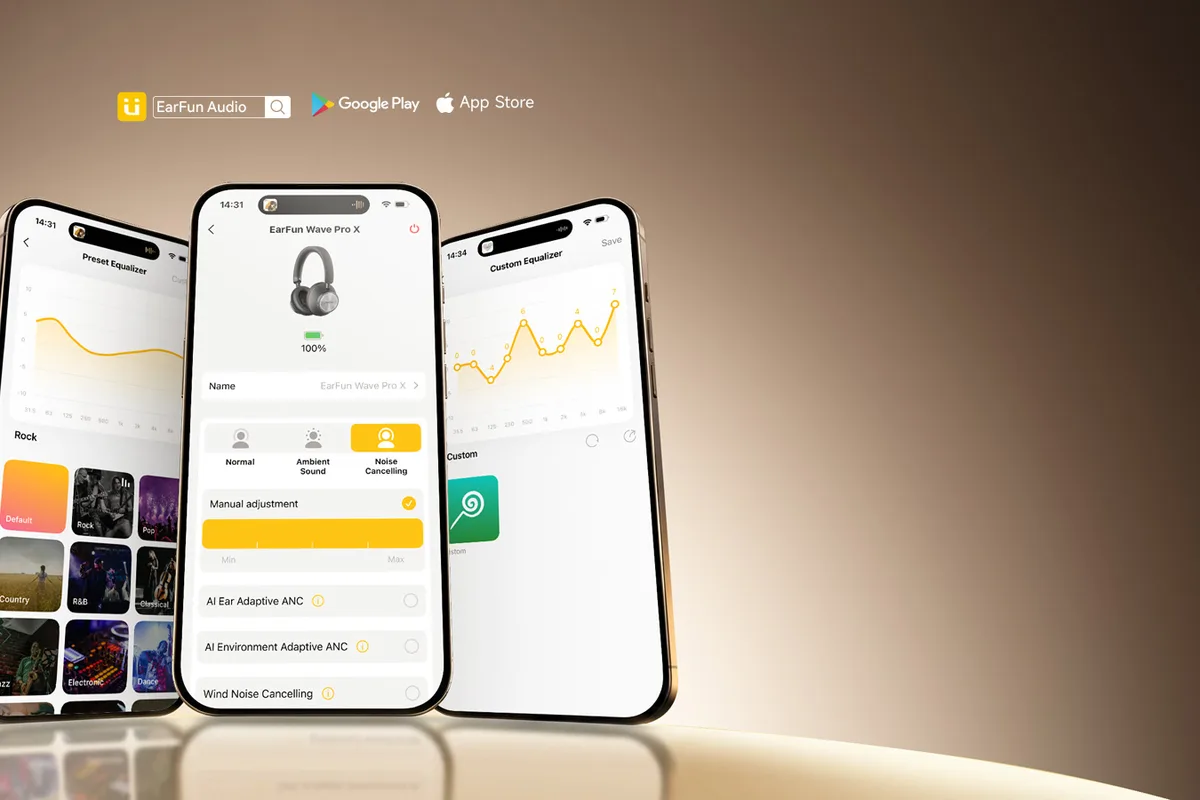
The app controls more than EQ
EarFun Audio provides ANC selection, button remapping and sound customization.
Preset and custom equalizers allow listeners to alter the default tuning.
That is especially relevant with a two-driver architecture whose factory crossover and tonal balance may not match every listener's preference.
Firmware updates are handled through the same application.
Hi-Res certification does not automatically make every song sound better
Wave Pro X carries both Hi-Res Audio and Hi-Res Wireless certification.
Those labels confirm that the system can meet defined technical capabilities around frequency response and signal transport.
They cannot turn a poor recording into a high-resolution master.
Nor do they guarantee that every listener will prefer the resulting sound.
Recording quality, mastering and the headphone's own frequency response remain more important than a logo.
The US price is even more aggressive than the European one
EarFun sells Wave Pro X for $129.99 in the United States.
The European list price is €149.99.
Either price sits far below many premium ANC headphones that combine advanced codecs and strong connectivity.
A more expensive competitor can still justify itself through better cancellation, microphones, build quality or acoustic tuning.
What EarFun makes difficult is using basic feature availability itself as the justification for a €400 price.
The dual-driver system matters more than the alphabet soup of codecs
Wireless audio products increasingly sell themselves through acronyms.
Bluetooth 6.0, LC3, aptX Adaptive, aptX Lossless, LDAC, LE Audio and Auracast give Wave Pro X an unusually long list.
Some depend heavily on the source device and others may produce only subtle differences in ordinary use.
DCAA is more fundamental.
It physically changes how electrical information becomes acoustic pressure in front of the ear.
If EarFun has tuned the crossover and phase relationship well, that benefit remains regardless of which streaming service is running.
At €149.99, the question shifts from “what is missing?” to “how good is all of it?”
Wave Pro X is not automatically better than a Sony, Bose or Sonos simply because it checks more boxes.
Its ANC, frequency response, distortion, microphone quality and long-session comfort still need to justify the specification sheet.
What EarFun changes is the expectation placed on the middle of the market.
At €149.99, it becomes harder for competitors to remove USB audio, multipoint, advanced codecs or a travel case and call those omissions normal because premium models traditionally charged extra for them.
Wave Pro X does not have to beat a €450 headphone in every measurement.
It only has to get close enough on the things that matter to make the extra €300 much harder to explain.