 By Adri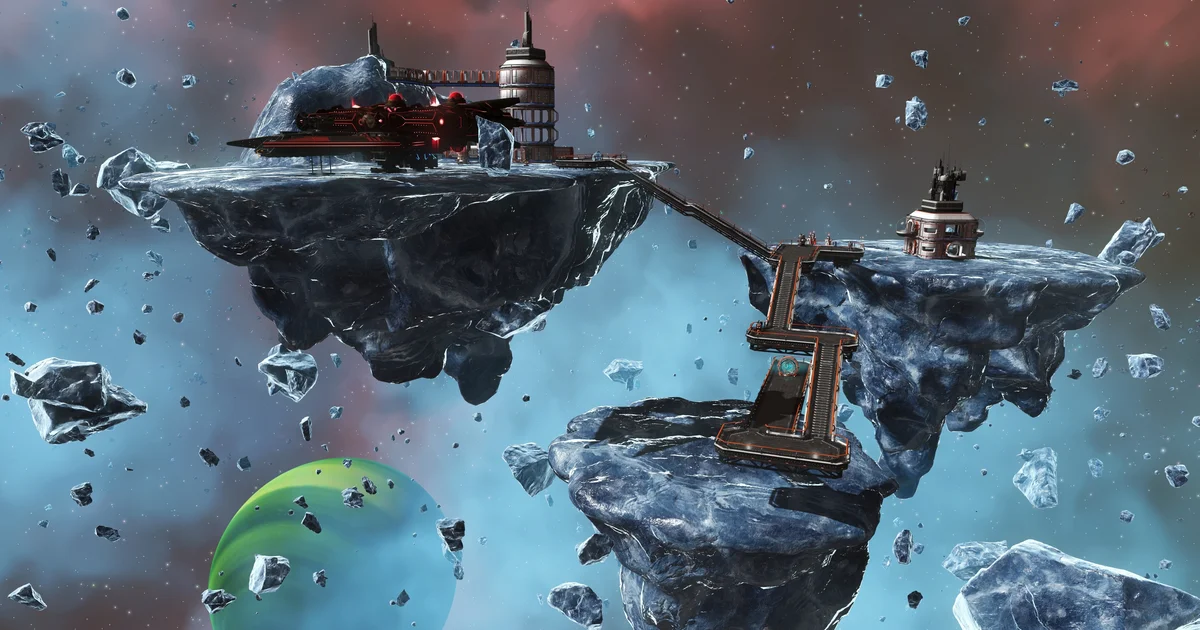
No Man’s Sky 7.0 launched on September 9.
Cosmos targets an area that had remained comparatively stable through a decade of updates: the space surrounding the game's planets.
Hello Games released it across PC, PS4, PS5, Xbox One, Xbox Series X|S, Nintendo Switch, Switch 2, Mac, PSVR, PSVR2 and PC VR, with the Xbox ecosystem also including Game Pass.
Procedural systems now need a richer orbital layer
No Man’s Sky has always generated star systems, but Cosmos adds considerably more structured activity between their planets.
A new map reveals orbital points of interest including hulks, outposts and biologically compromised wrecks.
That expands the simulation problem.
Space is no longer simply a volume through which ships travel. It now has to support mission locations, economic interactions, persistent construction and player-owned infrastructure while remaining compatible with the game's procedural universe.
New activities reuse existing physics systems
Cosmos is particularly effective when it combines mechanics Hello Games has already introduced.
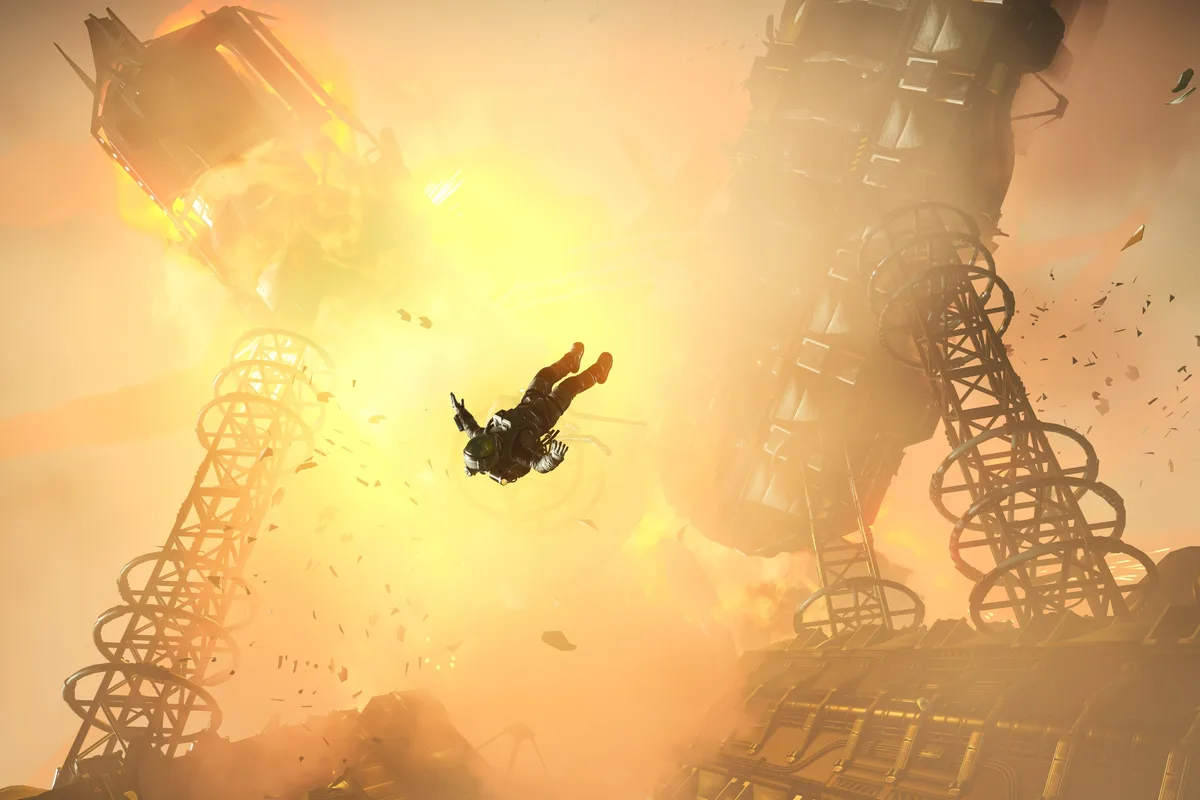
Large wrecks can be dismantled with the gravity gun. Physical pieces are pulled away from the structure and collected using a new ship tractor beam.
Push the salvage process too far and the hulk can enter a meltdown.
One activity therefore connects scanning, physics manipulation, piloting and resource collection instead of isolating each system.
Building no longer has a natural up or down
Traditional No Man’s Sky bases always had a convenient reference point: terrain.
Orbital construction removes it.
Players can build on sufficiently large asteroids or assemble modular structures freely in space.
The construction tools now have to remain usable without a conventional floor, landscape or planetary horizon providing obvious orientation.
Cosmos 7.01, released on Steam one day after the update, already fixed several geometry issues involving the new base parts.
Stations are becoming persistent customizable objects
Players can now purchase a space station and customize both its interior and exterior.
That adds another layer of saved player state to locations that also function as social and economic spaces.
The first hotfix illustrates some of the new edge cases.
Hello Games corrected station decorations disappearing in Korvax-controlled stations and improved VR controls for station decoration.
Those are small bugs, but they reveal where new complexity entered the system.
Alliances formalize behavior that previously lived outside the game
A player-owned station can become the center of an alliance.
Members can cooperate across a network of stations and compete through leaderboards measuring characteristics such as size and wealth.
No Man’s Sky players have organized civilizations for years using external community infrastructure.
Cosmos is interesting because Hello Games is now turning part of that social layer into persistent game data.
Supporting this hardware range is becoming a feature in itself
No Man’s Sky now spans hardware generations that were never originally designed to coexist for this long.
The update has to scale from consoles released more than a decade ago to current systems, handheld Nintendo hardware, Mac and VR.
CPU, GPU and memory budgets differ dramatically across those targets.
Yet Cosmos does not drop any of the platforms Hello Games lists for the current game.
Patch 7.01 arrived almost immediately
That breadth does not mean the launch was frictionless.
Hello Games pushed Cosmos 7.01 to Steam on September 10, with other platforms scheduled to follow.
The patch fixes geometry problems, missing station decorations, VR control issues and an object called the Grave of the Ocean King that could appear 600 times smaller than intended.
This is the less glamorous half of a long-running live game: adding large systems and then rapidly absorbing the strange interactions they create.
Longevity is an architecture problem
No Man’s Sky has received more than 40 major updates since 2016.
Its anniversary expedition turns those releases into a playable history, but the more important story is underneath them.
The game can still accept structural changes a decade after its original architecture was shipped.
Cosmos does not simply add more objects to the universe.
It changes what counts as buildable space, ownable territory and persistent community infrastructure.
Ten years later, that capacity to keep redefining the universe may be No Man’s Sky's most important technology.