
 By Adri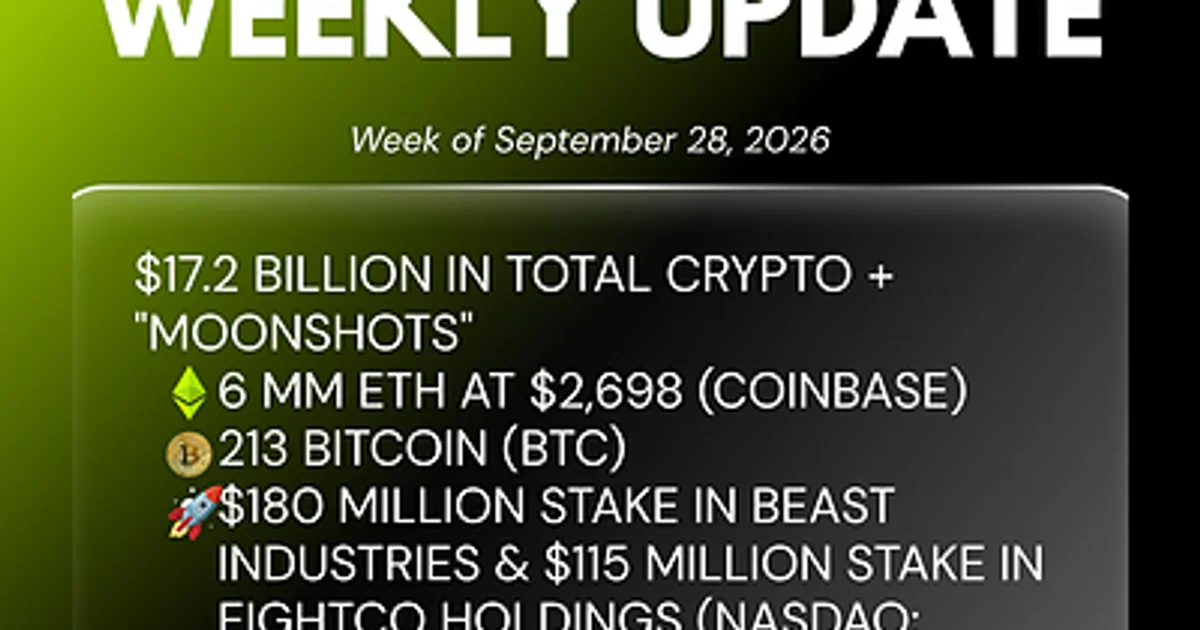
Six million ETH in less than fifteen months
BitMine announced on September 28 that its ether holdings had crossed six million for the first time. The precise balance was 6,001,302 ETH as of 3 p.m. Eastern Time on September 27.
The previous weekly disclosure showed 5,983,940 ETH. BitMine says it acquired another 17,362 ETH between the two updates.
The company did not disclose an average acquisition price for that week's purchase. Using the $2,698 ETH reference price in its September 27 snapshot, the six-million-token position was worth roughly $16.2 billion. That figure is inherently temporary because the dollar value moves with ether's market price.
One corporate treasury is approaching 5% of ETH supply
BitMine uses 122.1 million ETH as its total-supply reference and calculates that it now holds about 4.9%. The Block reports the same approximate 122.1 million figure for circulating supply.
The company calls its accumulation plan the "Alchemy of 5%." Its stated objective is to own 5% of ETH supply, and BitMine says the latest balance places it 98% of the way toward that target.
Five percent is not a permanently fixed number of tokens, however. Unlike Bitcoin's 21 million coin cap, Ethereum supply changes through protocol issuance and fee burning. Reaching and then maintaining a 5% share therefore depends both on BitMine's holdings and on Ethereum's changing supply.
The accumulation campaign began in June 2025
BitMine dates the start of its Ethereum treasury strategy to June 30, 2025. The company says it has purchased ETH every week since then.
Moving from 5.98 million to 6.00 million ETH in one week is relatively small beside the acquisition waves that built the original position. The milestone instead shows the scale reached in less than fifteen months: several million ether now sit on the balance sheet of one publicly traded company.
The Block's data places BitMine far ahead of other corporate Ethereum treasuries, with Sharplink at roughly 888,938 ETH and The Ether Machine at around 496,712 ETH.
Eighty-four percent of the pile is already staked
The figure that changes the nature of this treasury is 5,067,309 ETH. That is BitMine's reported staked balance as of September 27, equivalent to about 84% of its six million ETH.
At the company's $2,698 reference price, the staked position was worth approximately $13.7 billion. Some of it is handled through BitMine's own Made in America Validator Network, or MAVAN, while the company also refers to staking partners.
Crypto held passively in a treasury and crypto committed to validating a Proof-of-Stake network do not perform exactly the same job. The latter participates in network security and can generate rewards, while introducing validator, provider and operational risks of its own.
$358 million a year is a projection, not guaranteed revenue
BitMine currently projects approximately $358 million in annualized staking revenue. It says its staking operations produced a seven-day yield equivalent to 2.62% on an annualized basis.
That needs to remain labeled as a projection. A yield observed over seven days is not guaranteed for the following twelve months. Ethereum staking rewards can change with network participation and other protocol conditions, while their dollar value remains exposed to the ETH price.
BitMine also calculates that staking its current ETH position at scale through MAVAN and its partners could generate about $424 million in annualized rewards using the same 2.62% seven-day annualized yield. That is a company scenario, not $424 million already earned.
MAVAN turns the treasury into infrastructure
BitMine launched MAVAN earlier in 2026. The platform was initially built to support its own Ethereum treasury before expanding toward institutional investors, custodians and other ecosystem participants.
Its website describes a non-custodial, multi-zone validator operation with continuous monitoring. BitMine displays 99.9% validator uptime and zero slashing events, while its site also dates the staking figures used in those operational claims.
The strategic connection is straightforward. Accumulating more ETH gives BitMine more assets it can stake, while validator infrastructure built to handle that enormous internal position can also become a service offered to third parties.
Owning nearly 5% does not mean controlling 5% of validators
Holding 4.9% of ETH supply is not the same thing as controlling 4.9% of Ethereum validation. Not all existing ETH is staked, and not all of BitMine's ETH is staked either.
The opposite comparison matters too. Measuring 5.07 million staked ETH only against total coin supply understates its significance within the smaller pool actually participating in consensus. Concentration therefore needs to be examined through validator operators, infrastructure and control arrangements rather than a treasury percentage alone.
BitMine argues that its staking activity strengthens Ethereum's security and resilience. That is the company's position. A stake of this size simultaneously makes concentration a relevant question: who actually operates the validators, how keys and infrastructure are distributed, and how much activity depends on MAVAN or shared third-party providers.
The $17.2 billion headline includes more than ether
BitMine valued its combined crypto, cash, marketable securities and investments it calls "moonshots" at $17.2 billion.
Alongside 6,001,302 ETH, it reported 213 BTC, $672 million in cash and marketable securities, a $180 million stake in Beast Industries and a $115 million stake in Eightco Holdings.
The $17.2 billion figure should therefore not be read as $17.2 billion of ether or as a fixed balance-sheet value. BitMine's own disclosure notes that reported crypto values depend on the market prices used at the time of measurement.
Concentration cuts both ways
A company placing a very large share of its assets in one cryptoasset becomes highly sensitive to that asset. BitMine explicitly lists ETH volatility, protocol changes, staking operations, third-party providers, slashing and cybersecurity among the risks surrounding its strategy.
Staking more ETH can increase reward income, but a substantial decline in the token's price can reduce the dollar value of the treasury much faster. Staking does not remove that exposure.
The six-million milestone consequently exposes two forms of concentration at once. Ethereum has a listed corporate holder approaching 5% of its supply, while BitMine has tied an enormous part of its own balance sheet to Ethereum. With 5.07 million ETH already staked, that relationship is no longer just about keeping tokens in a treasury.