
 By Adri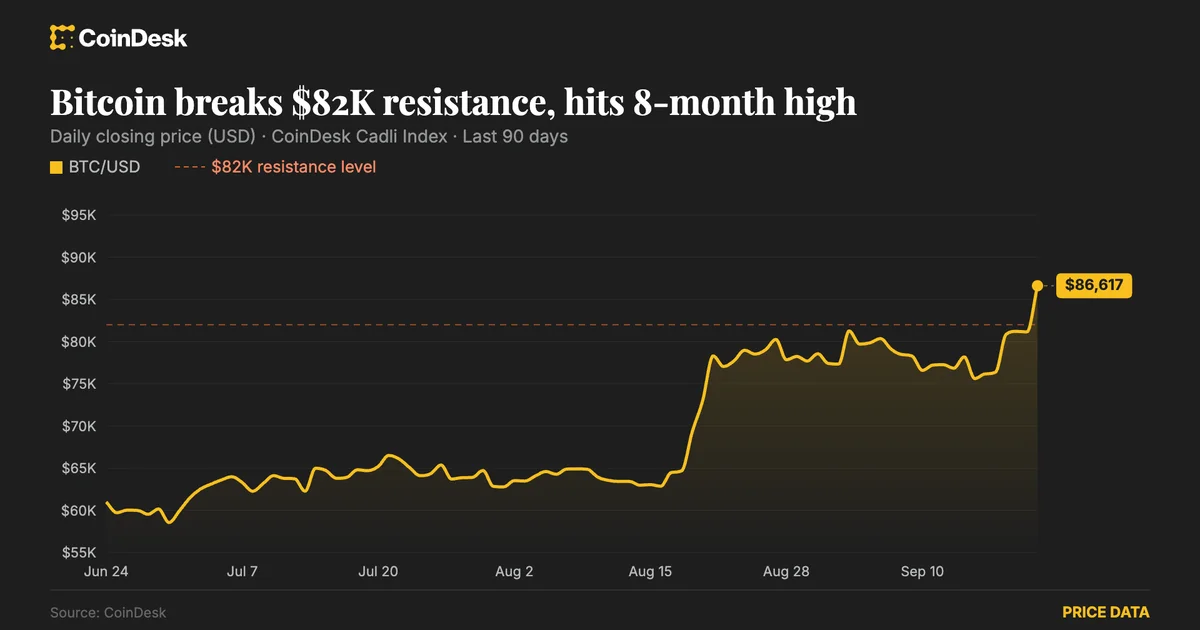
A $6,000 intraday range
Investing.com's historical data shows bitcoin opening September 21 at $81,175.5, reaching $87,363.2 and closing at $86,620.4. That was a 6.71 percent daily gain and the cryptocurrency's highest level in roughly eight months.
The acceleration had already begun before Monday. BTC closed around $76,440 on September 17 and $80,882 the following day before decisively moving through the $82,000 area on September 21.
The broader risk backdrop helped. Reuters reported a record Nasdaq close that Monday as US Treasury yields retreated and oil prices fell. Bitcoin gained more than 6 percent during the same session.
Breaking $82,000 forced bearish traders to buy
About $750 million of bearish crypto derivatives positions were liquidated as bitcoin broke through $82,000, according to CoinGlass data reported by CoinDesk. Closing a leveraged short requires a buy order, so a rising market can accelerate when enough bearish positions are forced out at once.
Schwab head of crypto research Jim Ferraioli specifically attributed part of the morning move to liquidations in short perpetual futures. The Wall Street Journal separately identified stronger ETF flows, regulatory developments and short covering among the factors supporting the rally.
That mechanism matters when interpreting the size of the move. Not every dollar of buying pressure represented a fresh investor deciding that bitcoin suddenly deserved a higher valuation. Some buyers were traders whose bearish positions could no longer remain open.
Spot ETF flows reversed sharply
US spot bitcoin ETFs had recorded about $746 million of combined outflows on the Tuesday and Wednesday before the rally, according to Farside data cited by CoinDesk. The direction then changed: approximately $160 million flowed in on Thursday and $433 million on Friday.
Those inflows provide a spot-demand component separate from the derivatives squeeze. The Wall Street Journal also pointed to renewed ETF demand when reporting bitcoin's move beyond $86,000.
Strategy added another visible source of buying. The company acquired 950 bitcoin for approximately $75.7 million during the previous week, bringing its holdings to 846,000 BTC.
Leverage is already rebuilding
The short squeeze did not leave derivatives markets empty. CoinDesk reported that roughly $2 billion in new leveraged exposure had entered bitcoin futures since the breakout, based on Coinalyze data. Open interest was increasing faster than bitcoin itself.
That makes the structure different from a rally powered entirely by unleveraged spot purchases. Forced short buying can amplify the move upward, while newly accumulated leverage can amplify a later reversal if long positions begin hitting liquidation thresholds.
Crypto-native positioning was also slower to turn bullish than price action, according to market data cited by CoinDesk. Bitcoin therefore moved into a new price range faster than parts of the market changed their positioning.
The October 2025 high is still far away
An eight-month high is not an all-time high. Bitcoin remains well below its October 2025 peak, and Investing.com's 52-week historical range still extends above $126,000.
September 21 nevertheless broke a meaningful summer barrier. The $82,000 area that had capped bitcoin since August gave way during a session with sharply higher trading activity. The relevant question after that break is less whether the rebound happened than how much demand remains once the mechanical contribution from short covering fades.
$86,000 did not become a permanent floor
The following sessions quickly demonstrated why a breakout price should not be mistaken for a stable valuation. Bitcoin closed near $86,205 on September 22, then around $84,394 on September 23. By September 26, historical market data placed it close to $84,000.
The move above $86,000 is therefore best treated as the September 21 rally milestone it was, rather than a price level bitcoin permanently secured. Spot buying, ETF flows, a supportive risk session and forced derivatives buying all contributed to the same move. Separating those ingredients will matter more than the round number if the market is going to hold its eight-month recovery.