 By Tsuky
The Equities Hub went live on September 25. Eligible holders can retain economic exposure to seven large U.S. companies while borrowing USDC against the tokenized positions instead of selling them.
The launch is deliberately narrow. The seven equity tokens are collateral only. They cannot themselves be borrowed, and users cannot borrow one stock token against another. USDC is the sole debt asset in the initial market.
Access is also constrained by the securities themselves. Coinbase Tokenized Stocks are offered under Regulation S to eligible non-U.S. persons in permitted jurisdictions. A permissionless blockchain address does not, by itself, make the securities legally available everywhere.
There is a real share behind each B20 token
The structure matters because these are not merely synthetic contracts referencing stock prices. Coinbase Onchain SPV Ltd. issues certificates backed by underlying shares held at Alpaca Securities in segregated custody accounts.
The issuer holds those shares under a trust structure for certificate holders. That gives the product economic exposure to actual equity rather than relying exclusively on a derivative that follows AAPL or NVDA.
The token is still not identical to holding an Apple share in an ordinary brokerage account. Issuance, custody, transfer eligibility, vesting and redemption sit inside a separate legal and operational stack. Aave's risk assessment notes that primary redemption is restricted to allowlisted participants and that secondary holders need to satisfy the issuer's vesting process before obtaining redemption rights.
Corporate actions also take an onchain route. Dividends are reinvested into additional underlying shares after applicable fees and withholding rather than paid as cash to the wallet. A multiplier then increases the economic value represented by each token. Stock splits are handled through the same mechanism.
Seven stocks feed one USDC credit market
Aave V4's Hub and Spoke architecture is doing real work here. The dedicated Equities Hub contains a USDC reserve, while the Mag-7 Spoke pools all seven collateral assets. A borrower can post a combination of supported stocks and manage the resulting USDC debt inside one position.
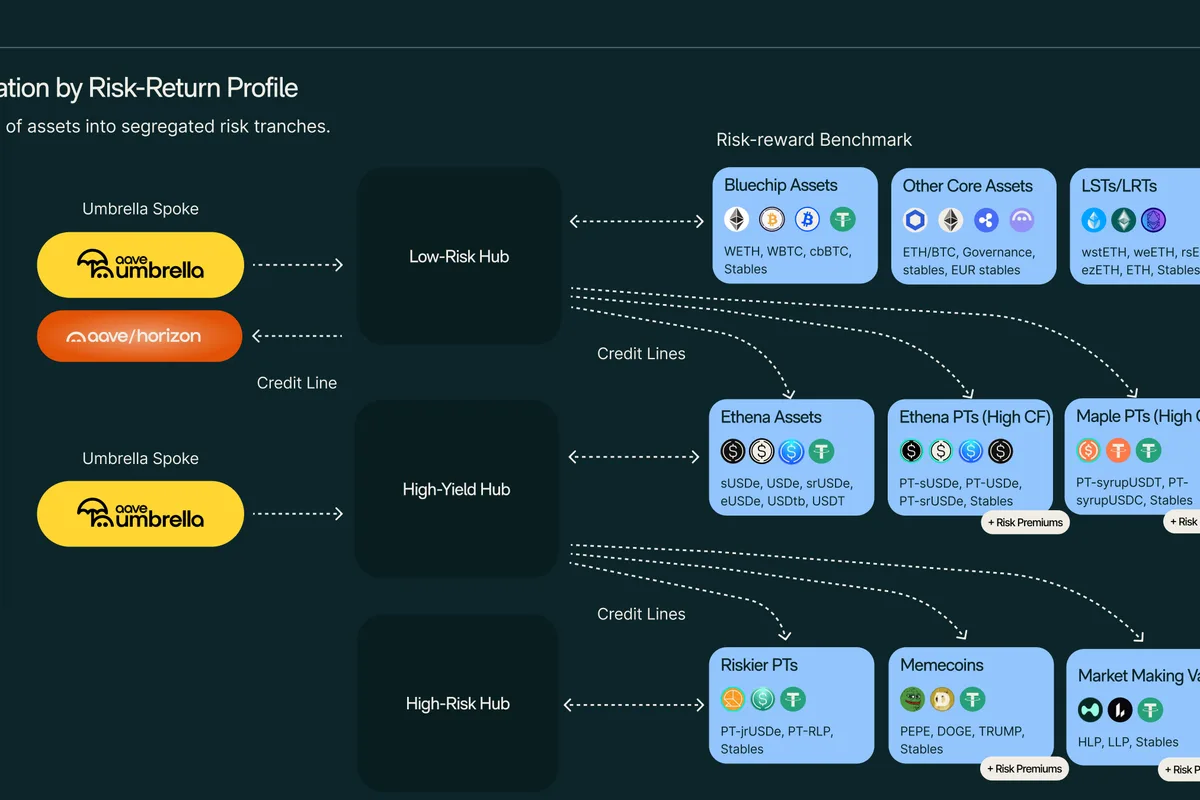
Pooling does not erase the individual risk settings. AAPLc starts with a 78% collateral factor, AMZNc 73%, GOOGLc 76%, METAc 65%, MSFTc 79%, NVDAc 70% and TSLAc 65%.
In Aave V4, that factor sets both borrowing capacity and the liquidation threshold. One hundred dollars of tokenized Microsoft therefore supports more debt than one hundred dollars of tokenized Tesla under the initial configuration.
The market is isolated from other Aave liquidity on Base. USDC suppliers entering the Equities Hub explicitly opt into lending against tokenized-stock collateral instead of silently extending the same exposure across unrelated Aave markets.
The $29 million figure is a cap, not deposits
The first deployment is small by design. LlamaRisk valued the combined collateral add caps at about $29.3 million when the parameters were prepared. That number describes maximum initial capacity, not money already deposited by users.
USDC has a $32 million add cap and a $21 million draw cap. The market can therefore accept up to $32 million of USDC under the initial settings while total debt drawn from the lending spoke is capped at $21 million.
Individual equity limits are 15,000 AAPLc, 10,500 AMZNc, 15,000 GOOGLc, 5,800 METAc, 5,200 MSFTc, 24,000 NVDAc and 14,000 TSLAc.
Those caps are not simply a ranking of which companies are more volatile. LlamaRisk also modeled Base liquidity, token issuance throughput, redemption paths and perpetual markets that a liquidator might use to hedge seized collateral. At launch, token-market depth is often the binding constraint.
Aave stays open on Saturday; the equity oracle does not
This is where an always-on lending protocol meets a market that still has a weekend.
Users can supply, borrow, repay and withdraw around the clock. Chainlink's tokenized-equity feeds, however, publish from Sunday at 20:00 ET through Friday at 20:00 ET. Over weekends and U.S. market holidays, the last published collateral price remains in place.
Aave says a position's health factor can therefore deteriorate only through accrued interest while the feed is frozen. The larger price risk arrives when pricing resumes and weekend news or an earnings gap is finally reflected in the collateral value.
The initial collateral factors were designed around exactly that problem. LlamaRisk modeled historical overnight and weekend declines and assumed that liquidation might not be completed until the next usable trading window.
That helps explain why Meta and Tesla start at 65% while Microsoft receives 79%. The buffers are designed around tail moves and off-hours liquidation conditions, not simply normal-session volatility.
Liquidating a tokenized stock is not just another DEX swap
Crypto-native collateral can often be sold into deep onchain liquidity immediately after a liquidation. The Coinbase equity tokens live in a much younger market whose depth bears little resemblance to the Nasdaq stocks underneath them.
LlamaRisk evaluated three practical liquidation routes: redeem through the issuer when the liquidator is eligible, sell the token on Base, or hedge the stock exposure with a perpetual until the underlying shares can be sold or redeemed.
A maximum 5.5% liquidation bonus is used across the seven names to cover those paths under the initial stress assumptions. The collateral caps also limit how much token inventory a liquidator could be forced to absorb in a worst-case position.
The scale mismatch is useful context. In the September 17 analysis, LlamaRisk estimated only roughly $300,000 to $1.1 million of Base liquidity could be sold per token within 2% price impact, depending on the name. That is tiny next to the public-market liquidity of the companies those certificates represent.
Putting Nvidia onchain does not magically import Nvidia's stock-market depth with it.
Tokenized stocks are becoming credit infrastructure
The first pitch for onchain equities was largely about self-custody, global distribution and trading beyond conventional exchange hours. Aave adds the DeFi feature that makes composability more than a slogan: the asset can now secure a loan while the holder keeps the equity exposure.
That is where tokenization starts producing a materially different financial object. A share locked inside a brokerage stack and a programmable representation of that share can carry similar economic exposure while behaving very differently inside other financial applications.
For now, Aave is treating the experiment cautiously: seven names, one debt asset, modest caps, asset-specific collateral factors and a dedicated risk silo. Additional Coinbase tokenized stocks and GHO borrowing may follow, but Aave says each expansion remains subject to governance and risk review.
The difficult part now is no longer proving that Apple or Nvidia can exist as tokens on Base. It is proving that an always-on credit market can safely lend against them while the underlying securities, their oracles and their deepest liquidity still operate on a very different clock.