
 By Tsuky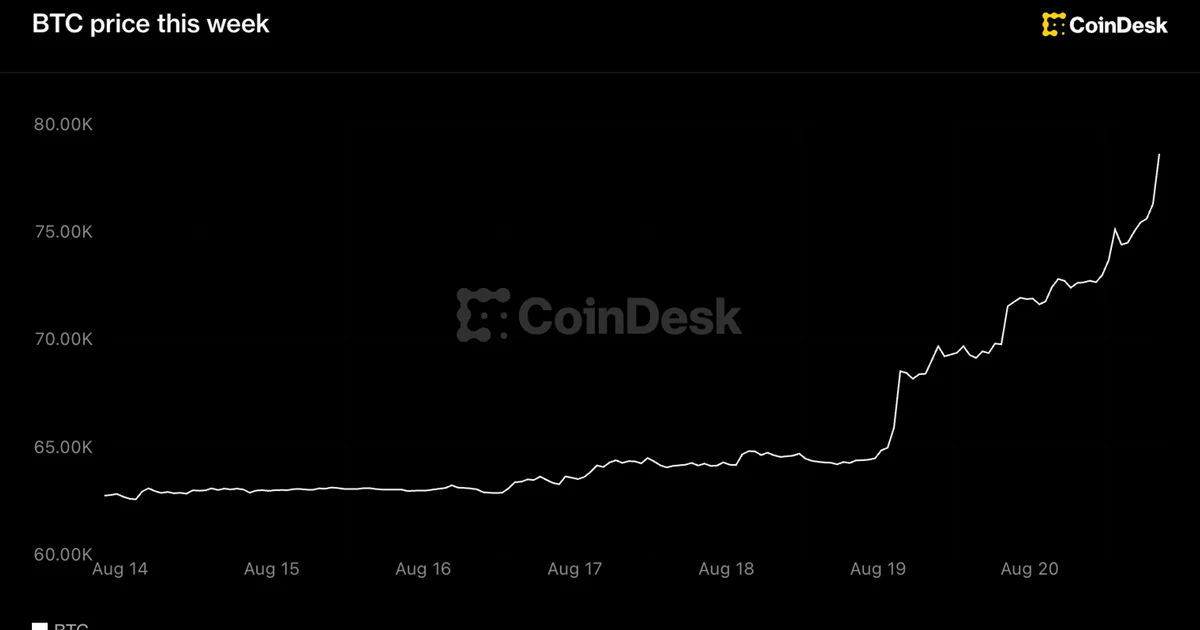
A September Treasury change moved markets in August
On August 19, the U.S. Treasury said it would at least double the maximum size of liquidity-support buybacks for nominal securities in the 10-to-30-year part of the curve. The cap moves from $2 billion to at least $4 billion per operation.
Those larger operations do not begin until September 9. Bitcoin therefore reacted to what the announcement implied for long-term yields and market liquidity rather than to Treasury cash directly entering crypto markets.

The announcement landed after a selloff had pushed the 30-year Treasury yield to its highest level since 2007. Reuters reported an initial drop in long yields and a broader lift for risk assets, although the relief in bonds did not last particularly long.
Bitcoin crossed $70,000 for the first time since June during the response. By Friday it had traded as high as $79,400, according to CoinDesk, with its gain since Monday approaching 24%.
Then the derivatives market did the violent part
BTC had spent roughly six weeks trapped between about $62,000 and $66,900. With volatility compressed, traders had built a dense collection of short positions around the upper edge of that range.
Once the ceiling broke, roughly $3 billion in short positions were liquidated over 24 hours, compared with $263.5 million in longs, according to CoinGlass figures cited by CoinDesk. More than $1 billion was cleared in a single hour.

Forced liquidations matter because closing a short requires buying back the asset. Enough forced buyers hitting limited resting supply can turn an ordinary breakout into a squeeze, which is what happened as bitcoin accelerated through the $60,000s and into the $70,000s.
President Donald Trump's renewed push for the CLARITY Act came later. CoinDesk notes that most of the first move had already happened before those comments, although the regulatory message provided another supportive catalyst afterward.
Spot demand was not absent
The rally was not composed entirely of forced derivatives buying. Farside Investors recorded positive net flows into U.S. spot bitcoin ETFs on every trading day from August 17 through August 21.
Those five sessions brought in $297.5 million, $189.3 million, $517.2 million, $606.3 million and $307.5 million respectively. Combined inflows were about $1.92 billion.
BlackRock's IBIT accounted for more than $1.3 billion of that five-day total.
Near $80,000 is still well below the old high
Bitcoin approached $80,000 again on Monday, August 24, after already reaching $79,400 on Friday. Indicative market data during Monday's session put the intraday high at roughly $79,981.
The move is large, but the reference point matters. Bitcoin's October 2025 record was above $126,000, leaving the current price far below its previous peak even after the sharpest weekly advance since March 2023.
Treasury's larger long-end buyback operations are scheduled to begin on September 9.