
 By Kilam
This is Arm's first AI-native Mali GPU
Arm announced Mali G2-Ultra NX on September 8 as part of its CSS for Mobile 2 platform.
The GPU introduces dedicated neural accelerators directly inside the shader cores.
Those accelerators share the GPU's coherent caches, memory system and control infrastructure instead of behaving like a completely separate NPU.
That lets neural rendering run alongside conventional graphics and compute workloads while reducing unnecessary movement of image data between different processors.
Neural Super Sampling is the obvious DLSS parallel
Arm calls its first reconstruction technology Neural Super Sampling, or NSS.
A game can render at a lower internal resolution and feed color, depth, motion vectors and temporal history into a neural network.
The model reconstructs a higher-resolution image and performs anti-aliasing as part of the process.
The core idea is familiar from modern PC graphics.
Rendering fewer native pixels can save far more work than simply making the shader hardware incrementally faster.
NFRU generates frames the game never rendered
Neural Frame Rate Upscaling takes the idea further.
NFRU examines two rendered frames alongside motion and depth information and generates an intermediate frame using a neural network.
Mali G2-Ultra NX includes hardware optical-flow acceleration to improve motion estimation.
The concept closely resembles frame-generation systems already available on PC GPUs.
Arm says the combination can support longer gaming sessions at up to 120 FPS under suitable workloads.
NSSD uses AI to clean up ray tracing
Neural Super Sampling and Denoising combines image reconstruction with neural denoising.
Ray-traced lighting naturally becomes noisy when only a limited number of rays can be traced per pixel.
A desktop GPU can throw more compute at that problem.
A smartphone cannot do so indefinitely without hitting thermal and power limits.
NSSD allows the GPU to work with sparser ray-tracing information and reconstruct a cleaner final image afterward.
Arm claims up to 4x performance efficiency in Neural Dawn
Arm and Sumo Digital built a technology demonstration called Neural Dawn around NFRU and NSSD.
Arm reports up to four times higher performance efficiency and as much as 70% less external-memory traffic compared with native rendering.
That is not a promise that every Mali game will suddenly run four times faster.
Neural Dawn is specifically engineered to exploit Arm's neural rendering stack.
The result is still significant because it illustrates why reconstruction can produce larger gains than another modest conventional GPU generation.
Without AI, gaming improves by up to 14%
Arm also publishes more conventional performance figures.
Mali G2-Ultra NX delivers up to 14% higher non-AI gaming performance than the previous generation.
Benchmark performance improves by as much as 24%.
Those numbers are much less dramatic than the Neural Dawn headline.
They also explain the strategy: brute-force mobile graphics has to operate within a thermal envelope measured in only a few watts.
The execution engine received its biggest redesign in seven generations
Neural acceleration is not the GPU's only architectural change.
Arm says the new execution engine represents the largest Mali instruction-set redesign in seven generations.
It provides up to twice as many registers per warp.
More local register capacity helps complex shaders keep working data closer to execution instead of repeatedly spilling it into slower memory.
That benefits conventional games as well as increasingly complex neural and ray-tracing pipelines.
Ray tracing reaches its third hardware generation
Mali G2-Ultra NX includes Arm's third-generation Ray Tracing Unit.
Arm reports up to 13% lower DRAM traffic in leading ray-tracing benchmarks.
The GPU also gains hardware Opacity Micromaps.
Those structures help rays deal more efficiently with partially transparent geometry such as foliage, fabrics and layered surfaces.
In one Arm demonstration, Opacity Micromaps increased frame rate by 30% and cut the ray-tracing workload by up to 70%.
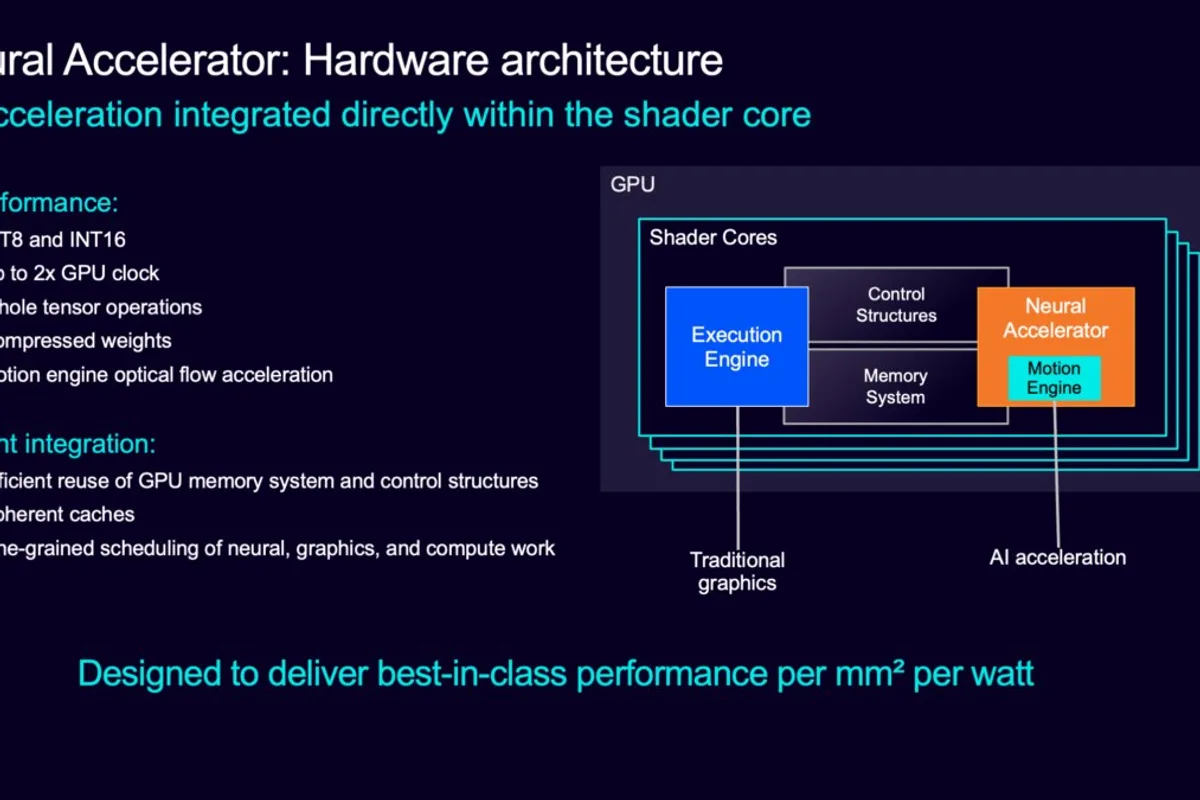
The neural accelerator sits directly beside the traditional execution engine
The internal architecture explains the AI-native label.
The new accelerator supports INT8 and INT16 processing, tensor-style operations and an optical-flow motion engine.
Arm says it can operate at up to twice the GPU clock depending on implementation.
A reference neural workload is designed around roughly a 1W power target.
Fine-grained scheduling lets neural, graphics and compute work share the same GPU resources without treating AI reconstruction as an external post-processing job.
Thermals remain the real mobile limit
A desktop graphics card can consume hundreds of watts and use large fans.
A phone has to fit its GPU, CPU, modem, display and battery inside a chassis only a few millimeters thick.
Simply adding more graphics hardware eventually creates heat that forces clock speeds back down.
Neural rendering attacks that constraint differently.
Instead of rendering twice as much information, the GPU attempts to infer part of the final result more efficiently.
That is the same transition PC graphics has already made.
Where Winds Meet is among the first games adopting the technology
Hardware support alone does not make neural graphics appear in existing games.
Engines need to provide motion, depth and temporal information and integrate Arm's software stack.
Where Winds Meet is among the first announced games bringing Arm Neural Technology into a production pipeline through Messiah Engine.
Tencent Games is working with Arm through MagicDawn and an NSSD demonstration for Arena Breakout: Infinite.
Unity China is integrating the technology into Tuanjie Engine.
Arm's Neural Graphics Development Kit provides NSS, NFRU, Vulkan machine-learning extensions and plug-ins including support for Unreal Engine workflows.
Not every neural feature will necessarily arrive at once
Mali G2-Ultra NX provides hardware designed to accelerate NSS, NFRU and NSSD.
That does not mean every first-generation phone using the GPU will expose all three techniques in commercial games immediately.
Neural Super Sampling is the most straightforward feature to deploy broadly.
Frame generation and more sophisticated ray-tracing reconstruction depend more heavily on game-engine and developer integration.
As on PC, the software catalog may matter almost as much as the silicon.
Xiaomi 18 Fold provides an early commercial showcase
Xiaomi's new 18 Fold is among the first announced devices using Mali G2-Ultra NX through Xiaomi's in-house XRing O3 platform.
That makes the foldable an early real-world test for Arm's neural-graphics strategy.
Independent testing will need to determine how much of the claimed efficiency survives real phone thermals, battery limits and production game engines.
The first silicon matters less than whether developers actually adopt the reconstruction stack across multiple SoCs and devices.
Mobile graphics is following exactly the path desktop GPUs already took
Phone GPUs traditionally improved through more execution units, higher clocks and more memory bandwidth.
Mali G2-Ultra NX still improves all of the conventional machinery.
It also introduces another option.
A pixel can be reconstructed instead of fully rendered. A frame can be generated between two real ones. Ray-tracing noise can be removed after the fact instead of eliminated by tracing many more rays.
That also means the FPS counter increasingly stops representing how many frames the game engine actually rendered.
PC players have already spent several GPU generations learning to live with that distinction.
Mali G2-Ultra NX is bringing it to the phone in your pocket.