
 By Tsuky
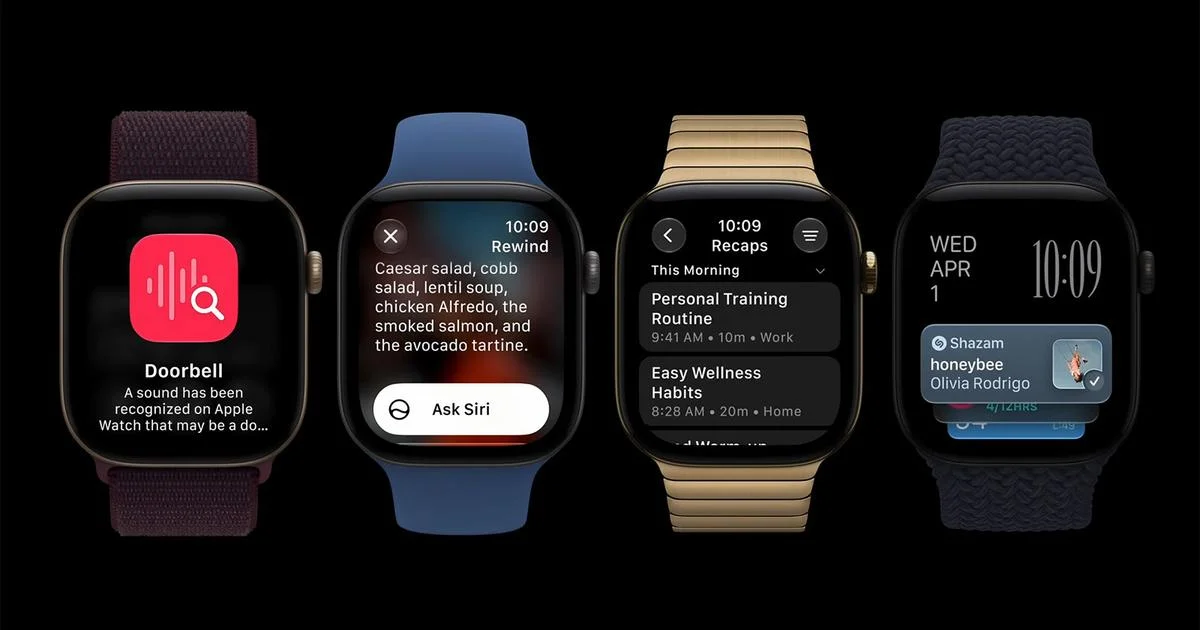
There is an obvious appeal to recovering a sentence you just missed. Someone gives you directions, lists several items or mentions an unfamiliar detail. Rather than interrupting them and asking for a repetition, you press the Digital Crown twice and read the previous 15 seconds on your Apple Watch.
That is the premise behind Live Rewind, one of two new Audio Intelligence features arriving in the first developer beta of watchOS 27.3. Siri Recap addresses a broader problem by creating short notes from conversations throughout selected parts of the day.
Apple announced both capabilities in September alongside the Apple Watch Series 12 and Ultra 4. Their appearance in the November beta marks the beginning of actual developer testing, rather than a general consumer release.
The distinction matters because these features involve an unusually sensitive category of information. They are designed to interpret conversations occurring around the wearer, including words spoken by people who are not interacting with the watch.
Live Rewind keeps a temporary window into recent speech
Live Rewind uses the Apple Watch microphones and a protected audio buffer within the S11 processor. Recent audio is continuously replaced in that buffer, allowing the device to retrieve the last 15 seconds when the user deliberately activates the feature.
A double press of the Digital Crown triggers speech recognition and displays a text snippet on the watch. Users can save that snippet to the Siri app or ask Siri a question about its contents.
The feature does not provide an ongoing written transcript of everything said nearby. Apple describes it as a temporary aid for recalling a missed phrase or instruction.
Unless saved, the text disappears permanently from the watch roughly 30 seconds after the display dims. The underlying audio is processed without creating an ordinary recording file.
Apple has added an audible notification that sounds when Live Rewind is activated, including when the watch is in silent mode. A full-screen animation and microphone indicator accompany the action.
These measures are intended to inform people nearby that the transcription feature has been triggered. They do not remove the underlying need for the watch to maintain a short temporary audio buffer before the user requests the transcript.
Accuracy also remains a practical limitation. Speech recognition may misunderstand a word, omit a phrase or struggle with noise and overlapping speakers. Apple explicitly warns that important information should be confirmed through other reliable means.
Siri Recap is built around summaries rather than recordings
Siri Recap takes a different approach. Once enabled, it can monitor conversations during selected periods and create high-level notes intended to help users remember their main topics.
The wearer can set time-based or location-based schedules through the Watch app on iPhone. A schedule might enable the feature during working hours while automatically excluding evenings or particular locations.
The feature can also be controlled manually through the Apple Watch Control Center. Activation is optional, rather than an unavoidable consequence of installing watchOS 27.3.
Generated notes appear in the Siri app, where users can review, edit, export or delete them. Summaries that are not saved are automatically removed after seven days.
Apple deliberately avoids producing a complete transcript. Siri Recap aims to identify the central subjects of a conversation and present them as short notes, with a title and key points.
It also avoids identifying speakers. Names mentioned during a conversation may still appear, but the system does not automatically assign statements to specific participants.
Certain sensitive information is filtered from summaries, including financial details, government-issued identifiers and authentication data. Apple acknowledges that automated filtering is imperfect and may fail to remove every sensitive detail.
This creates an accuracy trade-off. Excluding sensitive information may protect privacy, but the same information could be essential to a legitimate summary. A meeting about financial planning, for example, might lose important details if the system removes figures or identifiers.
Inside the Secure Exclave processing architecture
Apple's privacy strategy starts with dedicated hardware. The S11 chip includes a Secure Exclave, a protected processing environment intended to isolate audio information from the operating system, applications and other components.
Apple says raw audio processed in this environment cannot be accessed by the user, applications or Apple itself. The information is removed after processing.
For Live Rewind, speech recognition runs locally across the watch and its paired iPhone. The normal transcription process does not require transmitting raw audio to a remote server.
Siri Recap involves an additional stage. Audio detected by the watch is encrypted and transferred into the paired iPhone's secure processing environment. There it is transcribed and reduced to a condensed representation of the conversation.
This condensed text is sent securely to Apple's Private Cloud Compute infrastructure, where Apple Foundation Models produce and format the summary. The resulting notes are encrypted and returned to the user's devices.
Apple says Private Cloud Compute does not retain the information after the request has been processed. The company also states that its security architecture permits independent inspection of the protections used by the service.
Saved Siri Recap notes and Live Rewind snippets can synchronize through iCloud with end-to-end encryption when the account uses two-factor authentication and the devices have passcodes.
The important technical distinction is that Siri Recap is not entirely an on-device feature. The initial audio handling and transcription involve protected local environments, while the final summary generation uses cloud-based models.
Nor does the absence of traditional audio files mean the system processes no conversational content. Speech is still interpreted, condensed and transformed into information that may later be saved or exported.
Privacy protections do not automatically provide consent
Apple's engineering addresses several potential security risks, particularly unauthorized access to raw audio and stored notes. However, protecting the data does not resolve every question about whether it should be processed in the first place.
The wearer can choose to enable Siri Recap, but another participant in a conversation may be unaware that an AI system is extracting information from the exchange.
This becomes particularly relevant in workplaces, healthcare environments and situations involving confidential information. Even a brief summary may preserve sensitive details that the speaker did not expect to become part of a digital record.
Apple provides manual controls, scheduling and audible indicators, but these protections cannot independently establish that every person involved has understood and agreed to the use of the feature.
Legal requirements may also vary by jurisdiction and context. Avoiding the storage of raw audio does not automatically make every use of automated conversation summarization appropriate or lawful.
There is a separate concern about reliability. Encryption helps protect information against unauthorized access; it does not prevent an AI model from misunderstanding a conversation or creating an incomplete account of what happened.
Apple positions both features as memory aids, not authoritative records of conversations.
Compatibility rules leave many Apple Watch owners out
Siri Recap and Live Rewind require an Apple Watch Series 12 or Apple Watch Ultra 4. Older models do not meet the announced hardware requirements for these capabilities.
A compatible iPhone is also necessary. Apple specifies an Apple Intelligence-enabled iPhone 16 or later, excluding the iPhone 16e, with Siri AI and the required software.
English is the initial supported language. Apple intends to add more languages, but has not published a complete rollout schedule.
Children under 13 cannot use the new conversation features. For users under 18 with Child Accounts, a parent or guardian must authorize access.
Regional availability introduces another major restriction. Apple states that Siri Recap and Live Rewind will not initially be available in the European Union. Users in France, Germany and other EU member states should therefore not assume that installing the developer beta will unlock the features.
The company has not announced a confirmed date for their European debut. Siri AI also remains subject to regional restrictions on supported Apple devices.
Apple is distributing the first developer beta of watchOS 27.3 as of November 3, 2026. The consumer release has not yet been issued, and a precise public launch date has not been confirmed in the documentation reviewed.
Apple also warns that Audio Intelligence functions involving server-side models may be subject to daily usage limits. The company identifies Siri Recap and Live Rewind among the affected capabilities without specifying a universal quota applicable to all users.
A different role for wearable AI
The new capabilities expand the role of Apple Watch beyond notifications, fitness tracking and short interactions. They turn conversations into information the wearer can revisit, either immediately through Live Rewind or later through Siri Recap.
The two approaches have different limitations. A 15-second transcript can miss essential context, while a generated summary may remove details or misrepresent the original discussion.
Early independent beta coverage indicates that Live Rewind can provide useful results under favorable conditions, although transcription mistakes remain possible. Siri Recap has shown promise for identifying broad meeting topics, but its filtering of sensitive details can also reduce the usefulness of the resulting notes.
Broader assessment will require more testing across everyday environments, different speaking styles and complicated conversations. Apple has not demonstrated that the tools can provide comprehensive or error-free records.
For now, both features remain experimental, available only with compatible recent hardware, supported software and the initial language and regional conditions. Their absence from the European Union is one of the most significant limits of the November launch.