
 By Camille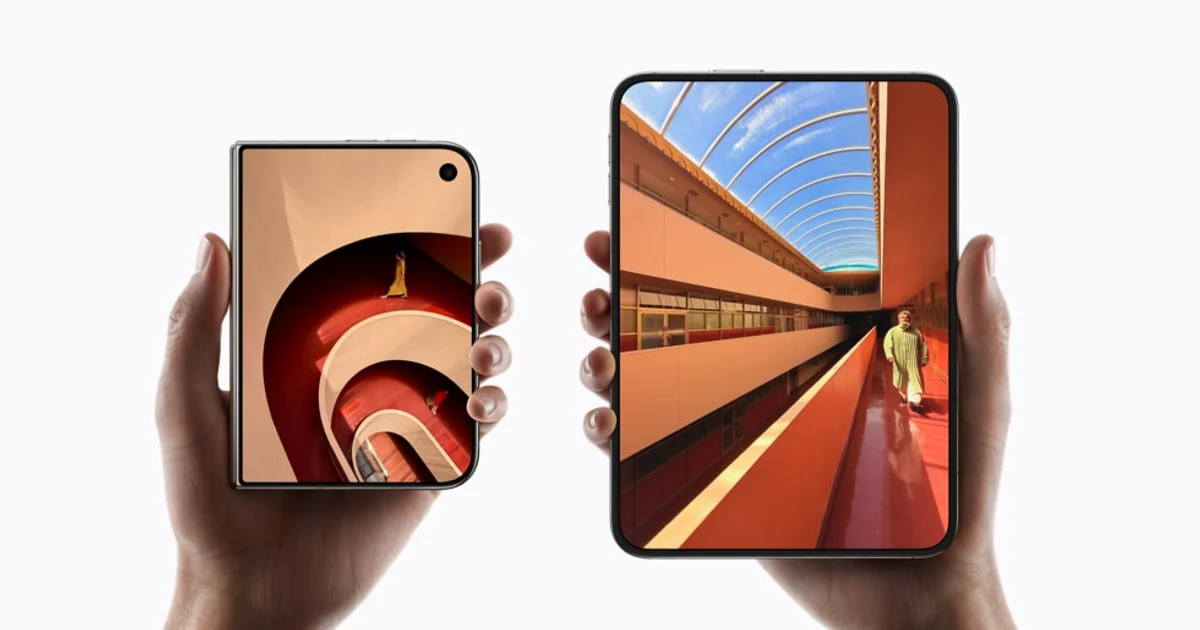
The foldable iPhone is real. Apple introduced iPhone Duo on September 9, with pre-orders scheduled for October 16 and availability beginning October 23 across more than 70 countries and regions.
Pricing starts at $1,999 for 256GB. Storage options continue through 512GB, 1TB and 2TB, placing the Duo well beyond ordinary flagship-phone territory before any accessories are added.
It is compact outside and tablet-like inside
When closed, iPhone Duo uses a 5.4-inch Super Retina XDR outer display. Apple says that screen provides 90% of the display area of iPhone 18 Pro while keeping the device roughly passport-sized.
Opening it reveals a 7.6-inch inner display that Apple says is 50% larger than the screen on iPhone 18 Pro Max. Both displays use the same aspect ratio, allowing apps and content to scale proportionally as the device changes state.
ProMotion, Always On and up to 3,000 nits of outdoor peak brightness are supported on both displays. The folding panel also uses a nano-texture finish intended to reduce reflections and make the crease less visually intrusive.

iOS 27 is doing more than stretching apps
Apple has reworked parts of iOS specifically for the Duo rather than treating the large screen as an oversized version of a normal iPhone. Controls move around the interface as the device changes orientation, while the Home Screen and system UI make use of the additional width.
Split View also brings two apps side by side to iPhone for the first time. Users can open two windows of the same app, swap between app pairs and keep Siri AI visible alongside other content.
Netflix, Zoom and Slack are among the third-party apps already adapted to the format. Apple Pencil USB-C support is due later in the year.
A20 Pro gets a foldable-specific cooling system
The Duo uses the same A20 Pro family as iPhone 18 Pro, built on a 2-nanometer process. Apple pairs it with a custom vapor chamber and a new chip package designed around the foldable chassis.
Apple claims up to 35% better sustained performance than iPhone 17 Pro. It also says the six-core CPU is up to 20% faster than A19 Pro and the seven-core GPU up to 40% faster and more efficient. Those remain manufacturer performance claims until independent testing is available.
Two physical battery cells sit on opposite sides of the fold. Apple rates the phone for up to 31 hours of video playback using the inner display, 44 hours using the outer display and around 24 hours of mixed use across both screens.
More than 100 components sit inside the hinge
The chassis uses grade 5 titanium, while the hinge itself contains more than 100 components. Internal ribs and a titanium plate beneath the folding display reinforce the structure.
Apple still claims an IP68 water- and dust-resistance rating, notable for a product with a mechanical hinge and flexible display.
One familiar iPhone feature does disappear. Face ID has been replaced by Touch ID in the side button, with Apple Watch unlocking available as another option.
The cameras are capable, but this is not an 18 Pro Max
The rear system combines a 48MP Fusion Main camera and a 48MP Fusion Ultra Wide. The main camera also provides an optical-quality 2x crop, but there is no dedicated telephoto camera comparable to Apple's Pro models.
The fold itself creates several useful camera modes. Subjects can preview themselves on the outer display, the rear cameras can be used for higher-quality selfies and the phone can sit partially folded for hands-free video or FaceTime calls.
A FaceTime camera also sits beneath the inner display and remains hidden when not in use.
Apple is late to a market that is still tiny
Samsung shipped the first Galaxy Fold in 2019, while Huawei, Google, Honor, Oppo and Xiaomi have all spent years refining their own foldable approaches. Apple has arrived after multiple generations of competing hardware.
The category itself, however, remains small. Foldables still account for less than 5% of global smartphone sales, according to market data cited by Reuters.
That gives Apple an unusual opportunity. It does not need the Duo to replace conventional iPhones immediately; it needs to make a still-niche form factor feel ordinary enough that more buyers consider it.
At $1,999, ordinary may be the harder part.