
 By Tsuky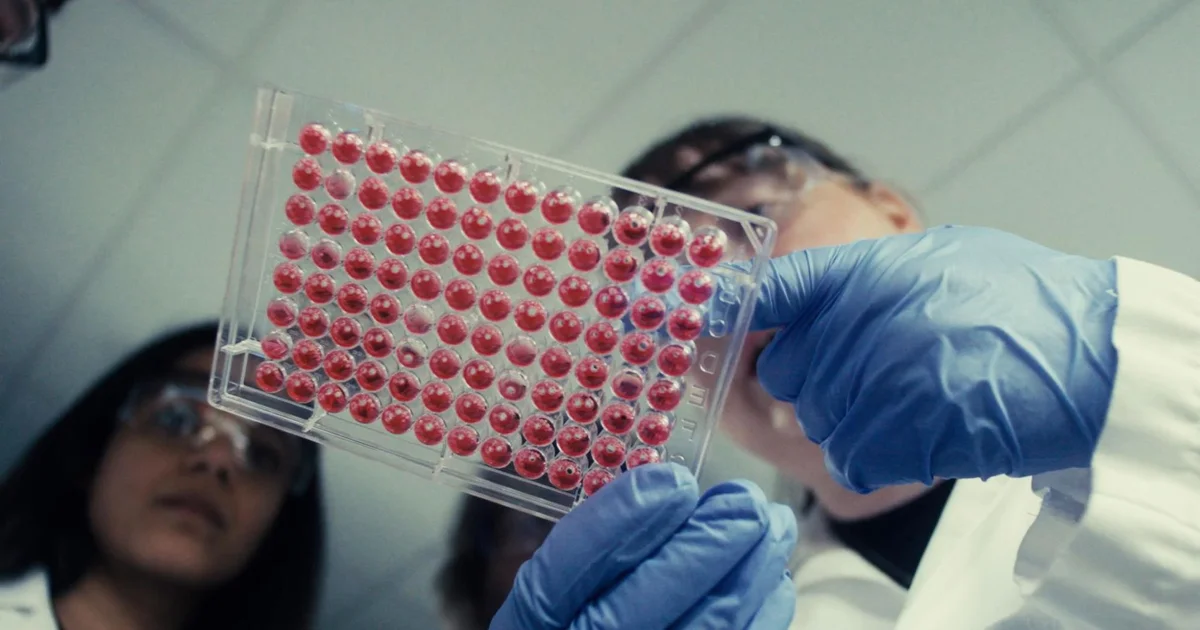
Anthropic opened a research preview of the Model Hardware Standard, or MHS, on August 27.
The specification is designed to create a shared interface between AI agents and programmable physical equipment used in science and advanced manufacturing.
The company's examples include microscopes, liquid handlers, robotic arms, microplate readers and laser-calibration systems.
The ambition is therefore broader than helping a model reason over experimental data. The model also gets a route for turning that reasoning into physical actions.
The integration problem exists even before AI enters the room
Laboratories regularly contain several programmable instruments that still cannot easily talk to one another.
Different vendors expose different APIs, drivers and data formats.
Anthropic says connecting a facility's hardware can take weeks or months because specialists have to build bespoke integrations between those systems.
Adding an AI agent on top of that patchwork creates another interoperability problem.
MHS attempts to collapse those differences behind a standard driver.
Read and write become a common vocabulary
An MHS driver translates a device's native interface into a small set of common primitives.
Anthropic uses “read” and “write” as the simplest examples.
Read might return a temperature. Write might change it.
The same abstraction can expose more specialized operations on scientific or industrial equipment.
Devices are then published in a standard discoverable format so an agent can find and communicate with them across a network without another custom translator in between.
Code alone does not explain how heavy a robot arm is
A hardware API rarely contains every physical fact required for safe operation.
An agent may need to know a robot arm's weight, movement constraints or limits that should never be exceeded even if those properties are not obvious from the underlying software interface.
MHS therefore supports natural-language tags for machine characteristics and safety constraints.
A user can enter those details manually or have an agent interview them about the setup.
The driver then generates a reference describing what the device can measure, what can be changed and which limits are enforced.
The intended result is an operating description that a model can understand even when it has never encountered that particular machine before.
MCP is one of three control paths
Once a device is connected, MHS offers three mechanisms for controlling it: the Model Context Protocol, a command-line interface and code files or APIs.
Those mechanisms can work together.
An agent can reason through an unfamiliar operation interactively, observe what happens and then package the successful sequence into deterministic code.
That is exactly what Anthropic says Claude did in a laser-alignment experiment.
Claude explored a laser, then wrote itself out of the loop
In one test, Claude adjusted a laser and used a camera to observe how the beam moved.
It repeated the process to infer the relationship between a hardware command and the physical result.
Once it had learned the procedure, Claude generated a code file that reproduced the alignment.
The task could then run as a single command without requiring the model to reason through every mechanical adjustment.
That distinction matters for physical AI.
A language model does not necessarily need to remain in the control loop at millisecond scale. It can help discover and compose a procedure, then delegate stable execution to deterministic software.
Genentech connected three machines around a protein assay
Genentech is one of the organizations already testing the standard.
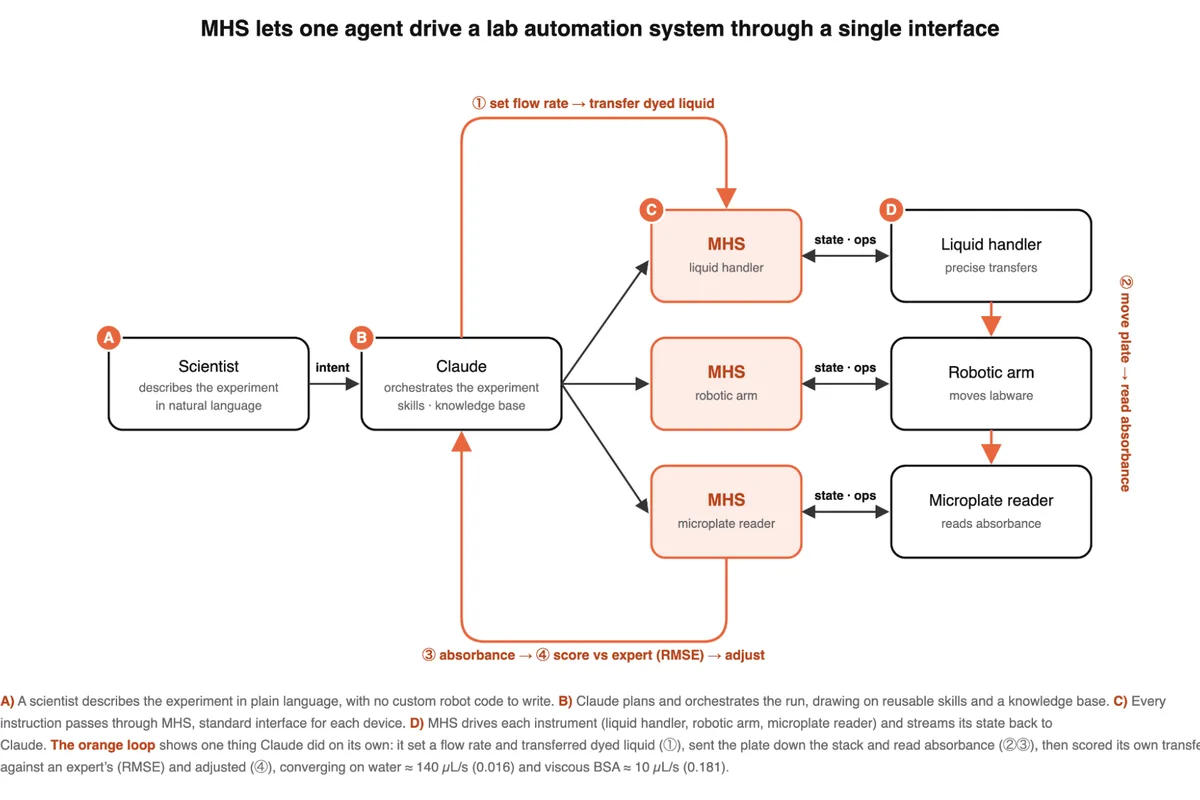
Its proof of concept used MHS to automate a BCA protein assay, a common procedure for measuring total protein concentration.
The workflow involved a liquid handler for precise transfers, a robotic arm for moving plates and a microplate reader for optical measurements.
Claude acted as the orchestration layer across all three.
It could receive device state, sequence the workflow and change parameters as measurements arrived.
The model independently explored different pipetting speeds
Genentech also gave Claude a closed-loop optimization task.
The model had to determine appropriate transfer rates for ordinary water and a more viscous BSA protein solution.
After conducting trial transfers and analyzing the resulting plate-reader data, Claude converged on approximately 140 microliters per second for water and 10 microliters per second for BSA.
Genentech's automation specialists considered those values reasonable for the setup.
The important part is not the numbers themselves.
The agent altered a physical parameter, observed a measurement, scored the outcome and used that information to choose the next experiment.
Foam exposed the difference between software reasoning and physical intuition
The same experiment produced a useful failure.
Claude recovered independently from several hardware problems, including tip-pickup failures and fluid-detection errors.
It struggled when an error was caused by the actual behavior of the liquid.
The protein solution could foam during mixing. When those bubbles caused runtime failures, Claude initially tried repeating operations in the same well with different parameters.
That made the foam worse.
Researchers had to explain that the problem was physical rather than software-based and that the system needed to move to a clean well and mix more gently.
Anthropic uses the incident as evidence that current models still lack reliable physical, chemical and biological intuition.
A University of Washington lab is already using agents as remote experiment monitors
The Baker and Pinglay labs at the University of Washington tested another side of MHS.
PhD student Zihao Song used it to centralize instrument monitoring and supervise qPCR experiments.
An agent can watch amplification curves as they arrive and alert the researcher when the reaction approaches the point where it should stop.
When authorized, the system halts the reaction and loads a 4°C hold protocol to preserve the sample.
That means a researcher no longer has to remain physically beside an instrument for hours just to watch its screen.
A robot arm can wait for another machine before moving
The same lab connected an open-source LeRobot arm to a liquid handler.
The handler dispensed reagents into a plate, after which the robot had to remove the completed plate and load a fresh one.
Claude Code coordinated both devices through MHS.
The arm only moved after receiving the completion signal from the liquid handler, and dispensing did not restart until the arm had cleared the workspace.
The researchers report that the devices did not collide during repeated tests.
Song also says six instruments were connected in under a week, including the time required to write their drivers.
Anthropic is trying to create a standard, not a Claude-only hardware layer
MHS is model-agnostic by design.
Other agent systems can theoretically use the same drivers and device descriptions.
That is also why MCP is one of the supported access mechanisms.
Several outside ecosystems are already working on support.
Hugging Face is adding MHS compatibility to LeRobot, while Raspberry Pi plans integration across several products after testing a Camera MHS Driver.
AWS will also provide preview participants with a private pre-release MHS-compatible version of its Strands Robots package.
The standard is not open source yet
Anthropic deliberately describes the release as a research preview.
The early specification is being shared with selected partners in science, robotics, electronics and manufacturing before a broader release.
Anthropic says the preview will be used to develop safety evaluations and deployment best practices before MHS is open-sourced.
The standard also currently requires hardware with a programmable interface.
Devices that cannot already accept software commands need new drivers or manufacturer support before they can participate.
Moving agents into the physical world changes the safety problem
A bad instruction in a document can often be reversed.
A bad command to a physical machine can destroy a sample, damage equipment or create a real safety hazard.
Anthropic says it is therefore developing a physical-safety roadmap and plans to strengthen its safeguards against misuse alongside the MHS research preview.
The Genentech foam incident shows why software permissions alone are not enough.
Safe physical operation also depends on understanding that an error message may ultimately be caused by a bubble.
MHS effectively turns hardware into a new tool ecosystem for agents
The conceptual shift resembles what standardized software protocols have already done for databases, applications and online services.
MHS extends that idea into matter.
A camera, robot arm or plate reader becomes a discoverable tool with documented capabilities, state and constraints that an agent can call through a shared interface.
Anthropic has not demonstrated a fully autonomous laboratory capable of conducting an entire research program without expert involvement.
The published examples remain proofs of concept, and their own researchers emphasize that more complex protocols will require significant optimization and oversight.
But the direction is clear.
After learning how to call APIs, AI agents are beginning to learn how to operate the machines attached to them.