
 By Camille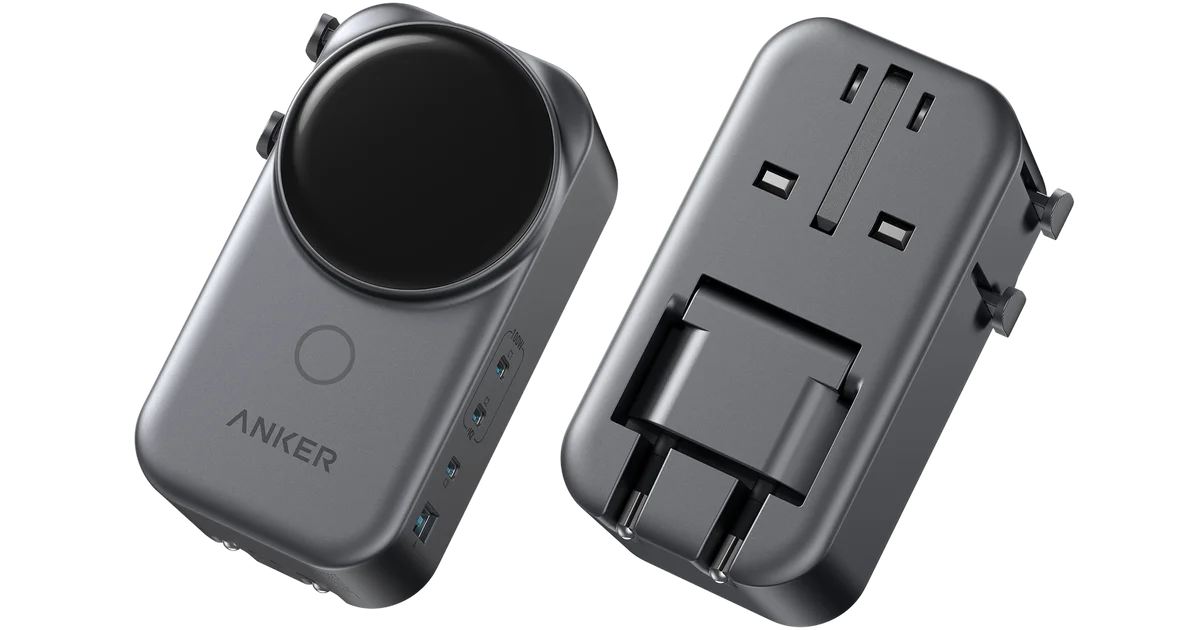
Three plug standards live inside the same body
The charger has built-in US, UK and EU plug configurations rather than relying on a bag of removable adapters. A mechanical interlock allows only one plug system to extend at a time.
Anker says the design covers use across more than 200 countries and regions. The device itself accepts an input range of 100 to 275V at 50 or 60Hz.
At 3.74 x 1.98 x 1.59 inches and 0.58 pounds, it is not exceptionally tiny. Its argument is consolidation rather than disappearing in a pocket.
Two USB-C ports can reach 100W
There are three USB-C connections and one USB-A port. Either of the first two USB-C ports can provide up to 100W when used individually, enough for many modern laptops.
Total output is still capped at 100W. Connect several devices and PowerIQ 4.0 distributes that budget between them rather than somehow producing 100W from every socket.
USB-C3 is limited to 15W and USB-A reaches 12W.
The display is more useful abroad than it looks
A 1.3-inch LCD on the front can show live charging output, temperature and detected voltage. Anker says local voltage is identified in around one second.
That gives travellers a quick way to confirm whether they are looking at a roughly 120V or 230V supply before connecting equipment, while also showing how the 100W charging budget is being allocated.
The first two USB-C ports can additionally identify certain compatible Apple device models. The lower-power ports do not offer the same device-recognition feature.
A universal plug adapter is not a universal voltage converter
The distinction matters. The charger's own USB electronics support a broad input range, but the travel-adapter function does not automatically make every mains-powered appliance safe on every electrical system.
A device designed only for 120V still needs appropriate voltage conversion before being connected to a 230V supply. Changing the physical shape of the plug does not change the voltage coming from the wall.
USB-C laptops, phones and tablets avoid much of that complication because the Anker charger handles the AC-to-DC conversion itself.
ActiveShield watches what 100W does inside a small enclosure
Anker's ActiveShield 4.0 system performs more than ten million temperature checks per day, according to the company, and the charger includes 320V overvoltage protection.
Its own documentation also notes that prolonged operation at full output can trigger overtemperature protection, at which point charging power is automatically reduced.
That is a reasonable limitation for a compact travel unit pushing laptop-class power rather than a surprising footnote.
The appeal is what can stay at home
The Universal Charger weighs 262 grams. A conventional compact USB-C brick can obviously be lighter.
The comparison changes once a separate international adapter and several chargers are added to the bag. One unit can potentially handle a laptop, phone, tablet and small accessory from the same wall outlet.
US pricing is $79.99, with ordering opening around the IFA launch and shipments scheduled during September depending on availability.
It is still a travel adapter. The clever part is that it may be the only charger that needs to come along with it.