
 By Adri
The refresh interval is exactly 1ms
At 1000Hz, a new refresh starts every 1ms. At 500Hz the interval is 2ms, at 360Hz roughly 2.78ms, and at 240Hz around 4.17ms.
That reduces the time between display refreshes and can improve motion continuity when enough unique rendered frames are available.
It does not make total system latency 1ms. Input devices, the game engine, CPU work, GPU rendering, frame queues, synchronization, scanout and pixel transitions all remain in the path.
1000 refreshes need frames to display
The panel's extreme refresh rate makes the most sense in games that can reach extremely high frame rates. Competitive titles at reduced graphics settings are the obvious target.
A system rendering 200fps does not suddenly create 1000 unique game states simply because the display refreshes at 1000Hz. Adaptive synchronization can align display timing with fluctuating output, but it cannot invent frames generated by the game.
That also explains the 1080p resolution. Moving to 4K would quadruple the pixel count per rendered frame before asking the GPU to approach four-digit frame rates.
The quoted 0.3ms response time needs context
Acer specifies a 0.3ms response time with VRB Pro. Visual Response Boost Pro is intended to improve perceived motion clarity and reduce ghosting.
That figure should not be treated as identical to the one-millisecond refresh interval or assumed to describe every gray-to-gray transition under every setting. Independent measurements of pixel response, overshoot, persistence and end-to-end display latency will matter much more.
At these refresh rates, slow pixel behavior could erase some of the benefit promised by an otherwise impressive timing specification.
IPS remains part of the high-refresh race
The XB253Q U1 uses IPS rather than OLED. Acer rates native brightness at 400 nits, with a 450-nit peak in HDR400 mode. Color coverage is listed at 99% sRGB and 90% DCI-P3 with 8-bit + FRC output.
Those specifications make the product's priority fairly obvious. This is not being pitched as a reference HDR monitor. Temporal performance comes first.
The enormous 100,000,000:1 contrast figure in Acer's specification table uses its ACM dynamic contrast metric and should not be confused with native static IPS contrast.
DisplayPort 2.1 and HDMI 2.1 handle the inputs
The monitor carries one DisplayPort 2.1 connection and two HDMI 2.1 inputs. There are no built-in speakers, while the stand provides 150mm height adjustment, tilt, swivel and pivot. VESA 100 × 100mm mounting is supported.
Acer also uses Circular Polarizer technology. The company claims the approach changes the polarization characteristics of emitted light to more closely resemble natural ambient light, helping reduce glare and visual fatigue.
That feature will need independent evaluation just as much as the extreme refresh rate.
The 1000Hz barrier is already becoming a category
Acer is not alone. LG has already brought a native 1000Hz gaming monitor to market, while Samsung has demonstrated a gaming display reaching 1100Hz.
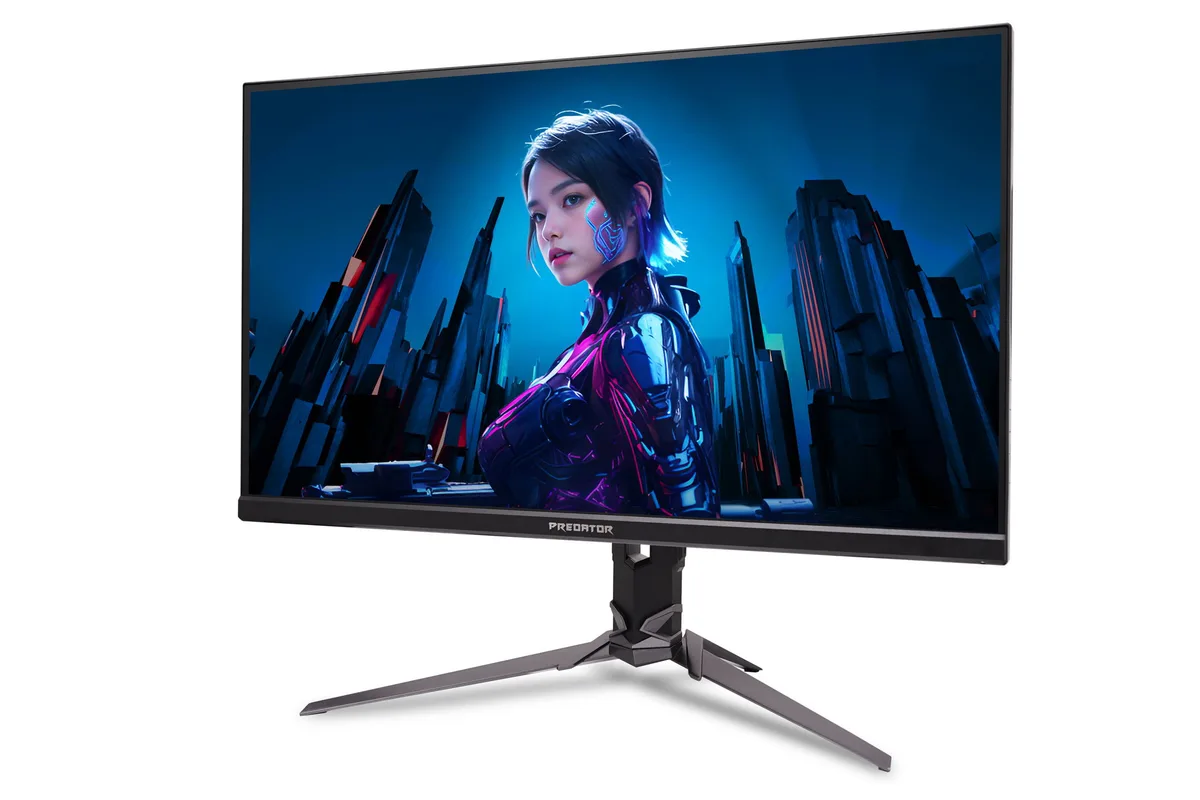
The Predator XB253Q U1 is scheduled for the first quarter of 2027 at €1,099 in Europe and $1,099.99 in North America.
The specification race has therefore moved beyond simply proving that 1000Hz is possible. The useful part begins when measured motion clarity and system latency show what another 500Hz actually buys.