
 By Adri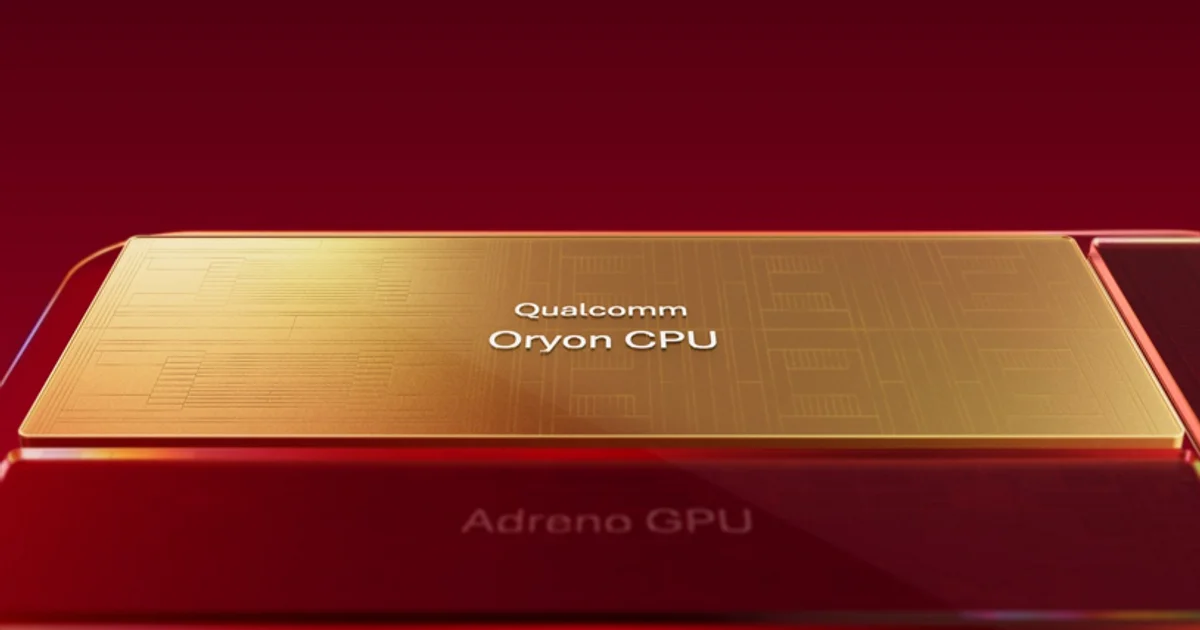
The smartphone has officially entered 5GHz territory.
At least on the specification sheet.
Qualcomm announced on August 25 that its next-generation Oryon CPU for premium Snapdragon platforms can reach a peak clock of 5GHz.
The company describes it as the first mobile CPU to cross that threshold.
Two Prime Cores reach the headline frequency
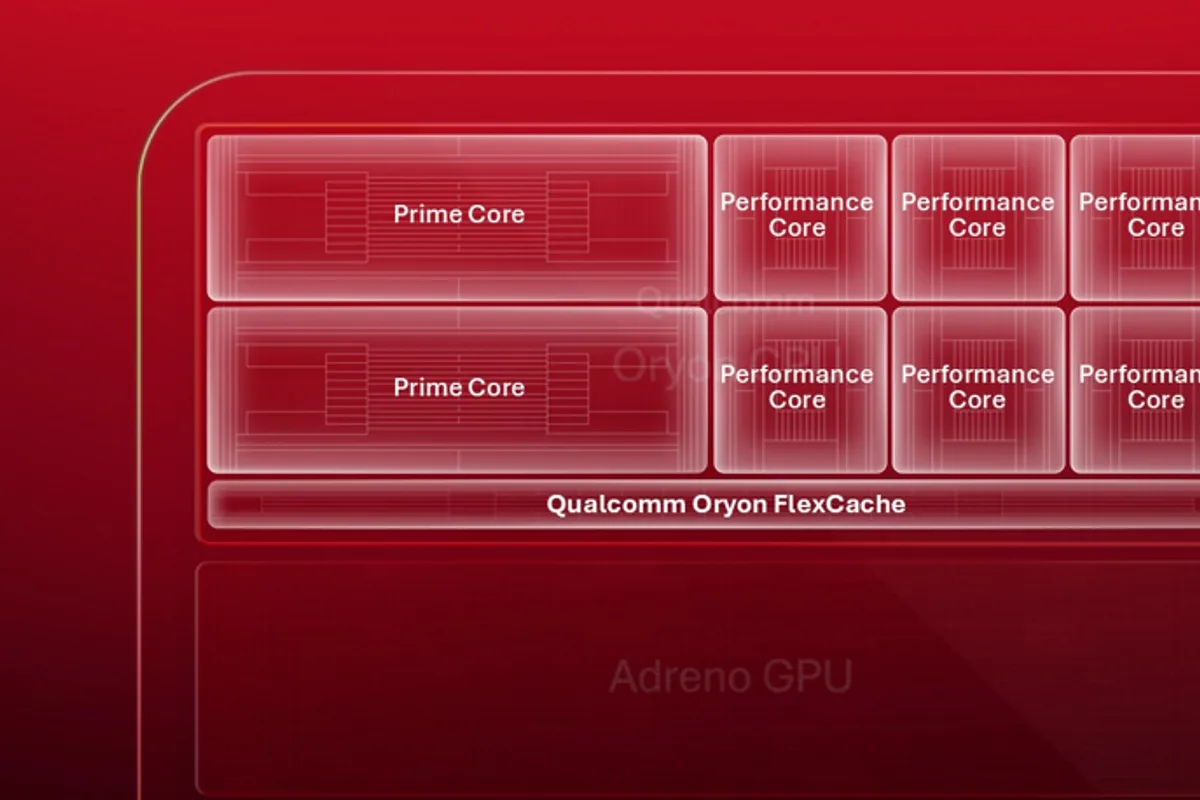
Qualcomm's published diagram shows an eight-core configuration.
Two Prime Cores can operate at up to 5GHz, accompanied by six Performance Cores.
The company has not yet disclosed the frequencies of those six cores, exact cache capacities or the power required to sustain the maximum boost.
Five gigahertz should therefore be understood as a peak capability of selected cores rather than the permanent operating speed of the entire processor.
Peak clock says nothing about how long a phone can hold it
Mobile silicon always lives inside a thermal limit.
A CPU can reach an aggressive clock for a short burst and then reduce frequency once heat and power exceed what the chassis can dissipate.
Qualcomm has not yet released independent handset benchmarks, sustained-frequency traces or detailed power measurements for the 5GHz state.
The frequency alone therefore cannot establish the real performance advantage.
Qualcomm is deliberately talking about IPC too
The company says the high clock is paired with strong instructions per clock.
That distinction matters because two processors running at the same frequency can accomplish very different amounts of work.
Microarchitecture, execution width, prediction, memory latency and cache behaviour all determine how useful each clock cycle becomes.
Qualcomm says Oryon is fully custom from its microarchitecture through implementation choices and the wider CPU subsystem, allowing the company to tune those layers together.
Oryon has become a brand rather than an experiment
Qualcomm first introduced the custom architecture through Snapdragon X PCs before moving Oryon into flagship smartphones.
That gave the company much more control over CPU differentiation than relying entirely on standard cores.
Five gigahertz now provides an extremely simple public symbol of that internal design effort.
The engineering challenge is keeping the advantage inside a battery-powered device that fits in a pocket.
FlexCache may be the more consequential change
The next mobile Oryon introduces Qualcomm Oryon FlexCache.
Different classes of CPU core can access the same shared cache pool, with capacity allocated dynamically according to workload demand.
A Prime Core handling a large task can therefore draw on more of that pool instead of being restricted to a rigid private allocation.
Qualcomm's goal is to keep larger working sets resident close to the CPU rather than spilling into system memory.
Every trip to DRAM costs time and energy
A cache miss forces the CPU to search farther down the memory hierarchy.
That increases latency and generally consumes more energy.
Inside a phone, avoiding unnecessary memory traffic can therefore improve both responsiveness and efficiency.
Qualcomm explicitly connects FlexCache to current industry memory constraints, arguing that performance can remain stronger when cores need to reach system memory less often.
Gaming could benefit more from consistency than peak speed
Qualcomm names gaming as one of the main use cases.
Modern games maintain substantial simulation state while background threads handle physics, world logic and other tasks.
If those workloads migrate between cores or outgrow local caches, memory stalls can contribute to frame-time instability.
A larger shared working set should theoretically reduce some of those transitions.
Qualcomm claims better frame-rate stability and less stutter, although those benefits still require independent testing on final hardware.
Multitasking relies on the same principle
Phone workloads constantly move between cores.
Apps return to the foreground, background services wake and user interactions trigger short bursts of work.
A shared cache can reduce the chance that every migration begins with a cold working set.
That may improve the perceived speed of switching back into applications without simply increasing peak clock.
Video editing is almost an ideal demonstration
Decode, effects, preview and export stages can move frames through several CPU tasks.
Repeatedly sending the same data back to system memory creates unnecessary traffic.
Qualcomm specifically argues that FlexCache can keep more of those handoffs inside the cache hierarchy.
This is the kind of workload where architecture may matter more than the frequency written on the box.
The CPU is also being positioned as an AI orchestrator
Qualcomm's 2026 messaging is notably different from the older assumption that AI performance can be summarised by NPU TOPS.
Agentic systems do more than run a neural model once.
They plan tasks, call tools, execute conventional code, access data and hand work between CPU cores and dedicated accelerators.
Qualcomm is therefore positioning the CPU as an orchestration layer for local agents rather than merely the component running Android around the NPU.
FlexCache responds to AI workloads that cannot live inside one accelerator
Qualcomm describes an agent handing steps between different cores while keeping a shared dataset resident.
Reducing cold-cache transitions may make that process more efficient.
It is a subtle but important shift in mobile silicon marketing.
The industry has spent several years selling enormous NPU numbers. Qualcomm is now arguing that CPU cache architecture can also determine whether an AI experience feels responsive.
Five gigahertz is still an excellent marketing weapon
Dynamic heterogeneous cache allocation takes time to explain.
5GHz does not.
The number also creates an immediate symbolic comparison with frequencies historically associated with desktop processors.
That comparison should not be taken literally.
Desktop CPUs can consume dramatically more power and operate beneath substantial cooling systems. A mobile SoC shares a far smaller energy and thermal envelope with its GPU, modem, NPU, ISP and other components.
The achievement is not turning a phone into a desktop CPU. It is reaching this frequency within a radically different power environment.
The previous generation was already close
Snapdragon 8 Elite Gen 5 reached 4.74GHz, following 4.47GHz on the previous flagship generation.
Moving from 4.74 to 5GHz is therefore roughly a 5.5% increase in peak frequency.
Any much larger performance improvement will need to come from IPC, cache behaviour, memory and other architectural changes.
That makes FlexCache more relevant than the round number initially suggests.
Competitors do not need to match the clock
Apple, MediaTek, Samsung and Chinese silicon designers can deliver competitive CPU performance at lower frequencies if their architectures perform more work per cycle or sustain performance more efficiently.
A wider core operating more slowly can still beat a narrower design at a higher clock.
Short benchmark victories therefore need to be followed by sustained performance, temperature and power testing.
On a phone, the twentieth benchmark run can be more informative than the first.
Much of the Snapdragon platform remains undisclosed
Qualcomm deliberately started its preview with the CPU.
The next Adreno GPU, NPU and full commercial name of the platform have not yet been detailed.
Snapdragon Summit 2026 runs from September 22 to 24 in Hawaii.
That event should reveal considerably more about the complete SoC and the first devices expected to use it.
The record now has to survive inside an actual phone
That will be the meaningful test.
A development platform can demonstrate architectural potential. A thin flagship has to share space with a battery, cameras, modem, cooling hardware and the heat of the user's hand.
If Oryon preserves much of its advantage in that environment, 5GHz will become more than a headline.
If maximum frequency lasts only briefly before aggressive throttling, stronger IPC and FlexCache may prove to be the changes that actually define this generation.
The irony is that Qualcomm's easiest number to market may ultimately be the least interesting part of the design.