
 By Kilam
Digital Foundry used unusually strong language after examining Clair Obscur: Expedition 33 on consoles: an exceptional achievement.
That conclusion matters not because Sandfall somehow escaped the normal limitations of Unreal Engine 5, but because the studio uses familiar technology to produce images that rarely look familiar.
Lumen and Nanite do a great deal, but they do not choose the scenery
Expedition 33 relies on several modern Unreal Engine 5 features. Lumen handles much of the indirect lighting and reflection work, Nanite supports dense geometry, and Virtual Shadow Maps help preserve detailed shadowing across complex environments.
Digital Foundry particularly praised the overall consistency achieved on PS5, PS5 Pro and Xbox Series X.
None of those systems can decide that Flying Waters should resemble an underwater landscape suspended outside water, or that a mountain should be framed behind impossible architecture.
The art team turns the renderer into a game.
Lighting gives each region a different material identity
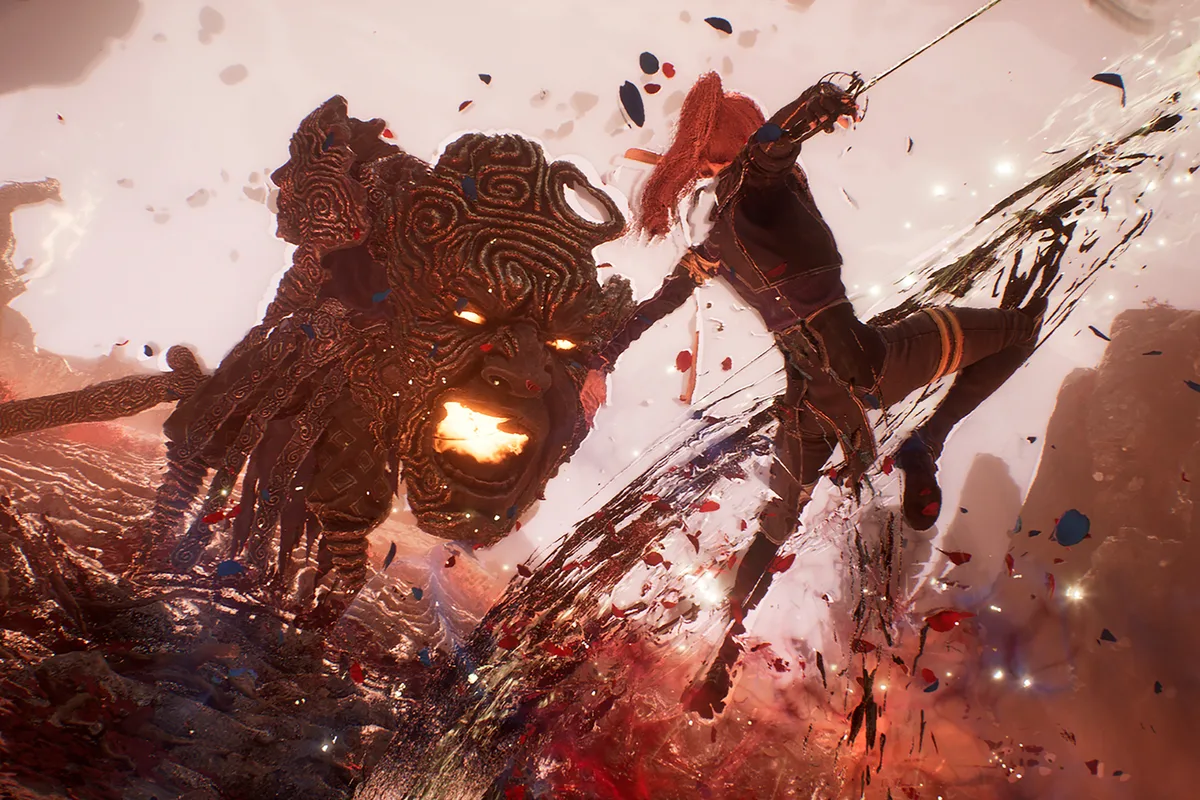
One of Lumen's most visible strengths here is the way indirect light influences entire spaces rather than remaining tied to obvious direct sources.
Expedition 33 benefits because its regions constantly change palette, material and environmental density.
A glowing forest, mineral landscape or color-saturated surreal zone does not simply resemble the same level under another sky.
PS5 and Series X offer the strongest console balance
Digital Foundry identifies quality modes targeting 30fps and performance modes targeting 60fps on the higher-end consoles.
Gameplay is generally strong on PS5 and Xbox Series X, with expected image-quality compromises in the faster modes.
Sixty frames per second also has mechanical value here. Expedition 33 asks for timing-based parries, dodges and jumps, so faster response directly complements the combat design.
Series S makes the rendering cost much easier to see
Digital Foundry considers Series S the most compromised console version.
The complete experience survives, but shadow quality, detail and other visual elements are reduced more noticeably than on PS5 or Series X.
The result remains coherent, yet the gap clearly demonstrates that modern UE5 rendering features have a real hardware cost.
Epic settings on PC are a luxury, not a requirement
Launch analysis showed that Expedition 33 can become demanding at high resolution and Epic settings.
Treating the maximum preset as the only acceptable image is a poor way to evaluate PC scalability, though.
Much of the game's visual identity survives at reduced settings while performance can improve substantially.
The game still inherits some familiar UE5 behavior, including occasional pop-in and pacing or smoothness issues in certain situations.
Thirty-frame-per-second cutscenes remain a small interruption
Cinematics continue to use a 30fps presentation even when gameplay runs at a higher rate.
Digital Foundry notes imperfect frame pacing in places, particularly during slower camera movement.
It never becomes severe enough to undermine the cinematography, but it is one of the few areas where the sophistication of the image does not completely conceal a technical limitation.
Sandfall kept working after release
Technical support did not stop in April 2025.
The major Thank You Update in December added a new environment, more battles and Photo Mode while also bringing performance and quality-of-life improvements across platforms, including handheld PCs.
Official updates continued into 2026, with Sandfall still adding fixes and smaller content additions around the first anniversary.
Photo Mode feels almost inevitable
Sandfall added Photo Mode with the Thank You Update and later published a development blog explaining some of the work behind it.
That feature is not a technical benchmark. It is simply unusually well suited to a game whose environments depend as much on composition, contrast and silhouette as raw detail.
Expedition 33 frequently looks spectacular without placing the player at an obvious designated screenshot spot.
The strongest technical compliment is how quickly Unreal Engine 5 disappears
Many contemporary games use Lumen, Nanite and related technologies.
Expedition 33 is never interesting merely because those features are present.
The achievement lies in the priorities: technology used to light unusual shapes, geometry spent on spaces that already possess a visual identity, and performance solid enough for those decisions to survive actual play.
Digital Foundry's description of an exceptional achievement is deserved. The engine provides the toolset; Sandfall looks like it knew what it wanted to build before opening the box.