
 By Kilam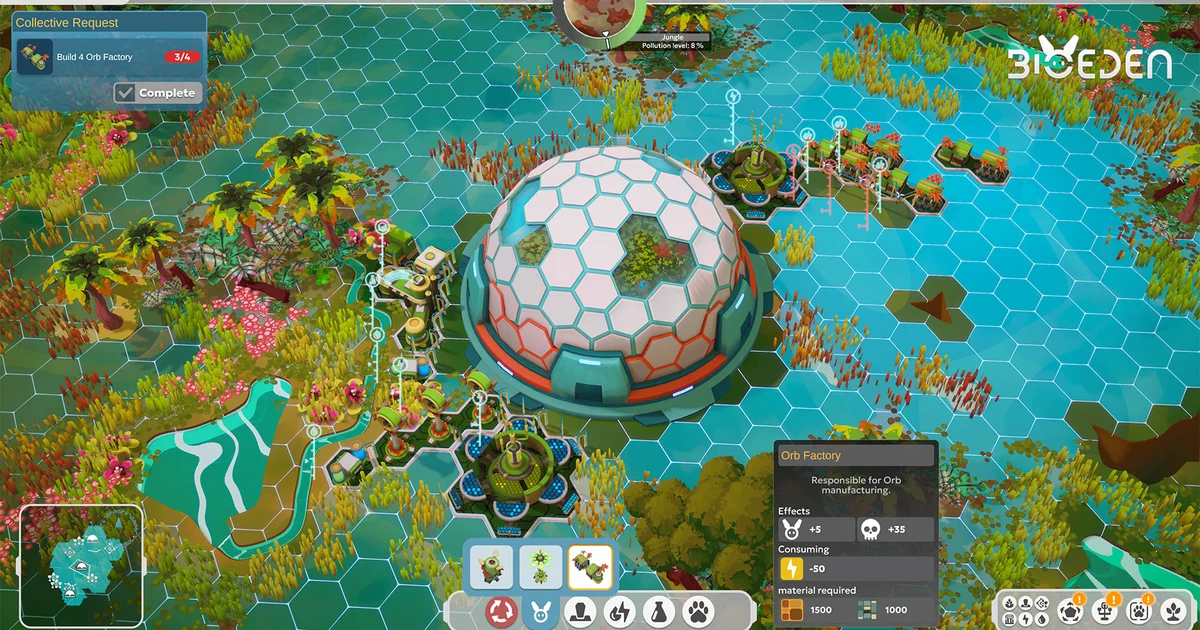
Built to keep a busy map readable
BioEden has to display a surprising amount of information at once. Power and water networks cross the terrain while resource counters, pollution, habitat limits, animal requirements and Collective objectives compete for attention. The visual solution is deliberately simple: broad shapes, strong contrast and highly saturated colours.
It works. Domes stand apart from the landscape immediately, utility structures remain recognisable at a distance and restored land looks materially different from damaged terrain. The graphics are doing interface work as much as aesthetic work.
Gamesurf identifies the trade-off clearly. The pastel presentation is pleasant, but biome design lacks variety and structures are not particularly imaginative. Once the visual language has been learned, the game rarely introduces a radically different one.
Its best visual effect is the planet itself
The most effective piece of presentation is not a conventional graphics feature. It is environmental state change. Polluted ground becomes healthier, colour returns and revived species eventually populate spaces that previously looked dead.
That transformation provides feedback without another window or meter. It also explains why several reviewers remained attached to the restoration loop after its strategic challenge had faded. The map itself records progress.
Quality-of-life is where the rough edges appear
Gameliner reports several small omissions that matter over a full campaign. Screen shake from environmental events reportedly cannot be disabled, while animal releases cannot be automated once a population reaches a desired threshold. Both turn repeated actions into more manual work than necessary.
Feedback can also disappear at odd moments. Fully restoring a region may happen with little dedicated audiovisual acknowledgement, despite restoration being the central objective of the game. A busy management interface needs to communicate routine information, but it also needs to tell the player when something important is finished.
Habitat construction has its own usability wrinkles. Animal temperature requirements and the needs of required plants can conflict, encouraging arrangements that satisfy the simulation while looking less like the natural space the game is trying to represent.
Reasonable PC requirements
The official Steam listing specifies a Ryzen 3 1200 or Core i5-4690K, 8 GB of RAM and a 4 GB Radeon RX 460 or GeForce GTX 960 for a stated target of 1080p at 30 fps using the Low preset. An SSD is required.
Recommended specifications rise to 16 GB of RAM, a Ryzen 5 1600X or Core i7-7700K and a 6 GB RX 580 or GTX 1080, with the listed target becoming 1080p at 60 fps on Ultra. Storage is only 3 GB.
Those specifications fit a game whose technical priorities are readability and stylisation rather than rendering spectacle. BioEden does not look expensive, but it usually looks clear. The more obvious shortcomings are in interaction design and feedback rather than raw graphics technology.