
 By Kilam
Astro Bot has no graphics mode selector, no prominent ray-tracing menu and no desire to make its tiny white robot look like an actor filmed on a soundstage.
Digital Foundry nevertheless describes its technical execution as virtually flawless.
Base PS5 targets 60fps and almost never lets go
Digital Foundry measures a dynamic-resolution window of roughly 1440p to 2160p.
Frame rate targets 60fps and remains remarkably stable. John Linneman finds only extremely rare hitches, including moments when unusually large quantities of physics objects and effects occupy the screen simultaneously.
That priority makes perfect sense for a platformer. Jumping, air correction and obstacle response all benefit directly from consistency.
Dynamic resolution disappears behind a very clean image
Digital Foundry also praises the anti-aliasing and the lack of obvious ghosting associated with weaker temporal solutions.
The final picture remains stable enough that changes in internal resolution are difficult to notice during normal play.
Team Asobi therefore sacrifices temporary pixels before it sacrifices responsiveness.
Physics are everywhere because everything should look touchable
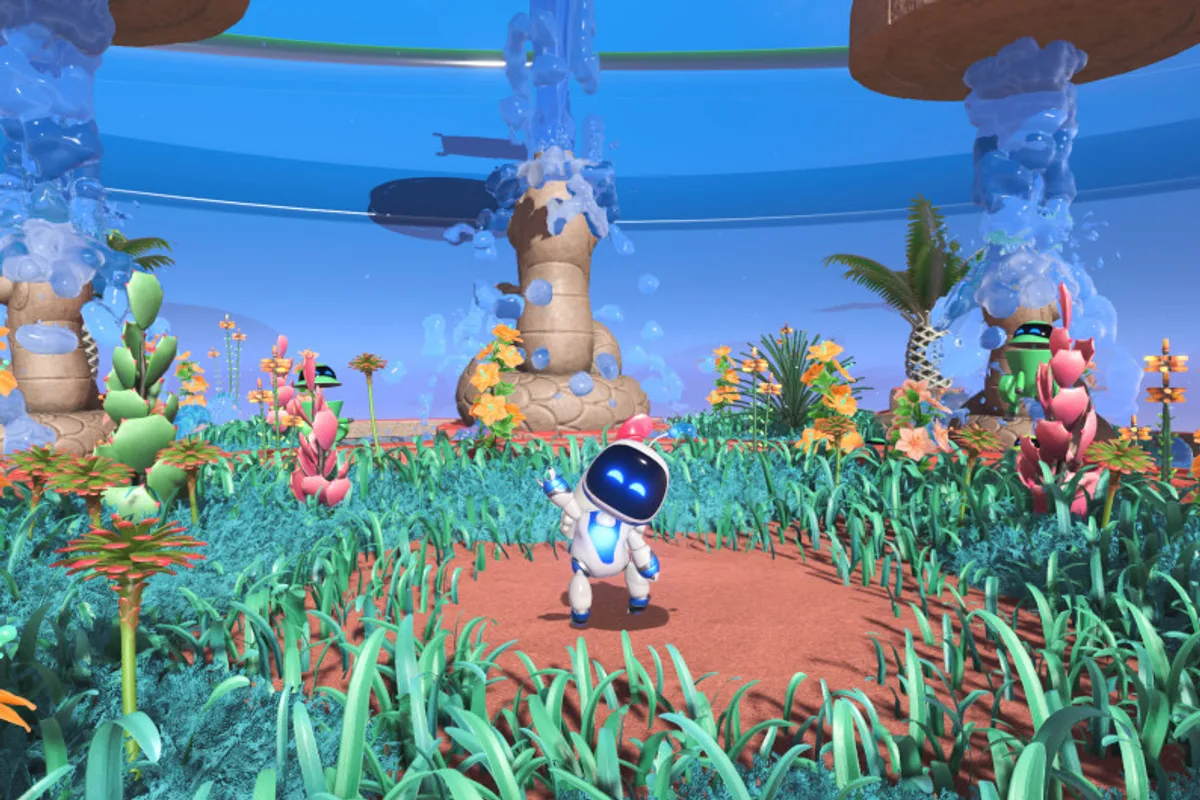
Astro Bot fills stages with small physical objects: leaves, debris, destructible pieces and materials that move when Astro pushes through them.
Digital Foundry emphasizes the sheer quantity of interaction.
The object count is not the important part. The result is that the environment constantly responds to contact.
Fluids become actual game systems
Water, slime and other liquids react to forces applied to them.
Those simulations are not restricted to decoration. Team Asobi turns them into mechanics and puzzles.
The sponge ability, for example, allows Astro to absorb large quantities of water, change size and then release that water back into the environment.
It neatly summarizes the studio's technical philosophy: an effect becomes more valuable when the player can manipulate it.
Simple materials benefit enormously from good lighting
Digital Foundry also highlights the quality of the physically based materials, from robot metal to softer and shinier surfaces.
The game does not need a photorealistic pipeline to make those objects attractive. Simple shapes actually make material differences easier to read.
The SSD protects momentum
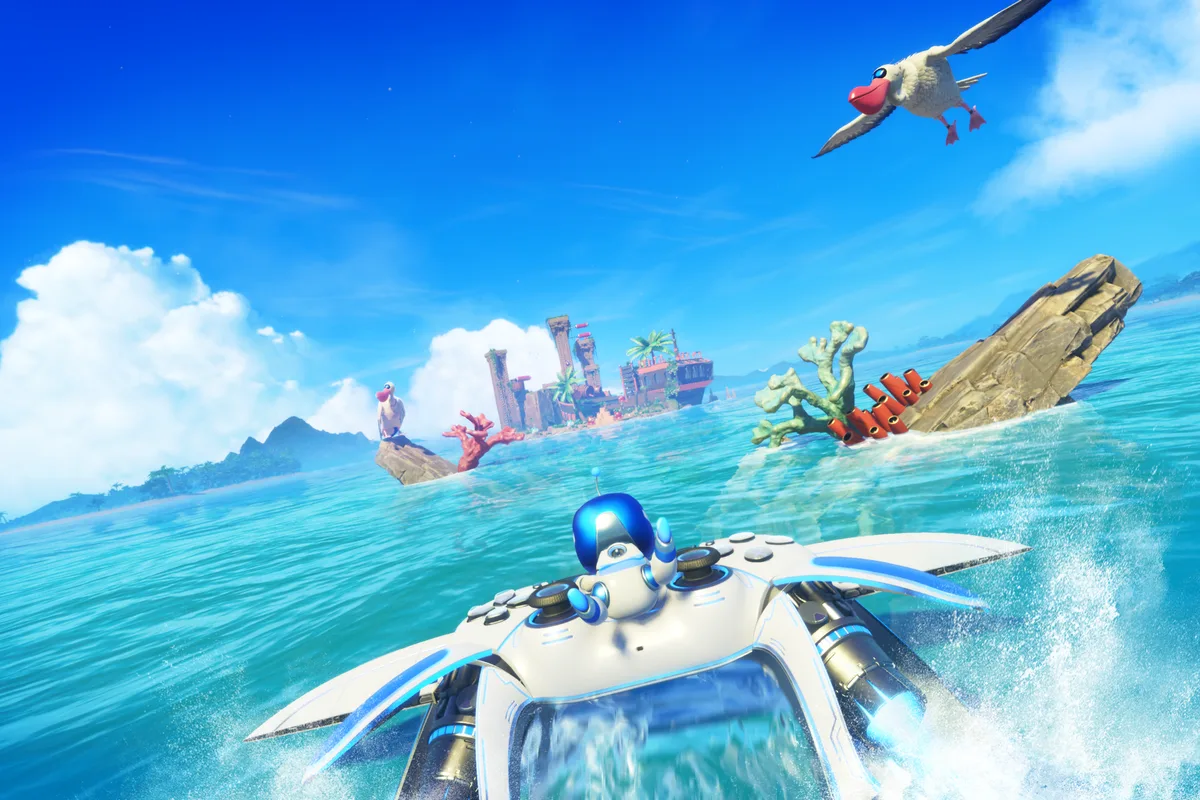
Loading is extremely fast and travel between stages is frequently disguised through animated transitions.
That is less spectacular than a particle explosion but perfectly suited to the game's structure: one idea ends and another arrives before energy can disappear.
DualSense becomes almost a second rendering channel
Haptics distinguish surfaces under Astro's feet. Adaptive triggers react to certain abilities and the controller speaker constantly supplements what happens on screen.
Tactile information occasionally becomes precise enough to help communicate a mechanic.
The cost is familiar: Push Square notes that constantly exercising every DualSense feature is demanding on battery life.
PS5 Pro improves exactly what remained available to improve
In February 2025, Team Asobi released PS5 Pro support with a straightforward promise: maintain the game's best resolution more consistently while preserving 60fps.
The choice makes sense. Base PS5 did not need a new performance mode; it was already operating at virtually locked 60fps.
Additional power could therefore be spent on image quality.
Astro Bot offers a different definition of next-generation technology
Astro Bot does not impress through a long list of graphics acronyms.
It spends hardware resources on reactions: objects that move, liquids that flow, surfaces the controller can communicate and transitions fast enough to disappear.
That is why Digital Foundry's verdict is so flattering. The technology is not sitting next to the game.
It is the reason almost everything seems to invite the player to touch it.