
 By Adri
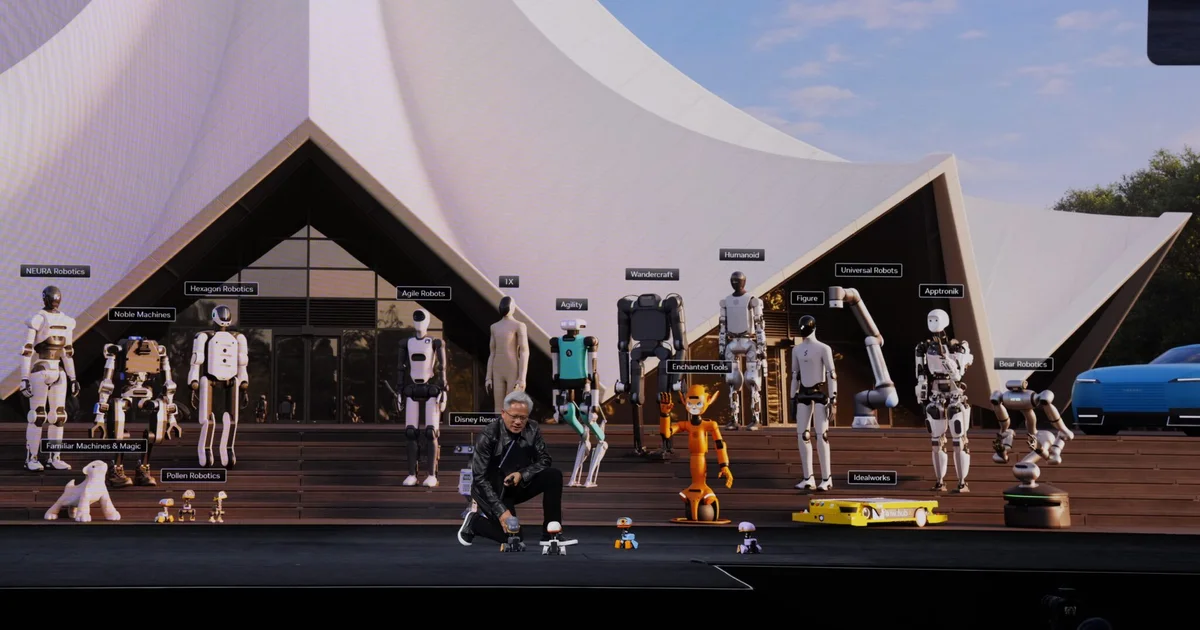
The presentation was designed to attract attention.
Jensen Huang stood in front of a stage populated by humanoid robots, industrial machines and four small duck-like robots.
The miniature machines performed simple movements while the audience watched.
For NVIDIA, the display was about more than entertaining spectators.
It illustrated the company's ambition to move artificial intelligence beyond generating digital information and toward systems capable of acting in physical environments.
GTC Berlin took place from October 20 through October 22, 2026.
On October 23, NVIDIA published a video titled Robots Steal the Show at GTC Berlin, highlighting humanoids, miniature bipeds and robotic manipulators demonstrated during the conference.
The video was a recap of earlier demonstrations, not the announcement of a newly launched commercial robot.
Its value lies in showing the different technologies required to connect AI models with physical machines.
Microduck illustrates NVIDIA's robotics workflow
Among the robots featured in Berlin, Microduck was particularly memorable.
The small bipedal robot is associated with Hugging Face and the Pollen Robotics ecosystem.
Its significance extends beyond its playful appearance.
Microduck provides an accessible demonstration of a development process involving local computing, cloud training and simulation.
During the October 21 keynote, Huang showed how an AI agent could help prepare a Microduck training workflow.
The demonstration began by setting up an environment and course in Isaac Sim.
Training tasks were then sent to cloud computing infrastructure.
The resulting behavior policy was brought back to RTX Spark for evaluation before being deployed onto a physical robot.
The workflow therefore involved three distinct stages: building a simulated world, training a behavior and testing whether that behavior transferred to real hardware.
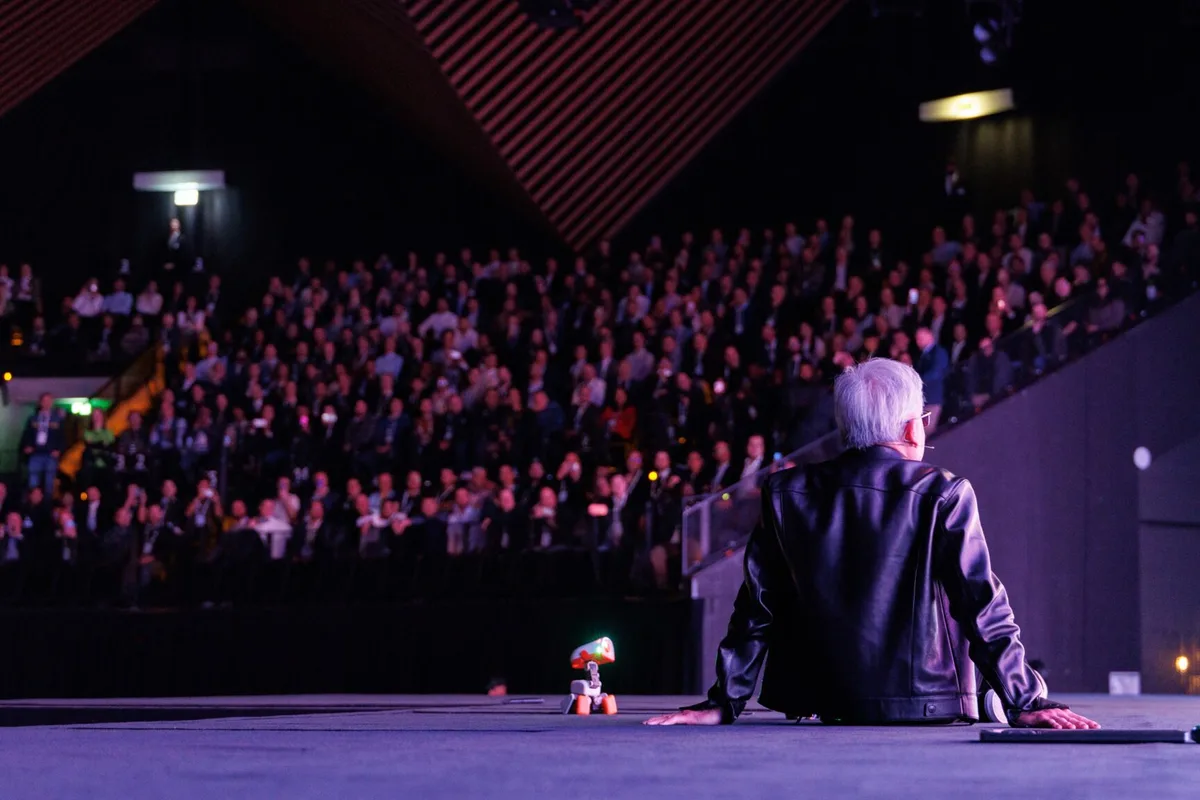
Four Microducks appeared onstage and performed movements including standing, sitting and resting.
These are relatively simple actions.
The engineering process behind them is more significant than the complexity of the movements themselves.
Why train robots in simulation?
Learning physical behavior directly on real hardware creates several constraints.
A robot can fall, damage its components or collide with nearby objects.
Each attempt consumes energy and requires access to physical equipment.
Those costs become substantial when an algorithm needs to perform many training iterations.
Simulation provides an alternative environment for experimentation.
Developers can change obstacle positions, surface properties or movement conditions without rebuilding a physical testing area.
They can also run numerous simulated experiments in parallel.
NVIDIA uses platforms including Isaac Sim and Isaac Lab to support different parts of this process.
Isaac Sim provides virtual environments for robots.
Isaac Lab supports learning workflows, including reinforcement learning.
However, successful simulated training is only part of the challenge.
The difficult stage comes when the trained behavior is transferred to a physical machine.
The persistent sim-to-real problem
This difficulty is commonly described as the sim-to-real gap.
Even sophisticated simulations cannot reproduce every characteristic of a physical environment perfectly.
Motors can behave slightly differently from their mathematical models.
Friction varies across surfaces.
Sensors introduce noise, while physical components may react differently under changing loads.
A movement that looks stable in simulation may therefore fail when executed by a real robot.
Developers need behaviors robust enough to tolerate those differences.
That can involve varying simulation parameters and repeatedly testing on physical hardware.
NVIDIA's Microduck example demonstrates the progression from simulated training to cloud computation, local evaluation and real execution.
However, the presentation does not provide a comprehensive success rate for unprepared real-world scenarios.
The demonstrated movements should therefore not be treated as proof of general reliability.
Humanoid robots represent a more ambitious challenge
Microducks attracted attention, but humanoids address a broader technical problem.
NVIDIA brought together several partners developing machines capable of performing human-like actions.
Robots of different sizes and designs were displayed during the conference.
Some feature articulated arms and hands intended for object manipulation.
Others place greater emphasis on locomotion.
These machines do not necessarily serve the same purpose.
Moving a load, grasping a component, navigating a cluttered area or working safely near a person requires different mechanical and software capabilities.
The humanoid form offers a theoretical advantage because many workplaces were designed for humans.
Doors, shelves, tools and workstations frequently reflect human proportions and physical abilities.
A robot able to use those environments could potentially operate without extensive reconstruction.
However, a humanoid is not always the most efficient solution.
For repetitive and tightly defined tasks, a fixed robotic arm or specialized machine may be simpler, cheaper and more reliable.
Agile ONE SN is planned for 2027
One of NVIDIA's significant Berlin announcements concerned Agile ONE SN.
Presented during the October 21 keynote, the reference humanoid platform is built around the NVIDIA Isaac GR00T ecosystem.
NVIDIA describes a body with 31 degrees of freedom.
In robotics, degrees of freedom refer to independent movement possibilities.
The number helps describe mechanical articulation, but it does not independently measure intelligence or practical usefulness.
Agile ONE SN is intended as a modular research and development platform.
Developers can use its complete workflow or select components according to their requirements.
NVIDIA highlights Isaac Capture for data collection, GR00T for robotics models, Isaac Lab for training and Isaac OS for runtime capabilities.
The company's stated goal is to reduce the preparation time required for robotics research.
Availability is expected in 2027.
Agile ONE SN should therefore not be described as a robot already deployed commercially at scale.
The information reviewed does not include independent long-duration industrial performance measurements.
Object manipulation introduces different engineering problems
Locomotion is only one part of robotics.
Manipulating objects creates another set of challenges.
GTC Berlin featured demonstrations of robots interacting with visitors and handling small objects.
These activities may appear less dramatic than a humanoid walking across a stage.
They still require sophisticated coordination.
A robot must identify an object's location, estimate its orientation and prepare a suitable movement.
It must then control its grip according to the object's shape, weight and physical properties.
Changes in the environment or human intervention may require immediate trajectory adjustments.
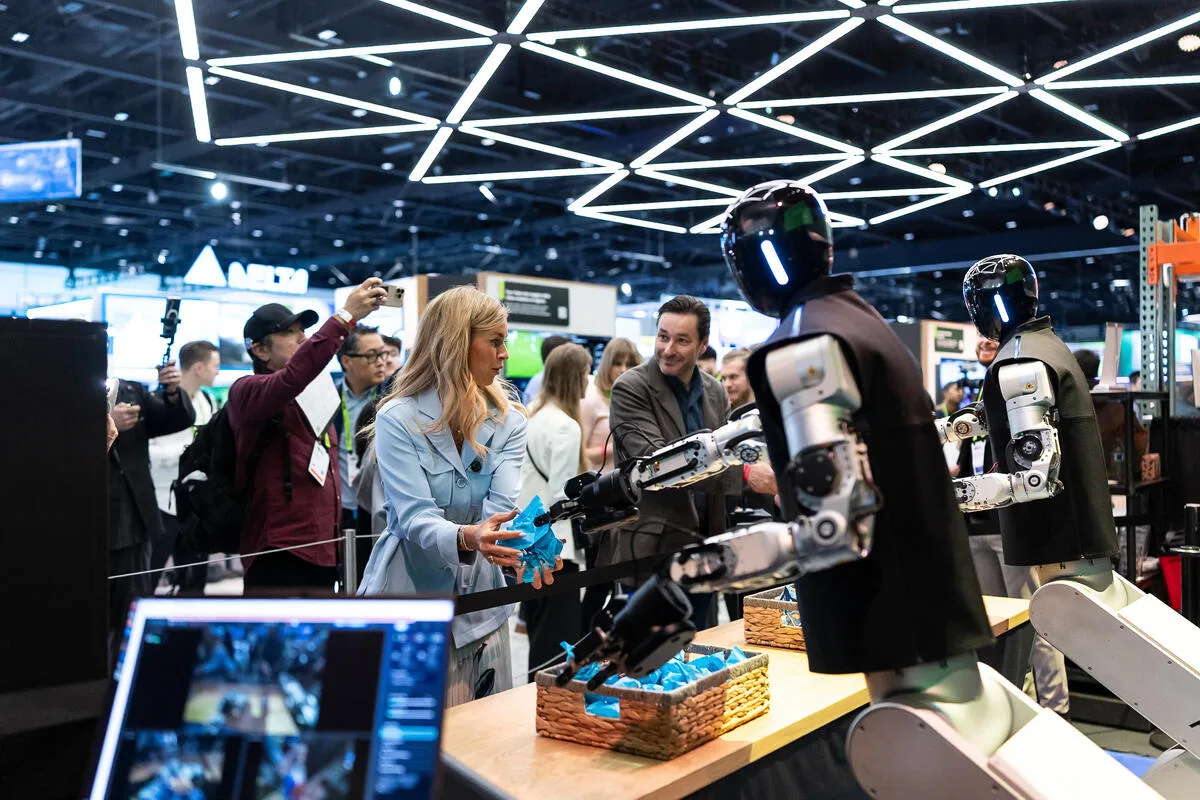
Public demonstrations naturally focus on scenarios that can be shown clearly to an audience.
They do not necessarily reproduce the full variety of objects, working conditions and unexpected events encountered in real businesses.
A robot successfully handing out several objects at a trade show may still require substantial engineering before operating independently for hours in a production environment.
Practical effectiveness depends on repeatability, failure rates, operating speed and recovery after mistakes.
Robotics requires specialized AI systems
NVIDIA promotes Isaac GR00T for selected humanoid robotics applications.
This approach is not simply a matter of placing a conversational AI model inside a mechanical body.
Robots need to coordinate functions with very different timing requirements.
They must perceive their surroundings, interpret instructions, make decisions and command motors or other actuators.
Some of those actions require extremely fast responses.
A balance correction cannot always wait several seconds for a general-purpose model to complete a reasoning process.
Robotics architectures therefore frequently combine specialized models, physical controllers and learned policies.
NVIDIA aims to provide common infrastructure connecting these components.
That is the central proposition of its physical AI platform: combine computing resources, models, simulators and robotic execution.
Local computers and cloud infrastructure play complementary roles
The Microduck demonstration also illustrates how computing tasks can be distributed.
A robot does not need to perform every operation required to train its behavior on its own hardware.
Large training workloads can run on more powerful cloud infrastructure.
The physical machine then executes a control policy suited to its available resources.
Between those stages, a local system such as RTX Spark can help developers prepare data, evaluate results and test configurations.
This arrangement provides access to substantial training resources without placing equivalent hardware inside every robot.
It does not eliminate onboard computing requirements.
A physical robot still needs enough processing capability to interpret sensor inputs and control movement within acceptable deadlines.
Power consumption, battery life and heat dissipation also remain important constraints.
They can be especially difficult to manage in compact robots.
A successful demonstration is not proof of industrial reliability
Public robot demonstrations provide useful evidence of technical progress, but they require careful interpretation.
A demonstration is usually prepared to show a particular capability under favorable conditions.
It may involve rehearsal, supervision or a restricted sequence of actions.
Reuters reported on October 21 that some of the small robots occasionally struggled to follow instructions during the event.
That does not eliminate the value of the demonstration.
It does show that current prototypes can encounter difficulties even in seemingly simple scenarios.
Assessing a robot's maturity requires additional measurements.
Relevant indicators include human intervention frequency, task completion rate, continuous operating duration and recovery from unexpected situations.
The GTC Berlin demonstrations do not provide comprehensive comparable data across those criteria.
It would therefore be premature to conclude that the displayed humanoids can replace human workers across a broad range of jobs.
Why NVIDIA is investing heavily in physical AI
NVIDIA's interest extends beyond manufacturing or selling robots.
The company supplies many of the components and software tools used to develop them.
Simulation requires graphics and computational resources.
Training robotics models can require accelerators located in large data centers.
Running learned policies on physical hardware also involves embedded computing platforms.
NVIDIA therefore offers products across several stages of the robotics development pipeline.
By encouraging adoption of its simulators, models and development tools, the company is attempting to make its platform a common foundation for robotics manufacturers.
The approach resembles NVIDIA's existing role in AI model training and data center infrastructure.
There is an obvious commercial dimension.
As robots become more dependent on simulation and accelerated computing, NVIDIA's hardware and software ecosystem could become increasingly valuable.
Long-term adoption, however, will depend on whether partners can produce useful machines at economically sustainable costs.
Robotics remains between research and widespread deployment
GTC Berlin illustrated an industry making progress at different rates.
Specialized industrial robots have performed repetitive tasks reliably for decades.
General-purpose humanoids are attempting something much broader: operating in human-oriented spaces while learning multiple types of behavior.
That ambition introduces substantially greater uncertainty.
Perception, balance, manipulation, human safety and recovery from unexpected events all need to work together.
Simulation and AI learning offer ways to reduce manual programming.
However, the Berlin demonstrations do not establish that one general model can solve every challenge in every environment.
The planned 2027 availability of Agile ONE SN also demonstrates that some announced platforms remain on a development roadmap.
Future availability of a reference system is not the same as established commercial deployment.
What NVIDIA's Berlin demonstrations really show
The October 23 recap video marked the public conclusion of a conference where NVIDIA wanted to make physical AI visible.
Microducks illustrate transferring behaviors learned in simulation to real robots.
Manipulators show how perception and learning can be connected to physical interaction with objects.
Humanoids represent the ambition to create more versatile machines.
However, all three areas share unresolved challenges: generalizing behavior, managing the required computing resources and demonstrating long-term reliability.
The future of physical AI will depend less on whether a robot completes a successful stage demonstration than on whether it can repeat useful actions reliably under changing conditions.
That is the difference between a compelling prototype, a practical research platform and a commercially valuable machine.
For NVIDIA, Berlin provided an opportunity to display the components of a broad robotics ecosystem.
For organizations considering adoption, the next step will be measuring whether those technologies can deliver repeatable, useful and economically justified results.