 By Adri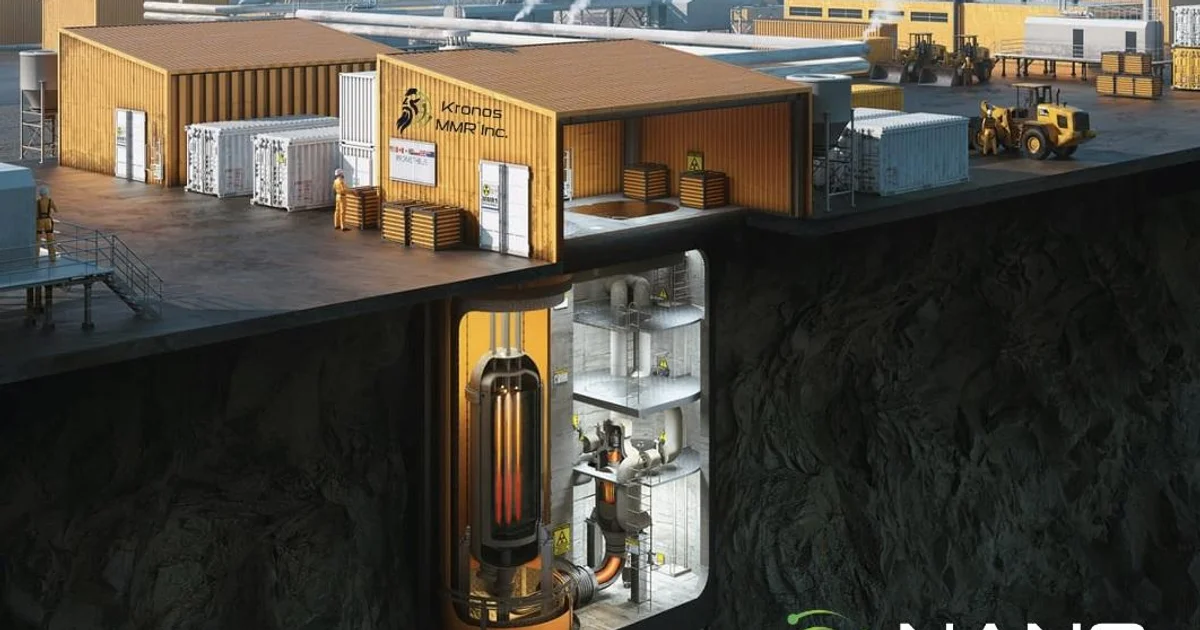
The phrase nuclear-powered AI infrastructure can make this sound much more finished than it is. There is no newly announced reactor sitting next to a GPU campus, and no power purchase from a named AI company.
The three companies have disclosed a Letter of Intent covering opportunities in the United States and selected international markets. It was formally executed in the previous month and is expressly non-binding and non-exclusive.
There is currently no announced host site, customer, project capacity, construction budget or deployment date under this collaboration.
The partnership is trying to assemble the pieces before choosing the site
NANO Nuclear has been named the preferred nuclear technology and services provider for opportunities pursued through the arrangement. Its expected role spans advanced microreactor technology, fuel supply and logistics and eventually reactor operations.
Preferred is not the same as exclusive. The framework itself is non-exclusive and does not create a reactor order.
IP3 brings a different part of the stack: project origination, development, financing and government engagement. That is important in nuclear because identifying a technically interesting reactor is only the beginning. Someone still has to construct a financeable project around the site, customer, licensing route and industrial supply chain.
Cybernetic Intelligence provides the compute side, including AI infrastructure, compute-sovereignty work and access to potential defense, intelligence and commercial computing customers.
The idea is to connect nuclear supply with identifiable demand early enough that both can be developed as one infrastructure project rather than trying to bolt a reactor onto an already finished data-center plan.
The first deliverable is supposed to be a pilot, but even that needs another agreement
The initial workstream is to identify and begin a mutually agreed pilot program. Project readiness, strategic priority and available resources are among the criteria the companies say they will use.
The LOI does not authorize that pilot by itself. Any selected project would require a separate definitive agreement covering scope, schedule, commercial terms and deliverables.
The opportunity list is broad: advanced-reactor pilots for military uses, resilient power for defense and intelligence facilities, sovereign-AI and high-performance-computing infrastructure, maritime nuclear applications and international strategic-energy projects.
That breadth says something about the maturity of the process. The companies are defining a pipeline to investigate rather than disclosing one finalized deployment.
Near-term work therefore looks more like development than construction: identify possible end users and host sites, assess regulatory frameworks, build feasibility material, engage financiers and industrial partners and determine what manufacturing and supply-chain capacity a deployment would require.
Nuclear development runs on a very different clock from AI hardware
That timing mismatch is the most useful context for the announcement. An AI infrastructure operator can cycle through multiple generations of accelerators while a new nuclear system is still moving through licensing and construction.
NANO Nuclear does not currently operate a commercial microreactor supplying an AI data center. Its lead program, KRONOS MMR, remains under development.
The University of Illinois Urbana-Champaign submitted a construction permit application for a KRONOS MMR project in March 2026. The U.S. Nuclear Regulatory Commission accepted the application for review in May and has begun its environmental, safety and technical work.
Acceptance for review is not a construction permit. NANO Nuclear currently believes that process could allow initial construction activity in the second half of 2027, subject to regulatory approval and the other requirements of the university project.
Its regulatory filings give a longer horizon for actual operation. The company currently targets around 2030 for initial operation or research availability of the University of Illinois reactor and the early 2030s for the first commercial launch of KRONOS. Those targets remain conditional on licensing, construction and successful commissioning.
A partnership signed in 2026 can therefore make sense as customer development without implying near-term power delivery. Nuclear projects often need the buyer, site, regulatory path and financing structure to develop in parallel for years. The distinction matters when the customer sector moves at AI speed.
The agreement does not actually select KRONOS for the future pilot
KRONOS is the obvious system to discuss because it is NANO Nuclear's most advanced reactor program from a U.S. licensing perspective. It is a stationary high-temperature gas-cooled design that the company says can produce up to 45 MW thermal and roughly 15 MW electric in a single-unit configuration.
NANO Nuclear has also explicitly positioned KRONOS for applications including data and AI centers. Its modular concept allows multiple units to be grouped when larger power levels are required.
Still, the September 25 LOI does not name KRONOS as the reactor for its eventual pilot. The company also has ZEUS and LOKI programs, while the collaboration itself covers uses ranging from secure computing to military and maritime applications.
Assigning a specific reactor to the future project before the project itself has been selected would therefore be speculation.
The attraction for AI is dedicated power, not a magically simpler power plant
The infrastructure argument is easy to understand. AI facilities require large amounts of reliable power, and some of the customers discussed here also care about energy resilience and sovereignty. A co-located reactor could theoretically be designed around a specific compute load instead of relying entirely on whatever grid capacity happens to be available nearby.
That does not make the energy side simple. Moving generation close to the servers also brings nuclear licensing, physical security, fuel logistics, operations, waste management and long-duration project finance close to the servers.
The collaboration is effectively an attempt to solve those problems as one stack. NANO Nuclear supplies the nuclear layer, IP3 tries to turn it into a buildable and financeable project, and Cybernetic Intelligence supplies the computing requirements and potential demand.
The next meaningful milestone will not be another rendering of a microreactor beside racks. It will be a named pilot with a host, a customer, a selected technology, financing assumptions and a project-specific agreement.
Until then, the September 25 deal is best understood as infrastructure origination. The companies have agreed to look for a place where nuclear power and secure AI compute can meet. They have not announced that such a place is ready to build.