
 By Camille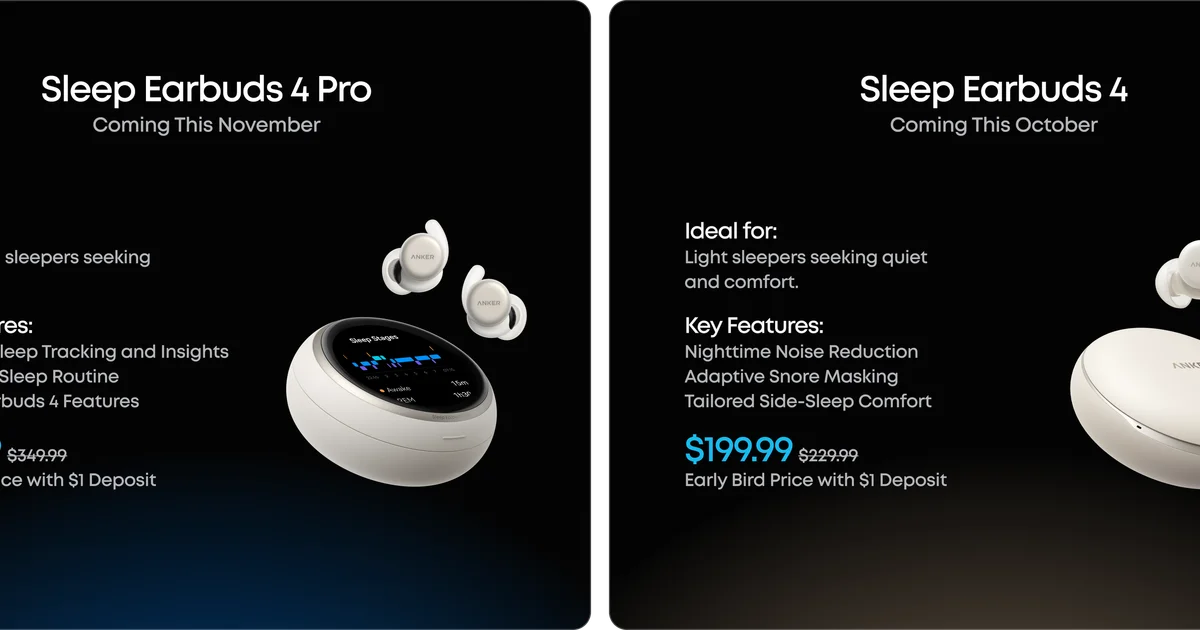
The PPG sensor sits directly inside the ear
Anker soundcore introduced Sleep Earbuds 4 Pro around IFA 2026 in Berlin.
The Pro model is scheduled for November in the US at $349.99.
A current pre-launch program lets customers place a $1 deposit to lock in a $30 launch discount.
The cheaper Sleep Earbuds 4 arrive earlier and focus more heavily on quiet, snore masking and comfort.
The Pro model is the one that adds physiological tracking.
Each earbud contains an optical PPG sensor.
The sensor samples at up to 100Hz
Photoplethysmography shines light into tissue and analyzes tiny optical changes caused by blood-volume variations with each heartbeat.
It is the same general sensing principle used by many watches and smart rings.
Anker moves that measurement into the ear canal.
The company describes the Pro sensor as operating at up to 100Hz.
That means the raw optical signal can be sampled as many as one hundred times each second before software processing.
The ear is an interesting place to measure heart signals
The ear canal contains a dense blood supply and generally moves less than a wrist while someone is asleep.
A correctly fitted earbud can therefore maintain a relatively stable position for several hours.
That does not automatically make every reading more accurate than every watch or ring.
Final accuracy still depends on sensor design, fit, motion rejection and individual anatomy.
The practical advantage is simpler: someone already wearing earbuds all night does not need a second device solely to collect sleep signals.
Heart rate, HRV and sleep stages all feed the morning report
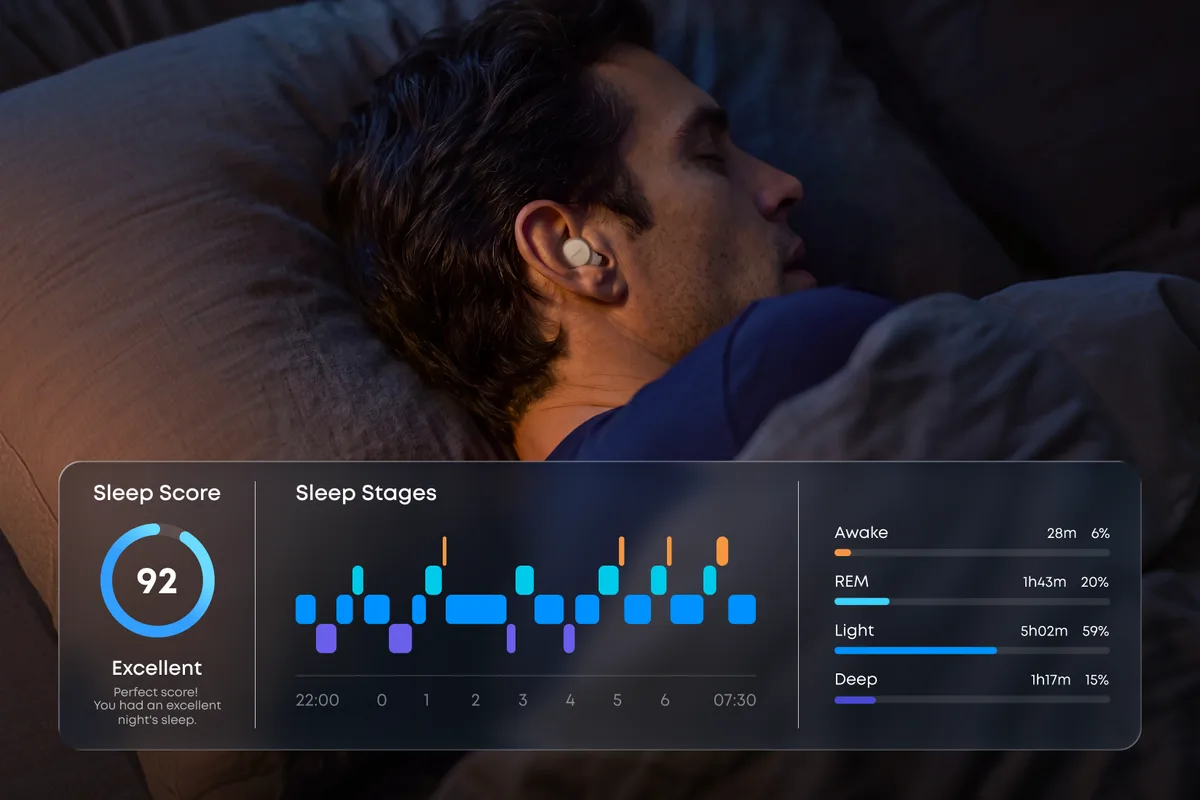
Soundcore uses the PPG data to track heart rate and heart-rate-variability-related changes overnight.
The system also estimates sleep stages and other nighttime behaviors.
A morning report produces a Sleep Score and a breakdown across Awake, REM, Light and Deep sleep.
The data can be used for longer-term patterns and practical sleep insights.
These earbuds are not a medical device
Soundcore explicitly says Sleep Earbuds 4 Pro are a general-wellness product.
They are not intended to diagnose sleep apnea, insomnia, heart disease or any other medical condition.
A poor sleep score can be useful as a trend or prompt for attention.
It is not a medical diagnosis, particularly when someone experiences breathing pauses, gasping or persistent daytime sleepiness.
The SleepHub case has its own AMOLED touchscreen
The other half of the system sits on the bedside table.
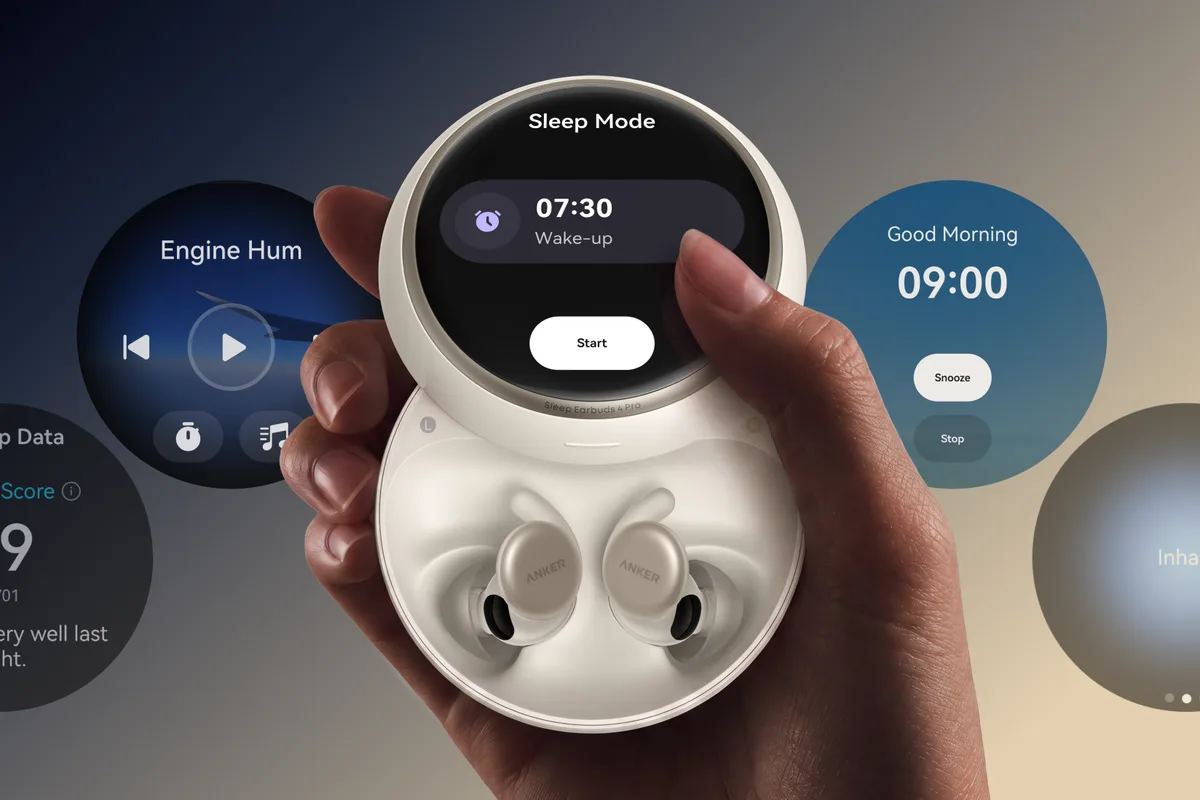
The charging case includes a circular AMOLED touchscreen.
It also contains its own processor and local storage.
Soundcore's goal is to reduce the need to pick up a smartphone immediately before sleep or first thing in the morning.
The case can control volume and sleep modes, start stored audio, set an alarm and display the morning report.
Sleep audio can live locally in the case
Local storage allows selected content to play without a constant phone or internet connection.
Soundcore also offers a curated library covering sleep sounds, meditation, white noise, brainwave audio and related material.
The company says access to that library does not require an additional monthly subscription.
That matters because a sleep product designed around reducing bedtime phone use would undermine itself if every interaction required opening an app.
BioSync changes playback according to estimated relaxation
The most experimental feature is called BioSync.
It uses PPG feedback to estimate how relaxed the wearer appears to be.
Soundcore says the system can reassess that state roughly every five minutes.
It can then change tempo, soundscape elements and binaural beats.
Instead of playing one static eight-hour track, the system creates a loop of sensing, adapting and measuring again.
Soundcore itself labels BioSync a lab feature
That wording is important.
BioSync is experimental rather than a validated medical intervention.
Soundcore warns that performance can vary and that lab features may change or be removed.
Claims about reliably making people fall asleep faster would therefore go beyond what the product currently establishes.
The technical idea is still unusual: physiological data collected by an audio product is being used to alter that product's playback during the same night.
Active noise cancellation is rated at up to 30dB
Sleep Earbuds 4 Pro use several forms of nighttime noise reduction.
Their physical fit provides passive isolation first.
Active noise cancellation is rated at up to 30dB under Soundcore's specified conditions.
That does not mean every external sound becomes uniformly 30dB quieter.
ANC works better on some continuous low-frequency noises than on sudden or highly variable sounds.
That limitation is one reason Soundcore uses a separate system specifically for snoring.
The charging case listens for a snoring partner
A microphone in the Smart Case monitors the room for snoring.
Soundcore recommends keeping the case within two meters of the earbuds with its microphone facing the sleeper.
When snoring is detected, the case signals the earbuds to alter their masking audio.
This is not the same thing as active cancellation.
Instead of mathematically cancelling every snore, the earbuds use more pleasant sound to make the disruption less perceptually dominant.
Adaptive masking can follow snoring as it changes
Snoring is not a fixed tone.
Pitch, loudness and rhythm can change throughout the night.
Adaptive Snore Masking therefore modifies its sound instead of relying on one constant layer of white noise.
That is also why the case remains an active part of the system while the earbuds are being worn.
It acts as a room microphone as well as a charger.
The more expensive Pro model actually lacks one feature from the standard version
The comparison with Sleep Earbuds 4 reveals an unusual tradeoff.
The standard model's Smart Sensing Case can recognize selected important sounds such as a crying baby or a fire alarm.
It can then reduce masking and make the external sound easier to hear.
Soundcore says the Pro does not include that same important-sound-awareness feature.
The premium model therefore prioritizes physiological tracking and phone-free controls rather than simply containing every feature of the cheaper version.
Battery life is designed around a full night rather than a full week
Launch information puts playback at roughly ten hours per charge.
The case extends total use to around forty hours.
Those figures look modest next to some modern music earbuds.
The comparison misses the physical constraint.
Sleep earbuds need extremely small shells and batteries so an ear can remain pressed against a pillow without a large object creating pressure.
Ten hours is intended to cover one complete night with some margin.
Each earbud weighs around three grams
Launch specifications put each earbud at roughly 3g.
That low mass is critical for side sleeping.
Soundcore also uses a layered ergonomic design intended to avoid pressure points in the ear.
Comfort will still vary dramatically between people.
An earbud can be nearly invisible to one sleeper and intolerable after two hours to another.
Sleeping in earbuds creates a different design problem from commuting
Daytime earbuds can be removed the moment they become uncomfortable.
Sleep earbuds are expected to remain in position for several hours while one side of the head may be pressed into a pillow.
They need to be tiny, stable and isolating without applying excessive pressure.
That explains why Sleep Earbuds 4 Pro do not chase large drivers or the huge batteries found in conventional music earbuds.
Bluetooth 6.0 still allows ordinary streamed audio
The earbuds use Bluetooth 6.0.
Owners can still stream their own podcast, music or calming content from a phone before sleeping.
A personal in-ear alarm can wake the wearer without playing through a room speaker.
Find Me can make the earbuds ring from the soundcore app when one disappears into bedding or under furniture.
The SleepHub also supports wireless charging
Wireless charging is part of the Pro package.
It is a small but sensible addition for something intended to remain on a bedside table.
The case can sit on a charging pad between nights instead of requiring a cable every time its battery falls.
At $349.99, the 4 Pro cost more than many premium music earbuds
US MSRP is $349.99.
The current pre-launch offer advertises an effective $319.99 Early Bird price after the deposit promotion.
That is more than many flagship true wireless models designed primarily around sound quality.
Soundcore is justifying the premium with sensors, tracking, local processing, storage and the AMOLED SleepHub rather than with an exotic driver or audiophile codec.
The buyer is not paying only to hear more.
They are paying to measure what happens after conscious listening ends.
They do not replace a watch or ring in every situation
A wrist or finger tracker can collect data during the day, workouts and sleep.
Sleep Earbuds 4 Pro are far more specialized.
Their PPG data exists only when someone actually wears the earbuds.
The advantage is that people already using sleep earbuds for masking would otherwise be wearing this device anyway.
For them, sleep tracking becomes an additional function of something already occupying the ear.
The important shift is that the earbuds can react to the data they collect
Many wearables tell users the next morning that they slept badly.
That information can be useful, but it arrives too late to change the night that just happened.
Sleep Earbuds 4 Pro attempt something more ambitious.
They collect a physiological signal while the wearer is trying to sleep, and BioSync can use that signal to modify the audio immediately.
There is no guarantee that this feedback loop will make every user sleep better, and Soundcore still labels it experimental.
But this is where the product stops being merely a tracker with speakers attached.
The $349.99 bet is that earbuds that understand something about how you are sleeping may eventually do more than show you a graph the following morning.