
 By Camille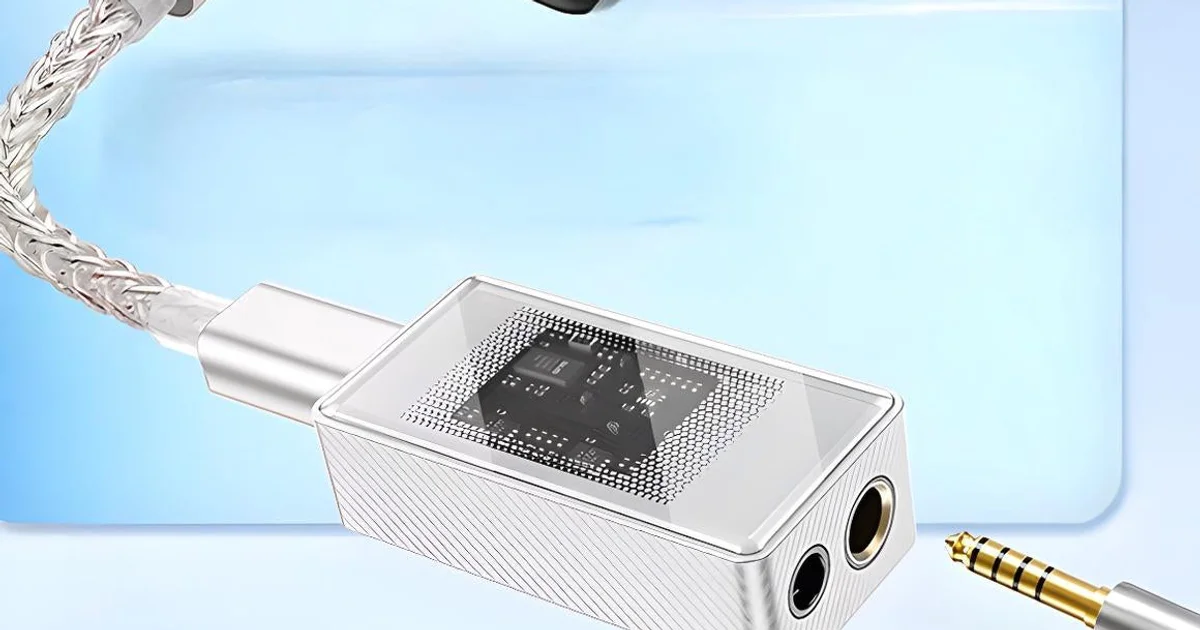
Two ports, two very different power figures
JCALLY developed the AP6 with audio reviewer and measurement specialist Crinacle. The company's own product material describes the dongle around a Conexant CX31993 DAC and two SG Micro SGM8262 op-amps.
Its 3.5mm output reaches approximately 115mW into 32 ohms. Moving to the 4.4mm connection raises that figure to about 440mW.
At 16 ohms, published specifications list 220mW single-ended and 540mW balanced. At 300 ohms, those numbers fall to 12.9mW and 51mW respectively.
The second jack is therefore more than connector convenience. Most of the AP6's unusual output capability depends on using it.
The decoding side stays deliberately simple
The CX31993 handles PCM at up to 32-bit/384kHz. There is no screen, onboard battery or Bluetooth radio to add another layer between the source and the amplifier.
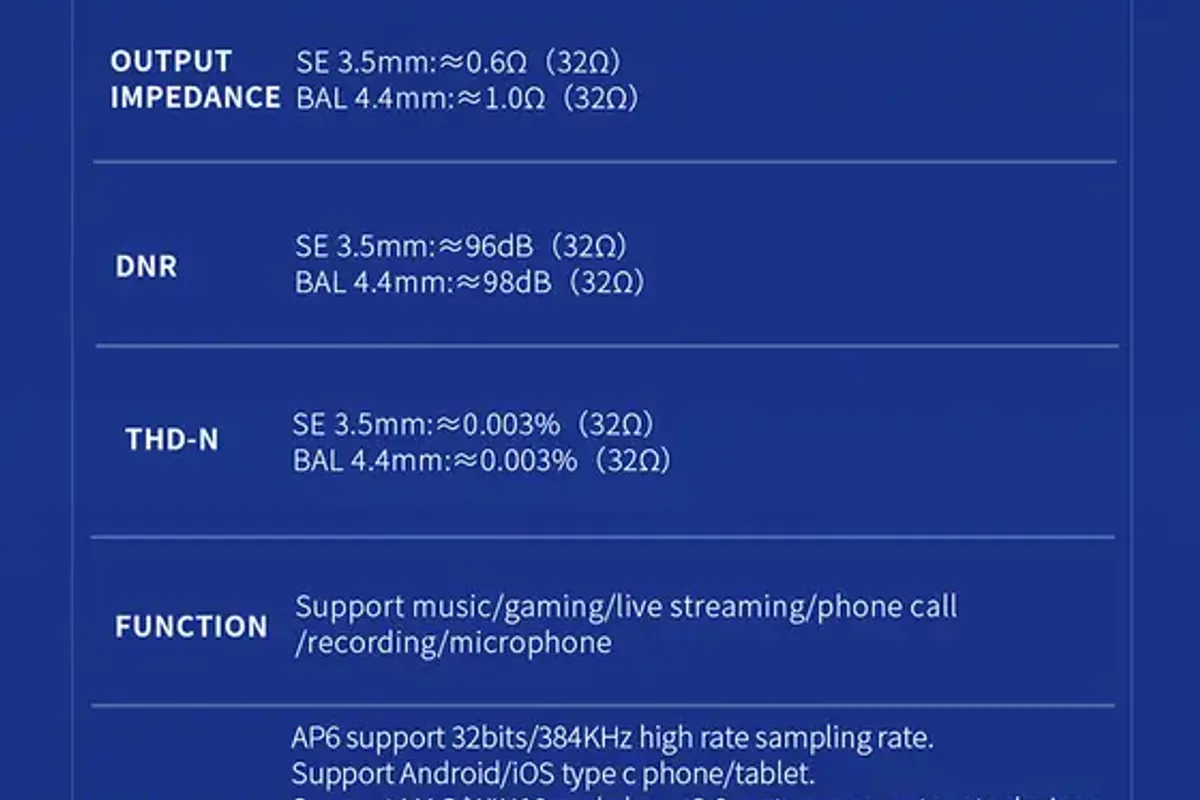
Published output impedance is approximately 0.6 ohm over 3.5mm and 1 ohm over 4.4mm. JCALLY's specification set lists roughly 118dB SNR for the single-ended path and 116dB for balanced operation at 32 ohms.
Crosstalk is rated at approximately -72dB and -114dB respectively, with THD+N specified around 0.003 percent.
All that power comes from the host device
There is no internal battery. A phone, tablet or computer supplies the AP6 through USB-C, which keeps the hardware extremely small but also means higher output ultimately comes out of the host's battery budget.
The manufacturer's material warns that the amplifier can generate noticeable heat during use. Owner comments published by retailers also mention the enclosure becoming warm, particularly under heavier loads.
Compatibility is broad, not universal
JCALLY includes a USB-C to USB-C cable and a USB-A adapter. Retail documentation lists support for modern USB-C Android and iOS devices, macOS and Windows 10 or newer systems.
The AP6 uses UAC 2.0 and does not support UAC 1.0 according to the available specifications. That matters for devices such as Nintendo Switch and PlayStation 5, where a simple direct USB connection should not be assumed to work.
Inline microphone and headset controls are supported with compatible cables and source devices.
The feature list is intentionally short
There is no parametric EQ built into the AP6, no display and no elaborate desktop mode. Volume is controlled from the source.
What the roughly $40 price buys instead is a compact metal dongle with both common audiophile headphone connectors and considerably more balanced-output power than its dimensions suggest.
The enclosure uses machined aluminum with a transparent window exposing part of the internal board. It measures 38.7 × 19.9 × 12.8mm and weighs around 13.5 grams.
The 4.4mm output defines the product
Sensitive IEMs do not need anything close to 440mW, and users should be careful with volume when combining this kind of output with efficient earphones.
For harder-to-drive portable headphones or IEMs already wired for 4.4mm, the AP6 makes considerably more sense. The 3.5mm jack keeps it flexible, although its 115mW rating at 32 ohms is far less unusual.
Crinacle currently lists the AP6 collaboration at $39.99, while US retailer Bloom Audio lists it at $39. JCALLY does not provide an official French retail price in the sources verified for this article.