
 By Adri
MediaTek unveiled the Dimensity 9600 Pro on September 15. Its new flagship smartphone SoC is manufactured on TSMC's 2nm process and uses the fourth generation of MediaTek's All Big Core strategy, still dispensing with conventional small efficiency cores.
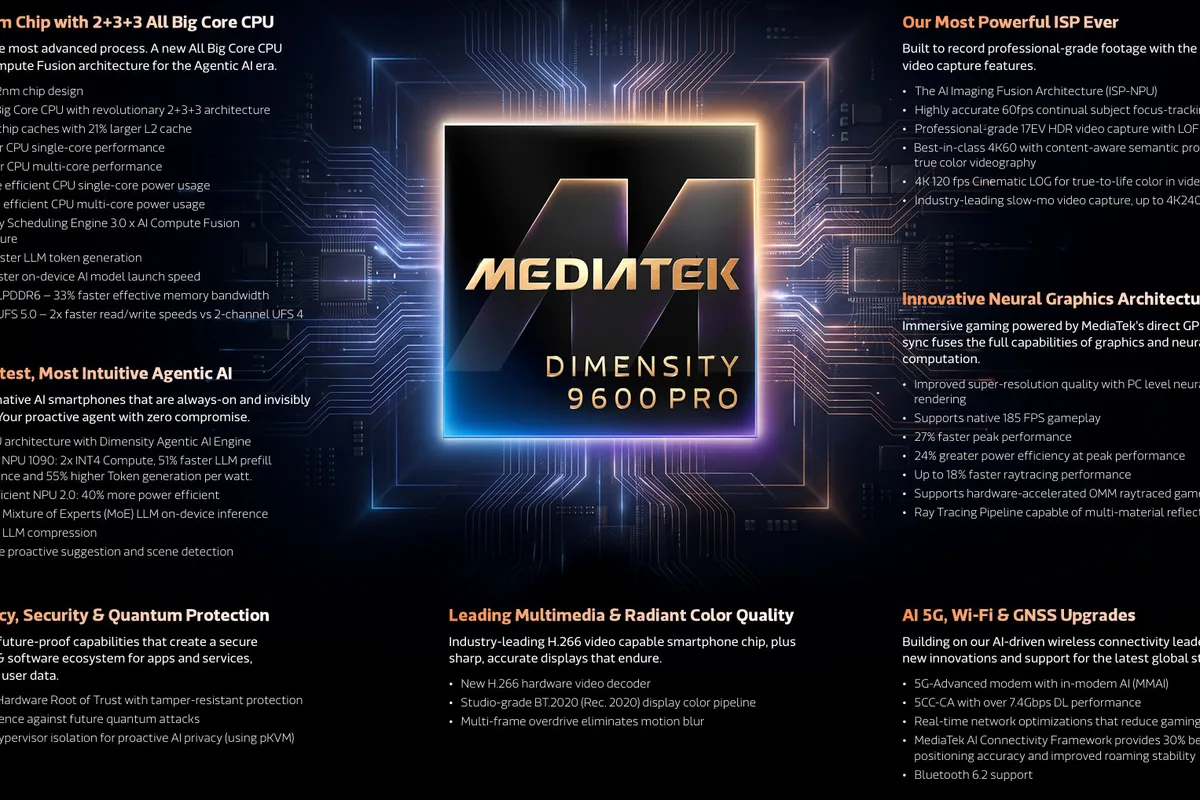
The CPU is arranged as 2+3+3: two Arm C2-Ultra cores clocked at up to 4.55GHz, three C2-Pro cores at 4.35GHz with 1MB of L2 cache each, and another three C2-Pro cores at 3.1GHz with 512KB of L2 each. MediaTek says total L2 capacity has increased by 21%, alongside 16MB of L3 and 10MB of system-level cache.
The efficiency numbers are more interesting than the benchmark gains
MediaTek's own testing puts single-core CPU performance up by as much as 17% and multi-core performance up by 15% compared with the previous generation. At the same time, the company claims 37% lower single-core power consumption and a much larger 61% reduction in multi-core power at peak performance.
That is the figure worth watching. Modern flagship phones are rarely short of brief bursts of processing power. Sustaining that performance after heat builds up is considerably harder. If the efficiency claim survives implementation in shipping devices, manufacturers gain more room to trade between temperature, battery life and sustained clocks.
These are MediaTek lab figures from demo hardware, not independent measurements from retail smartphones. Cooling systems, firmware and power limits will all affect the final result.
LPDDR6 and UFS 5.0 feed a much wider data path
The process shrink is accompanied by first-wave support for LPDDR6 and UFS 5.0. MediaTek says LPDDR6 raises effective memory bandwidth by 33% at the same frequency, while UFS 5.0 can double read and write speeds over the previous storage generation.
Those changes are less marketable than another CPU frequency headline, but they matter for AI workloads and anything moving large amounts of data through the chip. The Dimensity 9600 Pro combines 34.5MB of L2, L3 and system cache with a new scheduling engine designed to coordinate compute, memory and power resources.
Two NPUs split heavy AI from always-on work
MediaTek uses a dual-NPU arrangement. The NPU 1090 targets demanding generative AI workloads, while the Super Efficient NPU 2.0 provides a lower-power domain for persistent background intelligence and agent-like functions.
The company claims 40% lower power consumption for that efficient NPU. For the NPU 1090, MediaTek quotes twice the INT4 compute, 51% faster LLM prefill performance and 55% more token generation per watt. On-device inference for Mixture-of-Experts models with as many as 30 billion parameters is supported.
A parameter count alone says little about actual generation speed or how much memory an OEM will allocate to a model. What matters architecturally is that persistent AI now has dedicated hardware and its own power budget rather than being treated as an occasional burst workload.
G2-Ultra NX brings neural rendering into the graphics pipeline
The G2-Ultra NX GPU is rated by MediaTek for up to 27% higher peak graphics performance, 24% lower power consumption at peak and 18% faster hardware ray tracing. The platform also supports gaming beyond 185 frames per second.
Its Neural Graphics Architecture is the more telling change. GPU and NPU resources can work together on graphics tasks such as AI-assisted super-resolution. Mobile graphics are starting to follow the same broader shift already visible on PCs, where image reconstruction increasingly sits beside conventional raster performance.
The ISP now reaches 4K at 240fps
MediaTek's Imagiq 1290 image processor supports direct-output 4K slow motion at 240fps, 4K120 recording with stabilization, cinematic log capture and NPU-assisted imaging features. Camera sensors up to 200MP are supported.
The connectivity block includes Wi-Fi 7, Bluetooth 6.2 and 5G-Advanced. None of those features alone defines the chip, but together with LPDDR6 and UFS 5.0 they give MediaTek a broad platform for premium Android hardware rather than a processor focused only on CPU benchmark scores.
The first Dimensity 9600 Pro phones are expected this quarter, and Oppo has confirmed that the Find X10 Pro Max will be among the first devices to use it. Retail hardware will provide the more important test: whether that dramatic multi-core efficiency claim still holds once the chip is inside a thin phone rather than a lab platform.