
 By Adri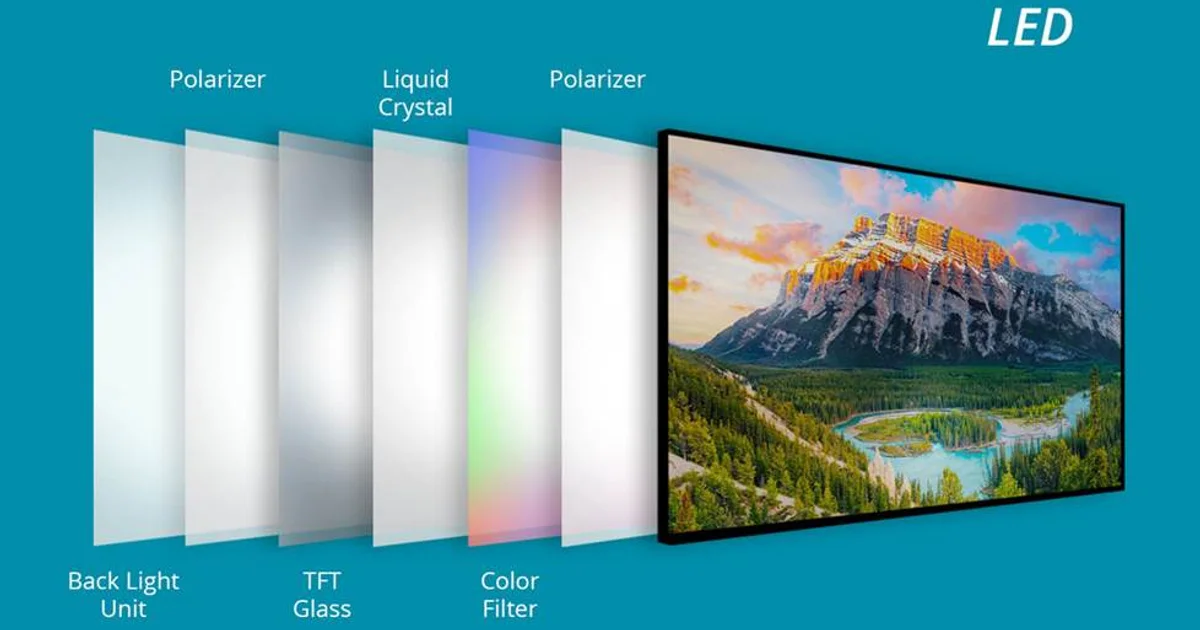
The basic LCD architecture is still a light valve
A conventional transmissive LCD needs a backlight. Light travels through optical films, polarizers, a TFT-controlled liquid-crystal layer and color filters before reaching the viewer.
The thin-film transistors address individual subpixels. Electrical voltage changes the orientation of the liquid crystals, which alters how much polarized light passes through.
The liquid crystals are therefore modulators rather than emitters. That distinction separates LCD fundamentally from OLED and true MicroLED.
An LED TV is normally an LCD TV
Older flat-panel LCD televisions used CCFL fluorescent backlights. LEDs gradually replaced those lamps because they are smaller, more efficient and much easier to control.
Manufacturers then shortened LED-backlit LCD into the far more marketable phrase LED TV.
The LED supplies the light. The LCD layer still makes the image.
Panel type comes before the backlight
TN, IPS and VA describe different ways of arranging and moving liquid crystals. The choice affects native contrast, viewing angle and pixel-transition behavior before Mini LED or any other backlight technology gets involved.
TN remains useful in extremely fast gaming monitors, but its viewing-angle and image-quality compromises make it uncommon in modern televisions.
IPS rotates the crystals largely within the plane of the panel. It typically keeps color and brightness more stable from the side, which is helpful in a room with wide seating.
Its weakness is native contrast. More backlight tends to leak through a dark IPS pixel than through a comparable VA cell.
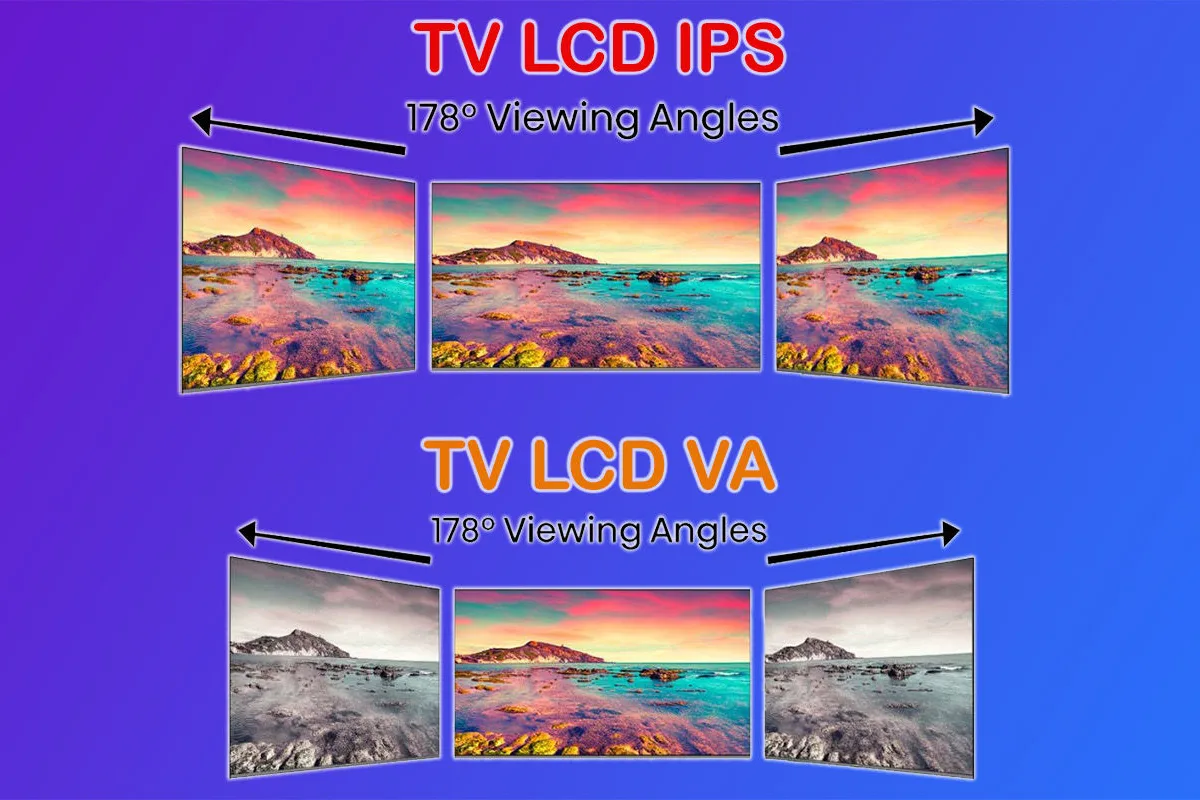
VA starts from the opposite trade-off. Its liquid-crystal structure blocks light more effectively, producing much deeper native blacks, but image accuracy usually deteriorates more quickly off-axis.
ADS, HVA and WHVA make the old labels less clean
Modern TVs rarely use only the oldest textbook versions of IPS and VA. ADS and ADS Pro are commonly grouped with IPS. HVA, PSVA and newer WHVA designs sit on the VA side.
Their purpose is familiar: keep the desirable property while reducing the traditional weakness. ADS improves several aspects of the IPS family, while recent VA developments attempt to broaden viewing angles without surrendering too much contrast.
The acronym alone still cannot tell you how a finished television performs.
Backlight architecture defines the second half of LCD performance
Edge-lit televisions put LEDs around the perimeter and spread their light across the panel using light guides. The method enables thin, inexpensive designs but gives the display relatively crude spatial control over brightness.
Direct-lit sets move an LED array behind the LCD. That usually helps uniformity, but a direct backlight does not automatically mean local dimming.
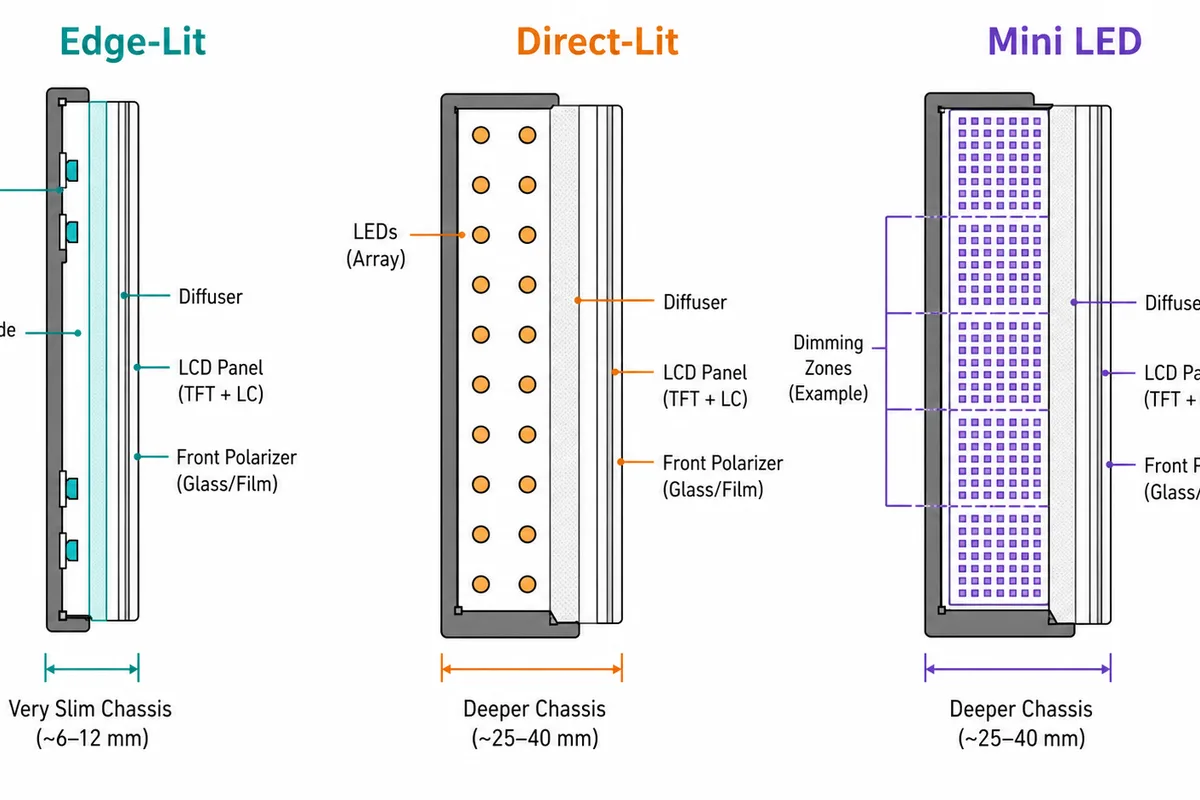
Full Array Local Dimming changes that. Groups of LEDs become independently controllable zones, allowing a television to dim one part of the image while keeping another bright.
Local dimming is an approximation of pixel-level control
A single local-dimming zone normally covers many LCD pixels. If a tiny bright object and black background occupy the same zone, the backlight cannot perfectly satisfy both.
Keep the zone bright and the surrounding black rises. Dim it aggressively and the highlight loses intensity.
The familiar halo around subtitles, stars or interface elements is blooming.
More zones help. Better algorithms help. Neither changes the fact that the lighting map has a lower spatial resolution than the 4K image itself.
Mini LED attacks that mismatch with scale
Mini LED makes the individual backlight sources much smaller. Manufacturers can fit far more of them behind an LCD and organize them into hundreds or thousands of local-dimming zones.
That can produce exceptional HDR brightness and dramatically better dark-scene contrast while reducing the size of visible halos.
The implementation matters more than the badge. A poor dimming algorithm with many zones can still crush shadow detail, fluctuate visibly or create halos. A well-controlled system with fewer zones can sometimes look cleaner.
LED count and zone count are not the same specification
A backlight can contain tens of thousands of Mini LEDs while grouping many of those diodes into far fewer independently controlled zones.
Advertising the raw number of LEDs therefore tells you very little about spatial precision by itself.
Zone count is more useful. Real measurements of blooming and contrast are better.
QLED changes color, not the fundamental display type
Most QLED televisions are LCD televisions using quantum dots to improve the spectral purity of their red, green and blue output.
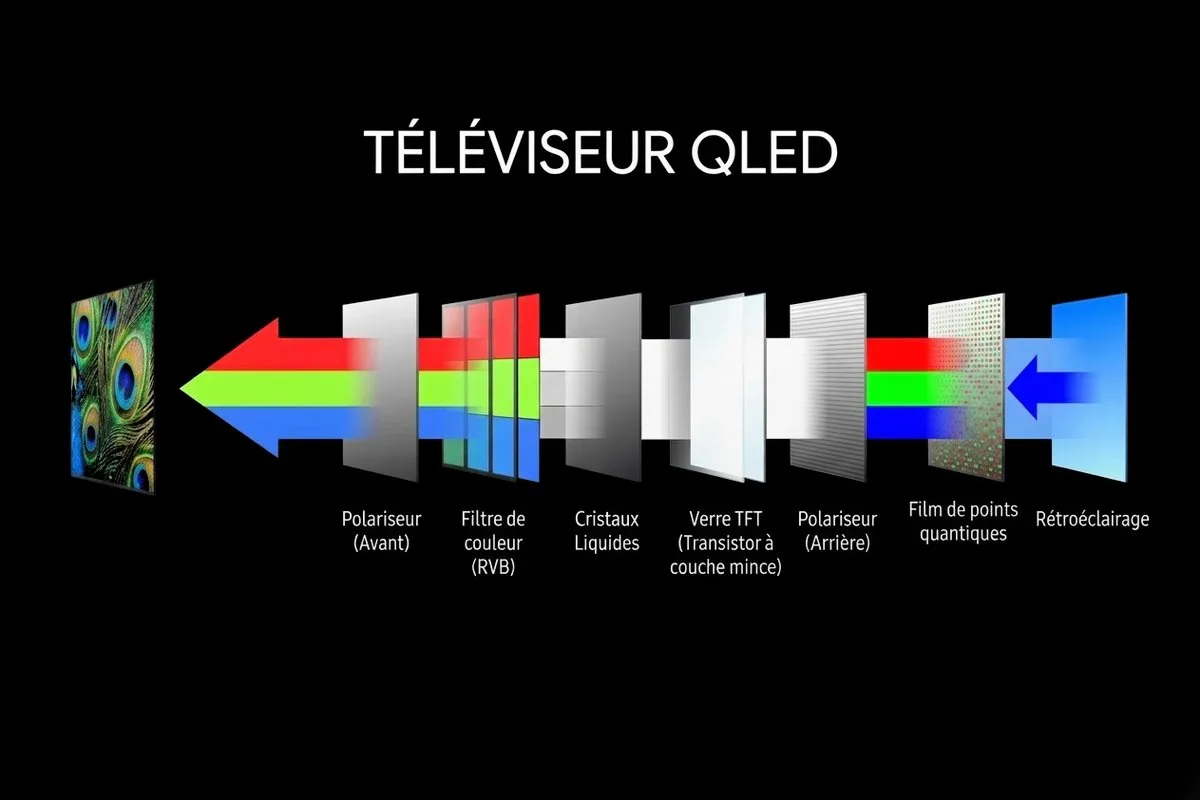
A common system begins with blue LEDs. Quantum-dot material converts part of that blue energy into narrow red and green wavelengths, giving the LCD cleaner primaries and helping it maintain strong saturation at high brightness.
That can improve color gamut and color volume significantly.
The quantum dots do not switch individual image pixels on and off. The LCD still performs that job.
QLED and Mini LED are complementary
There is no technical conflict between the two labels. Quantum dots can improve color while Mini LED improves the backlight's spatial control.
Samsung's Neo QLED range is a familiar example of this combination. LG has used QNED branding for LCD products combining different color technologies and, on relevant models, Mini LED backlighting.
A QLED can also be edge-lit. The word QLED alone says very little about black levels.
Dual Cell tried to build an LCD dimmer inside the LCD
Dual Cell takes a very different route. It places a monochrome LCD layer behind the main color LCD so that the second panel becomes a high-resolution light modulator.
Hisense commercialized the idea in the U9DG. The approach could generate unusually deep blacks because the extra LCD controlled the backlight at far finer resolution than conventional local-dimming zones.
Passing light through two LCD stacks costs efficiency, however. Complexity, thickness and cost also increase.
The technique never spread nearly as widely as Mini LED.
RGB Mini LED is the next major backlight shift
Most conventional Mini LED systems still begin with blue or white light and use phosphors or quantum dots to create the required color spectrum.
RGB Mini LED places independently controllable red, green and blue emitters in the backlight itself. The TV can therefore vary both the intensity and color composition of the light being sent toward different areas of the LCD.
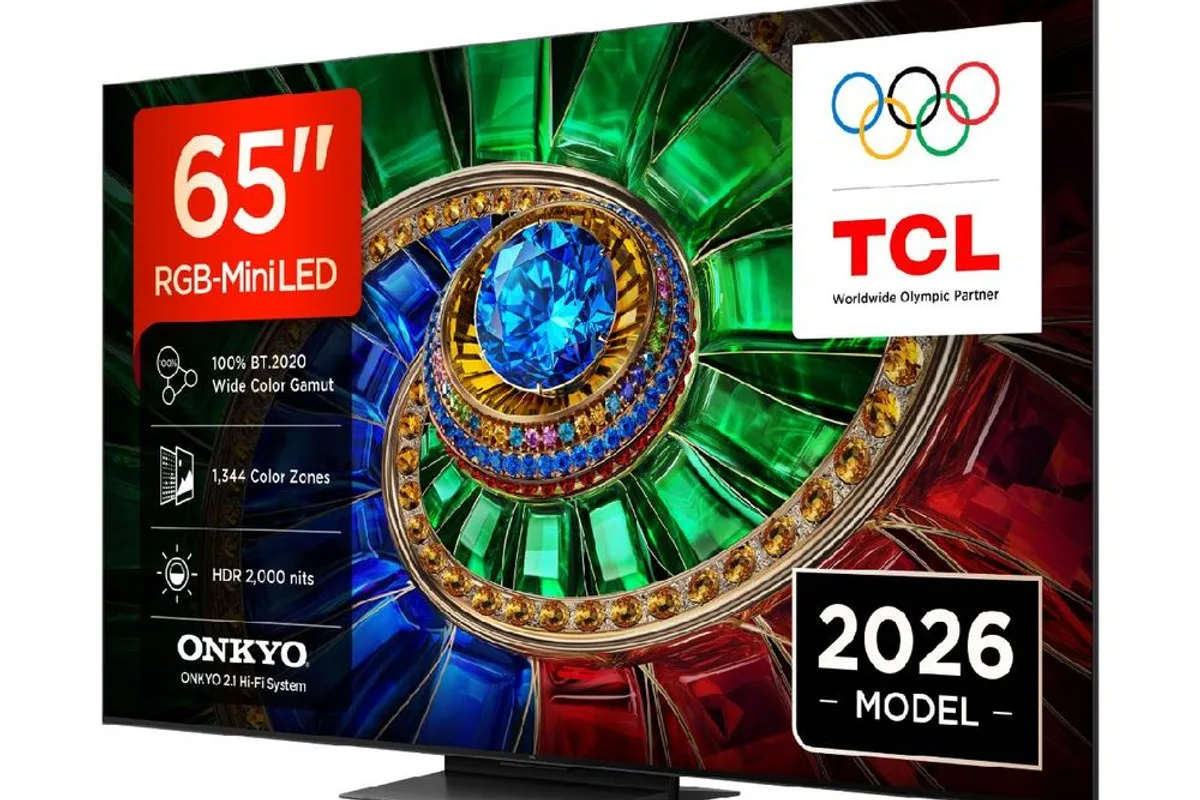
Hisense brought consumer RGB MiniLED televisions to market in 2025 and expanded the technology across far more sizes during 2026. Samsung's current Micro RGB televisions follow a related principle using extremely small RGB backlight elements.
These remain LCD televisions.
Samsung Micro RGB and true MicroLED are completely different products
The names are dangerously close.
Samsung Micro RGB uses microscopic red, green and blue elements as a backlight behind an LCD layer.
True MicroLED makes the RGB image with self-emissive inorganic LEDs at pixel level. There is no LCD shutter controlling a separate backlight.
Removing the word RGB from the wrong place changes the entire display architecture.
Four-color RGB backlights are already appearing
Hisense's 2026 116UXS extends the RGB concept by adding a cyan emitter alongside red, green and blue. At IFA 2026 the company quoted color coverage of 110% BT.2020 and peak brightness up to 10,000 nits for that flagship.
Those figures describe a particular high-end implementation, not RGB Mini LED as a universal standard.
The more interesting architectural point is that LCD backlights are beginning to control chromatic information as well as luminance.
RGB backlights can still bloom
None of this makes each LCD pixel self-emissive. One RGB backlight zone still illuminates multiple image pixels.
Bright objects against black backgrounds can therefore create halos. Color-aware backlighting also introduces another problem for the control algorithm: neighboring zones need to change hue and brightness without producing visible color contamination.
RGB Mini LED is a much more capable backlight, not an escape from local dimming.
Field Sequential LCD removes another old layer
Hisense used IFA 2026 to reveal Field Sequential Display technology, an LCD architecture that removes the conventional RGB color-filter layer.
Instead of showing red, green and blue subpixels simultaneously through fixed filters, the system displays the color components sequentially in time.
Removing absorptive color filters can theoretically improve optical efficiency and color purity. Hisense claims higher brightness, reduced energy consumption and operation up to 360Hz for the technology it demonstrated.
As of September 2026, this should be treated as an emerging LCD architecture rather than a ubiquitous consumer-TV feature.
LCD motion has two separate clocks
Refresh rate tells you how often the display can present a new frame. Pixel response describes how quickly the liquid crystals can actually reach the requested state.
A 144Hz panel has only about 6.9 milliseconds between refreshes. If an LCD transition takes longer than that, the old pixel state can bleed into subsequent frames.
Overdrive pushes the crystals harder to reduce that delay, but excessive overdrive creates overshoot and inverse ghosting.
This is why a fast refresh-rate number and a claimed 1ms response time should never be treated as interchangeable measurements.
VA has a particular motion weakness in dark transitions
Some VA panels transition slowly between very dark gray levels. In games or scrolling dark interfaces, that can create visible black smearing.
Modern fast VA and HVA panels have improved substantially, and model-to-model differences are large. IPS generally remains more predictable in this area.
LCD has an easy path to very high brightness
Because the light source is physically separate from the liquid crystals, premium LCD televisions can use increasingly powerful backlight systems.
That makes the technology exceptionally useful in bright rooms and for intense HDR highlights.
More power also means more thermal load, more complex control and potentially higher consumption. Mini LED and RGB systems therefore depend heavily on power management as well as picture processing.
Black level is still the problem every premium LCD is trying to solve
Liquid-crystal shutters are not perfectly opaque. Some backlight leakage remains even when a pixel requests black.
VA reduces that leakage through its cell structure. FALD attacks it by dimming the source. Mini LED makes those source zones smaller. Dual Cell inserted another modulator. RGB Mini LED now adds color-aware control.
They are different engineering attacks on the same old limitation.
OLED takes the opposite approach
An OLED pixel emits its own light and can shut off independently, which gives the technology effectively perfect black and pixel-level contrast without local-dimming zones.
LCD counters with much higher peak brightness on some models, broad availability across price and size classes, and no organic emissive layer subject to the same differential-aging mechanisms.
The choice is no longer simply LCD equals bright and OLED equals black. Premium Mini LED TVs have narrowed many of the practical differences. The underlying architectures remain fundamentally different.
Viewing-angle technology can alter the usual VA versus IPS rule
IPS and ADS still tend to preserve their image better from the side. VA still tends to produce better native contrast head-on.
Manufacturers can add optical layers that spread light across wider angles. Sony's X-Wide Angle and Samsung's Ultra Viewing Angle are examples of the idea.
These layers can reduce some of the contrast advantage they are trying to preserve, which is another reason specifications alone are not enough.
Panel uniformity is a different lottery
LCD can suffer from clouding, backlight bleed, vertical bands and dirty-screen effect. Large areas of uniform color make those defects easiest to see.
Sports are particularly unforgiving. A camera pan over a football pitch can make fixed darker patches in the panel look like dirt on the screen.
Uniformity can vary between models and sometimes between individual units of the same model.
HDR format does not tell you which LCD technology is inside
HDR10, HDR10+, Dolby Vision and HLG describe ways of delivering high-dynamic-range content. They are not panel technologies.
A television can therefore be VA, Quantum Dot, Mini LED, 144Hz and Dolby Vision compatible at the same time. Each label describes a different layer of the system.
The useful hierarchy when buying an LCD TV
- Identify the panel family when possible: VA/HVA/WHVA or IPS/ADS.
- Identify the backlight: Edge LED, Direct LED, FALD, Mini LED or RGB Mini LED.
- For local dimming, examine real blooming behavior rather than relying only on zone count.
- Treat Quantum Dot/QLED primarily as color technology.
- Do not confuse Mini LED, Micro RGB and true MicroLED.
- Check measured HDR brightness and black performance instead of the HDR logo alone.
- Prioritize native contrast and local dimming for dark-room movie viewing.
- Prioritize viewing angle if several people watch from the side.
- For gaming, check refresh rate, response behavior, VRR, HDMI bandwidth and input lag separately.
- Look for uniformity and dirty-screen-effect testing, especially for sports.
A quick map of the terminology
- LED TV: LCD with an LED backlight.
- QLED: normally an LCD using quantum dots for improved color.
- Neo QLED: Samsung LCD range combining QLED technologies with Mini LED on relevant models.
- LG QNED: LCD product family using different color and backlight technologies depending on model.
- Mini LED: LCD with a dense small-LED backlight.
- RGB Mini LED: LCD with controllable red, green and blue backlight emitters.
- Samsung Micro RGB: LCD with an extremely small RGB backlight.
- Dual Cell: LCD using a second LCD layer as a detailed light modulator.
- Field Sequential Display: emerging LCD architecture that can remove conventional RGB color filters by displaying color sequentially.
- OLED: not LCD.
- QD-OLED: not LCD.
- MicroLED: not LCD.
LCD in 2026 is therefore less one display technology than a platform on which several generations of optical engineering have accumulated. The crystals are still in the middle. Almost everything around them has changed.