
 By Adri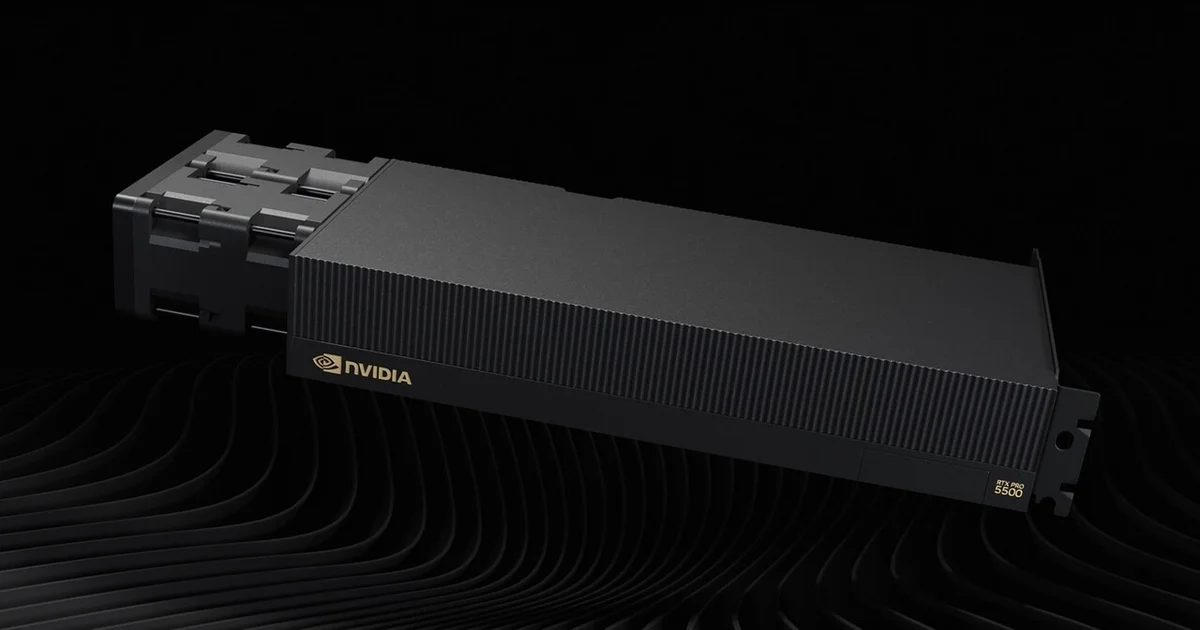
NVIDIA has quietly added the RTX PRO 5500 Blackwell Workstation Edition to its professional desktop GPU range. It formally sits between the RTX PRO 5000 and RTX PRO 6000, although its memory capacity and power envelope put it much closer to the top of that stack.
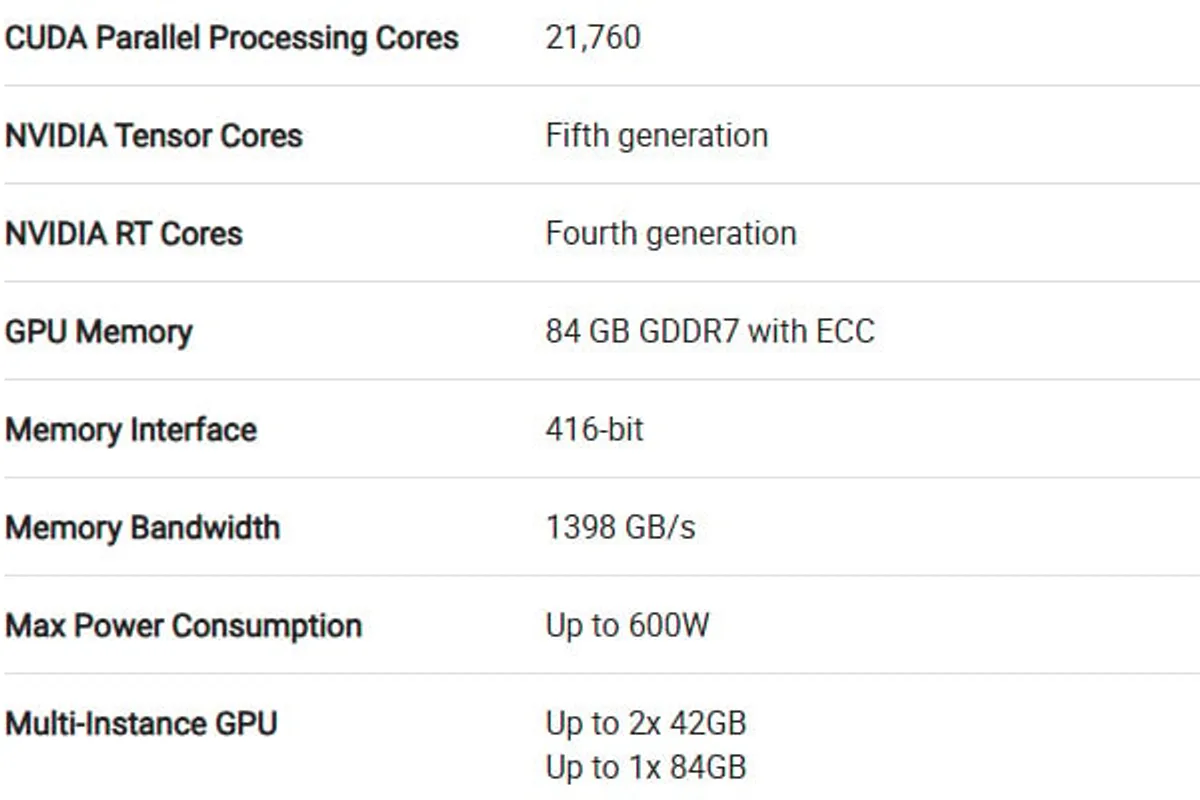
NVIDIA's current specification page confirms 84GB of ECC GDDR7, 1,398GB/s of memory bandwidth, PCIe 5.0 x16 connectivity and maximum power consumption of up to 600W. Availability is still listed only as “Coming Soon,” with no public price or precise launch date.
The 84GB matters more than a small compute advantage
NVIDIA's public product page does not currently expose every compute specification, but partner documentation and specialist reporting list 21,760 CUDA cores. That is the same CUDA-core count as the GeForce RTX 5090.
Memory is where the resemblance falls apart. The RTX 5090 has 32GB of GDDR7. RTX PRO 5500 carries 84GB and adds ECC.
That difference is not primarily about gaming frame rates. Large AI models, complex simulation datasets and heavyweight 3D scenes often hit capacity before they run out of shader throughput.
Once a workload exceeds local VRAM, it has to be split, offloaded into system memory or distributed across multiple accelerators. All three options introduce additional complexity and, frequently, substantial performance penalties.
An 84GB pool allows a different class of workload to remain resident on one GPU.
Memory bandwidth is not chasing the top number
The 84GB pool delivers an official 1,398GB/s of bandwidth. That is a large number in isolation, but it sits below the roughly 1,792GB/s available on a GeForce RTX 5090 or RTX PRO 6000 Blackwell.
Capacity is clearly receiving priority over maximum bandwidth. For inference or simulation, slower access to a model that fits can be much more useful than faster access to one that does not.
There is also an unresolved detail in partner material. Some documentation has listed a 416-bit memory interface, while technical analyses have noted that the published capacity and bandwidth fit more naturally with a different memory arrangement. NVIDIA's own current specification table does not state the bus width.
MIG turns one card into two isolated 42GB GPUs
RTX PRO 5500 supports NVIDIA Multi-Instance GPU. Administrators can expose the card as one 84GB instance or divide it into two isolated instances with up to 42GB each.
Each instance receives dedicated memory, cache and compute resources with guaranteed quality of service rather than relying entirely on software scheduling between users.
That feature fits the way NVIDIA is positioning the hardware. Its product page repeatedly emphasizes rack-mounted workstation deployments where GPU capacity can be centralized and assigned across teams.
For an organization, a 600W accelerator serving two isolated workstation sessions is a different proposition from putting a separate enthusiast GPU under every desk.
A 600W board makes cooling part of the platform
Maximum power consumption reaches 600W, matching the ceiling of the RTX PRO 6000 Blackwell Workstation Edition.
At that level, PSU sizing, airflow, rack density and heat removal stop being secondary details. NVIDIA lists active air cooling for the standard card and says a liquid-cooled RXM solution is also available.
The air-cooled board occupies two slots and is approximately 11.1 inches long. Up to four DisplayPort 2.1b outputs are supported.
Media hardware includes three ninth-generation NVENC encoders and three sixth-generation NVDEC decoders, targeting high-resolution professional H.264, HEVC and AV1 workflows.
The product page barely hides the AI priority
NVIDIA explicitly lists LLM inference, AI agents, generative AI and computer vision among the core workloads for RTX PRO 5500. Fifth-generation Tensor Cores support FP4, alongside the second-generation Transformer Engine in Blackwell.
The same card is being positioned for robotics simulation and physical AI through Omniverse, scientific computing, analytics, professional rendering and media production.
ECC memory becomes more meaningful in those environments. A rare memory error in a game may end with a crash. In a long-running scientific computation or professional simulation, silent corruption can invalidate hours of work.
The gap in NVIDIA's workstation stack was largely a memory gap
RTX PRO 5000 configurations offer 48GB or 72GB and operate at a much lower 300W ceiling. RTX PRO 6000 reaches 96GB and 600W. The 5500 lands between them with 84GB but inherits the flagship's maximum power envelope.
The model number therefore undersells how close the card sits to the upper end of the range in practical system requirements.
Pricing will decide whether that position makes sense. A professional GPU is not automatically attractive because one large model fits in its memory. It has to offer a better total deployment tradeoff than a PRO 6000, several smaller GPUs or rented cloud capacity.
This is not simply a 5090 with an extra 52GB attached
The matching reported CUDA-core count makes the GeForce comparison inevitable, but the products are optimized around different constraints.
GeForce RTX 5090 is built around gaming, creation and enthusiast compute. RTX PRO 5500 adds ECC, MIG, professional software support, far more memory and deployment options designed around managed workstations.
It also accepts lower memory bandwidth than the 5090 in exchange for that much larger pool.
RTX PRO 5500 becomes interesting when 32GB, 48GB or even 72GB stops being comfortable. NVIDIA has not yet disclosed how much it will charge to move that boundary to 84GB.