
 By Adri
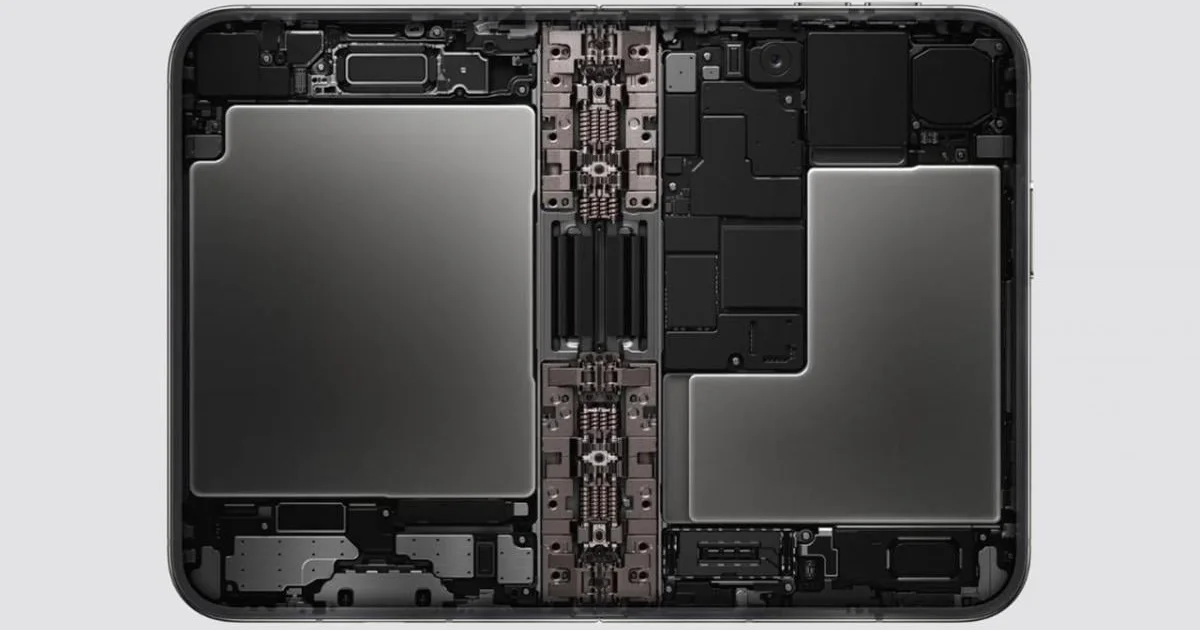
Apple's first foldable iPhone did not spend long on the market before reaching a teardown bench.
The iPhone Duo became available on October 23, 2026. Two days later, iFixit published its detailed investigation of the new device.
The results reveal a design that incorporates several repair-friendly features from conventional iPhones while retaining the major mechanical challenges of foldable smartphones.
iFixit assigned the phone a provisional repairability score of 5 out of 10.
According to the organization, that is its highest score for any foldable smartphone so far.
However, a category-leading result does not necessarily mean that the device is straightforward to repair.
The most difficult components to service are also the ones facing the greatest mechanical demands: the flexible inner display and the hinge.
Those parts have attracted additional scrutiny following early owner reports of cracked screens and bright display lines.
A surprisingly accessible internal design
One of iFixit's positive findings concerns the overall component layout.
Some smartphones require technicians to remove multiple unrelated components before reaching a relatively simple replacement part.
iFixit generally favors architectures that minimize those intermediate steps.
The iPhone Duo partially follows that principle.
Its outer display can be removed without destroying it, and several internal components are accessible without extensive disassembly.
Camera assemblies and parts of the charging hardware are positioned relatively close to the device's accessible surfaces.
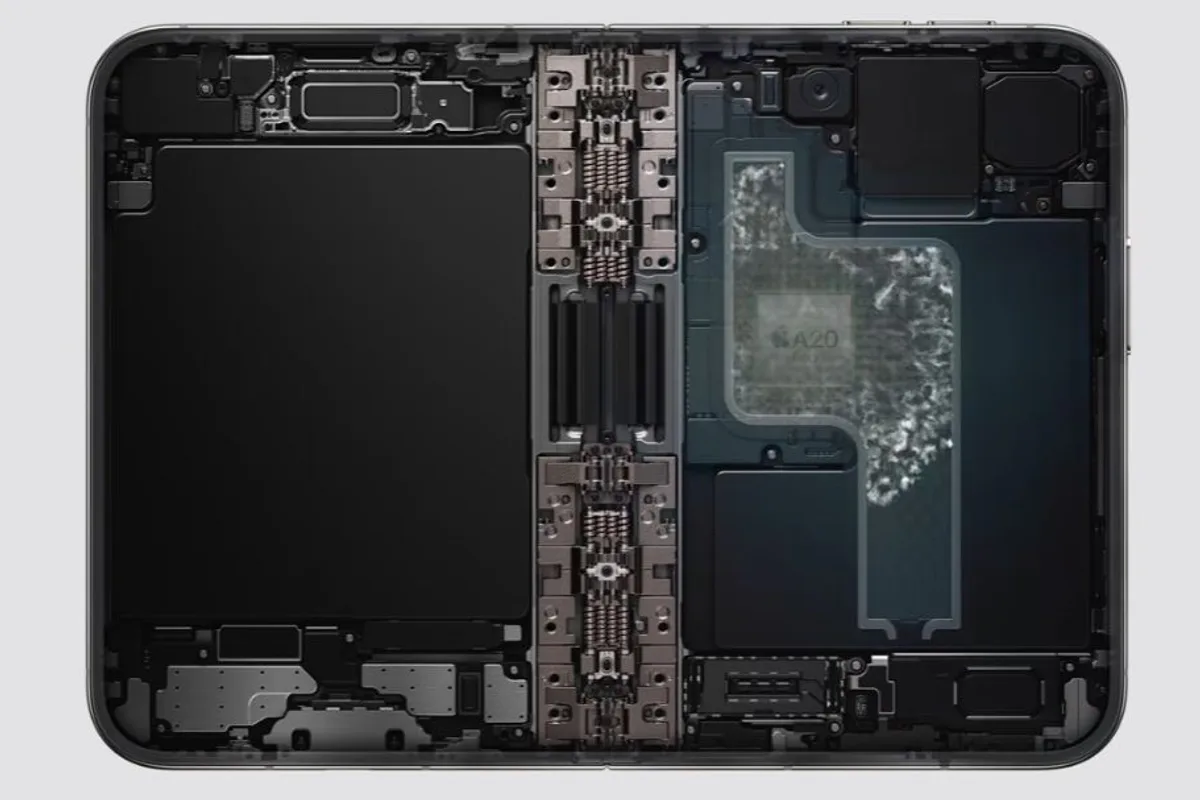
The logic board design is unusual as well.
Rather than using the stacked board architecture found in many recent iPhones, Apple employs a flatter main logic board alongside a separate input-output board.
This arrangement reduces the complexity of reaching some components.
Not every detail is convenient.
iFixit needed five different screwdriver types to complete the teardown, and some parts remain hidden beneath flexible cables.
A relatively accessible internal layout does not mean that the entire phone can be serviced with a single tool.
The dual batteries are a major repairability improvement
The battery system is arguably the most successful element of the design from a repair perspective.
The iPhone Duo contains two battery cells, one in each half of the phone.
iFixit identified capacities of 7.5 Wh and 11.6 Wh, giving a combined energy capacity of 19.1 Wh.
Both cells use electrically releasable adhesive.
By applying an appropriate electrical supply to designated release points, a technician can reduce the adhesive's grip.
The batteries can then be lifted without extensive bending or forceful prying.
This is particularly valuable for lithium-ion batteries, which can become hazardous if punctured or damaged during repair.
Apple also gives the cells metal protective shells.
During the teardown, iFixit removed both batteries cleanly and found minimal adhesive residue.
This does not make battery servicing risk-free. Proper procedures and equipment are still essential.
Nevertheless, it represents a substantial improvement over designs that require technicians to pull or pry aggressively against vulnerable battery cells.
The display crease is disguised rather than eliminated
The iPhone Duo's 7.6-inch inner screen is one of its defining features.
Apple highlights a special nano-texture finish intended to reduce reflections and make the central crease less visible.
iFixit examined the surface under a microscope.
At high magnification, the finish consists of extremely small rounded structures that scatter incoming light.
This diffusion reduces the sharp reflections that might otherwise reveal the screen's curvature at the fold.
When the phone is open, the result is an apparently smoother surface.
However, the physical crease remains.
After removing the nano-textured cover layer, iFixit found that the fold became significantly more visible.
The improvement therefore involves optical concealment as well as mechanical design.
That distinction matters when interpreting claims that a foldable display appears almost creaseless.
Unusual oval subpixels raise technical questions
The teardown uncovered another interesting display characteristic.
Under magnification, some red, green and blue subpixels have oval shapes pointing in different directions.
iFixit compared this arrangement with an Apple patent application describing ways to reduce diffraction artifacts.
Varying the shape and orientation of subpixels could theoretically prevent unwanted optical patterns from reinforcing one another.
That might contribute to the display's ability to reduce visible artifacts around the crease.
However, this remains an interpretation.
The microscopic structures are directly observable, and the patent provides a relevant technical explanation.
Apple has not confirmed that every detail of the observed layout implements that exact patent.
The evidence therefore supports a plausible hypothesis rather than a definitive statement about Apple's engineering intentions.
The protective layer can be replaced separately
The nano-textured surface also provides a practical repair advantage.
It sits on a replaceable polymer cover layer above the flexible OLED display.
According to iFixit, this layer can be serviced without replacing the underlying panel.
That is a meaningful improvement over early foldable smartphones, where removing an apparently protective surface could permanently damage the display.
iFixit reports US service prices of $49 without AppleCare and $19 with coverage.
Those are US prices and should not be presented as European repair quotations.
The procedure also requires specialized equipment and precise alignment.
It is not equivalent to peeling off and replacing an ordinary aftermarket screen protector.
Nevertheless, separating surface damage from full OLED replacement could offer meaningful savings for some owners.
A complete inner-display replacement costs $999 in the US
The situation changes dramatically when the flexible OLED itself is damaged.
iFixit reports a $999 US price for replacing the complete inner screen without coverage.
This figure does not establish the exact price of the same repair in France or other markets.
It nevertheless illustrates the potentially substantial cost of a major foldable display repair.
The component price is only part of the challenge.
Removing the inner display involves delicate work around adhesives and supporting structures.
Reassembly requires precise alignment to preserve the movement and reliability of the folding mechanism.
The technician must avoid damaging an extremely thin display assembly.
Even for experienced repairers, this remains considerably more demanding than replacing a screen on many conventional smartphones.
The display and hinge are among the largest reasons why the Duo does not receive a higher repairability score.
Early screen failures put the hinge under scrutiny
The teardown arrived alongside reports from some early iPhone Duo owners.
Several described cracks, bright lines or display defects appearing soon after purchase.
Some accounts mention an audible pop during opening or closing, followed by visible damage near the fold.
These reports warrant investigation but do not provide a statistically representative failure rate.
The number of affected devices relative to total sales remains unknown.
There is therefore insufficient evidence to describe the issue as a widespread defect.
To investigate the possible mechanics, iFixit constructed a three-dimensional model of the hinge.
The organization combined teardown footage, Apple patent information and computed tomography scans.
Several reported damage locations appear to cluster near the transition between the flexible cable passage and the central hinge support.
That pattern led the engineers to examine possible concentrations of mechanical stress.
A hinge support could create a pressure point
One hypothesis involves a central support component.
As the phone closes, certain hinge parts must move out of the way to accommodate the curved display.
iFixit modeled a scenario in which a support bar fails to lower sufficiently.
The flexible screen could then press against a more rigid point, producing localized mechanical stress.
Another possibility involves curved guides within the hinge mechanism.
Several components intersect around the area of concern, making it difficult to isolate a single responsible part.
The uncertainty is important.
A simulation showing a possible failure mechanism does not prove that it caused the reported damage.
Apple has not provided a definitive public explanation linking these reports to a particular hinge component.
Any claim of a confirmed design defect would therefore be premature.
The hinge uses sophisticated movement control
The iPhone Duo hinge combines linked metal joints, synchronization gears and springs.
These elements coordinate movement across different sections of the folding mechanism.
When closed, the flexible display bends into a waterdrop-like curve inside the hinge.
This arrangement helps avoid imposing an excessively sharp bend on the panel.
The display's internal layers must also move slightly relative to one another.
The principle resembles bending a stack of paper: outer layers travel farther than inner layers.
Apple uses specialized materials and adhesives to accommodate that movement.
An accordion-shaped flexible cable connects the two halves and carries electrical power and signals.
The architecture is sophisticated, but it also requires numerous mechanical interfaces to remain correctly positioned through repeated folding.
Fluorescent dust reached moving hinge components
iFixit also performed an experiment investigating particle ingress.
Technicians exposed the phone to fluorescent powder, repeatedly opened and closed it, then inspected where the particles had traveled.
Adhesive barriers stopped much of the powder from reaching sensitive electronics.
However, some particles entered openings and reached moving elements of the hinge.
The mechanism subsequently produced a noticeable grinding or crunching sound.
iFixit observed less visible powder than in some earlier experiments involving competing foldables.
The finding therefore does not establish that the Duo is uniquely vulnerable to dust.
It does show that moving hinge components were not completely isolated from the particles under the test conditions.
Apple advertises IP68 water and dust resistance.
iFixit's experiment was not a formal IP certification test and does not independently demonstrate non-compliance with that rating.
The practical concern is that cleaning or replacing hinge components requires access to a complex assembly involving the flexible display.
Easy battery replacement cannot solve every foldable repair problem
The provisional 5/10 score summarizes two contrasting design priorities.
Apple has adopted useful repair techniques for common servicing tasks.
The batteries release cleanly, the outer display can survive removal and smaller components are relatively accessible.
However, servicing the hinge and flexible inner screen remains difficult.
Those components also face the distinctive mechanical stresses associated with foldable phones.
Repairability depends on more than whether a component can technically be replaced.
Labor time, replacement-part pricing and parts availability also matter.
iFixit emphasizes that its score remains provisional.
Apple has published a repair manual, but iFixit is still awaiting availability of some replacement components.
The long-term repair ecosystem will therefore need to be assessed as replacement parts reach the market.
What the teardown means for potential buyers
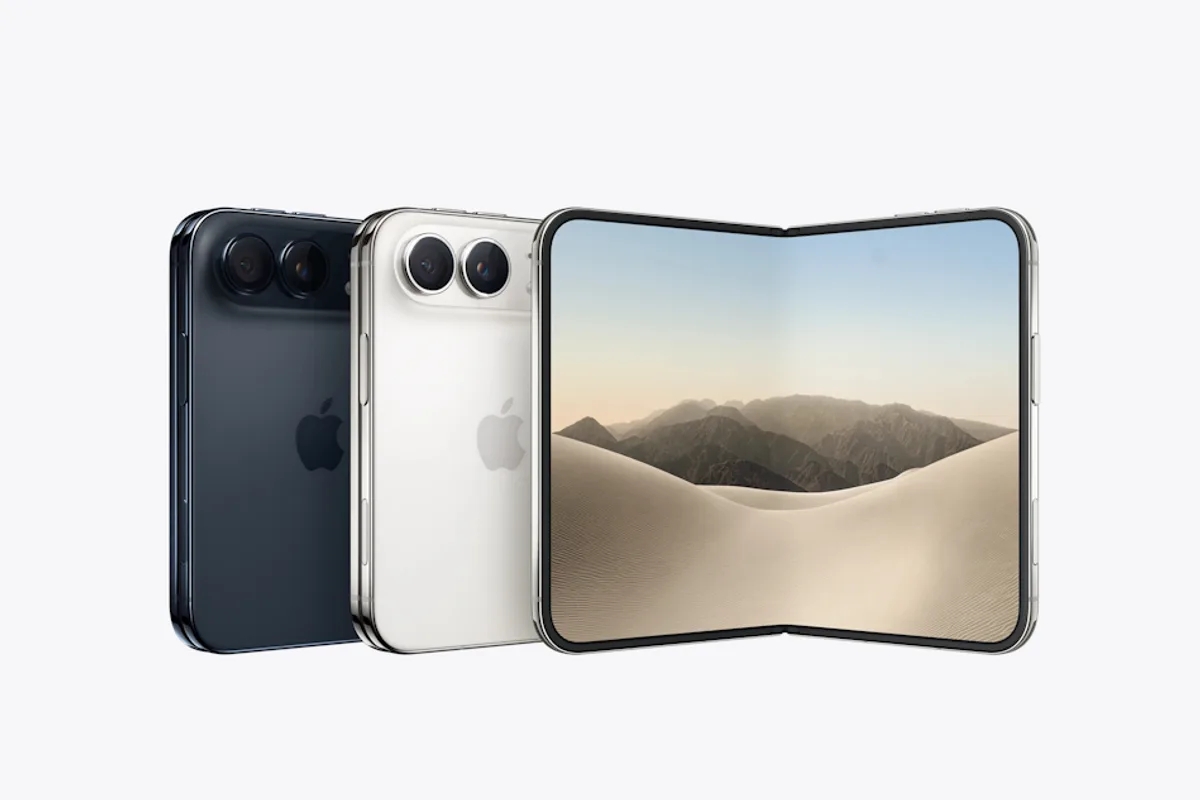
The iPhone Duo introduces a new form factor to Apple's smartphone lineup.
Its 7.6-inch inner display provides a much larger viewing area when unfolded, while the 5.4-inch outer screen preserves a compact closed configuration.
That versatility brings mechanical compromises.
The display must be flexible enough to fold and durable enough for repeated daily interaction.
The hinge must guide the movement accurately and support the panel when opened.
Early damage reports make those requirements especially relevant.
They do not establish the overall reliability of the product, but they provide reasons to watch for further independent testing and any additional statements from Apple.
Potential buyers should also consider local repair pricing, warranty terms and optional coverage.
A comparatively strong repairability score within the foldable category does not guarantee inexpensive maintenance.
Apple improves foldable repairs without eliminating the screen problem
iFixit's teardown identifies several positive engineering decisions.
The battery removal process is particularly effective, the internal layout simplifies some repairs and the replaceable cover layer reduces the need for complete OLED replacement following superficial damage.
However, the hinge and inner display remain substantial obstacles to convenient repair.
The investigation also reveals that the crease's reduced visibility results partly from sophisticated optical treatment rather than the complete elimination of physical curvature.
As for the first reported screen failures, iFixit's models provide interesting mechanical hypotheses without identifying a confirmed root cause.
The verdict is therefore more nuanced than the headline score suggests.
At 5/10, Apple has produced what iFixit considers the most repairable foldable it has examined so far, but not a device that is easy to fix in every situation.
The next important questions concern how the hinge and inner screen age during real use and whether owners can obtain affordable repairs once their devices move beyond warranty coverage.