
 By Adri
Samsung unveiled the P9 and P7 portable SSDs on August 26 at Gamescom 2026.
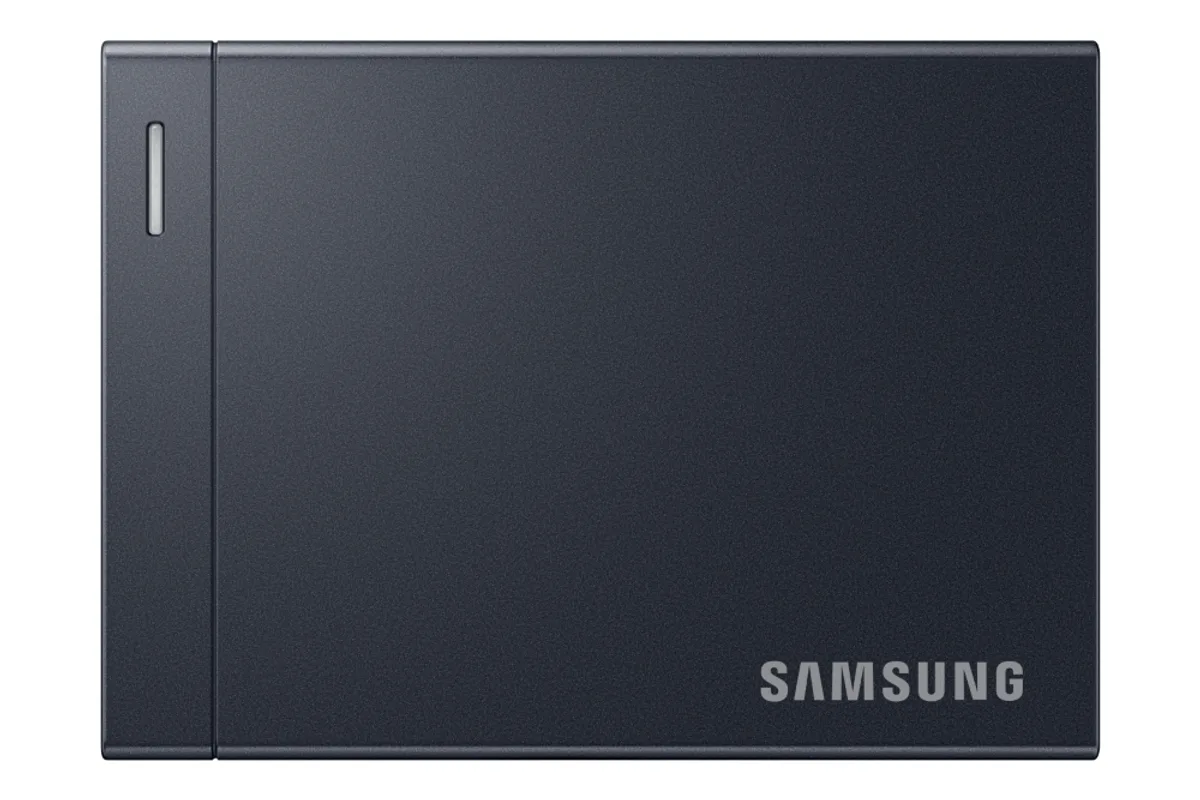
Both move to USB4. P9 is the performance flagship, while P7 is positioned more broadly across PCs, phones, cameras and game consoles.
P9 is where the generational performance jump becomes obvious.
4,000MB/s reads and 3,800MB/s writes
Samsung rates P9 for sequential read speeds up to 4,000MB/s and sequential writes up to 3,800MB/s.
The previous 4TB T9, using USB 3.2 Gen 2x2, was rated at up to 2,000MB/s for both reads and writes.
Samsung has therefore almost doubled headline sequential performance.
That does not automatically make P9 equivalent to a modern PCIe 4.0 drive installed directly inside a PC.
Fast internal NVMe SSDs can exceed 7GB/s, and random access behavior matters just as much as sequential throughput in many workloads.
But 4GB/s is high enough that the external interface stops being such an obvious bottleneck for large-file workflows.
USB4 changes more than the number after USB
The jump comes from the connection between storage and host.
The USB 3.2 Gen 2x2 link used by T9 provides 20Gb/s of raw bandwidth. A 40Gb/s USB4 implementation can effectively double that envelope.
Protocol overhead means real payload throughput remains below the raw interface rate, which is why Samsung's 4,000MB/s figure sits below the mathematical ceiling.
It is still fast enough to move very large project files at speeds that begin to resemble internal storage rather than a traditional external drive.
Eight terabytes matters almost as much as four gigabytes per second
P9 will be offered in 1TB, 2TB, 4TB and 8TB capacities depending on market.
Samsung describes the 8TB model as the world's first 8TB USB4 portable SSD capable of reaching 4,000MB/s.
That combination changes what the device can reasonably hold.
Portable SSDs have often been used as fast transfer drives or temporary project storage. At 8TB, one device can carry an entire large video project, a substantial RAW archive or a huge game library while retaining high transfer performance.
The obvious tradeoff is price.
Samsung lists U.S. MSRPs of $339.99 for 1TB, $649.99 for 2TB, $1,349.99 for 4TB and $2,699.99 for 8TB.
P9 is not competing with inexpensive commodity portable storage.
Samsung goes as far as claiming direct 12K recording
The company explicitly positions P9 for professional video workflows.
Samsung says its sustained write performance supports direct 12K recording.
That claim still depends on the actual codec, bitrate, camera and whether that camera supports external USB storage at the required rate.
“12K” by itself does not define a video data rate.
The positioning nevertheless makes Samsung's intent clear: P9 is supposed to become part of the capture pipeline rather than merely receiving footage afterward.
The same bandwidth matters for giant RAW files
Photography, editing and AI-assisted creation can benefit from the same shift.
A photographer working through hundreds of large RAW files, an editor carrying proxies and masters, or a creator maintaining local datasets can keep a larger part of a project on removable storage without immediately running into an old USB ceiling.
That does not guarantee identical performance in every workload.
Small-file and random access can behave very differently from headline sequential transfers.
Long sustained writes after caches are exhausted will also need independent testing.
Thermals become much more important at 4GB/s
Nearly doubling performance inside a compact enclosure inevitably increases thermal difficulty.
The USB4 controller, SSD controller and NAND all work harder during sustained transfers.
Portable SSDs generally have neither large heatsinks nor active fans.
Samsung emphasizes sustained write capability, but that is precisely why independent thermal measurements will matter.
Reaching 4,000MB/s briefly is a different achievement from staying fast across hundreds of gigabytes.
The host PC can now be the bottleneck instead
A USB4 SSD does not deliver 4,000MB/s from every USB-C port.
USB-C describes the connector, not the speed implemented behind it.
A system limited to USB 3.2 will continue limiting P9 to whatever that host controller can provide.
Even among USB4 and Thunderbolt systems, implementation details, drivers and internal architecture can influence throughput.
P9 therefore makes the most sense on recent systems capable of exposing the full interface.
P7 uses USB4 too, but Samsung is much quieter about its exact speed
P7 also moves to USB4.
Samsung's Gamescom announcement does not, however, publish the same specific sequential read and write figures it gives for P9.
It would therefore be incorrect to automatically assign P9's 4,000MB/s and 3,800MB/s numbers to the lower model.
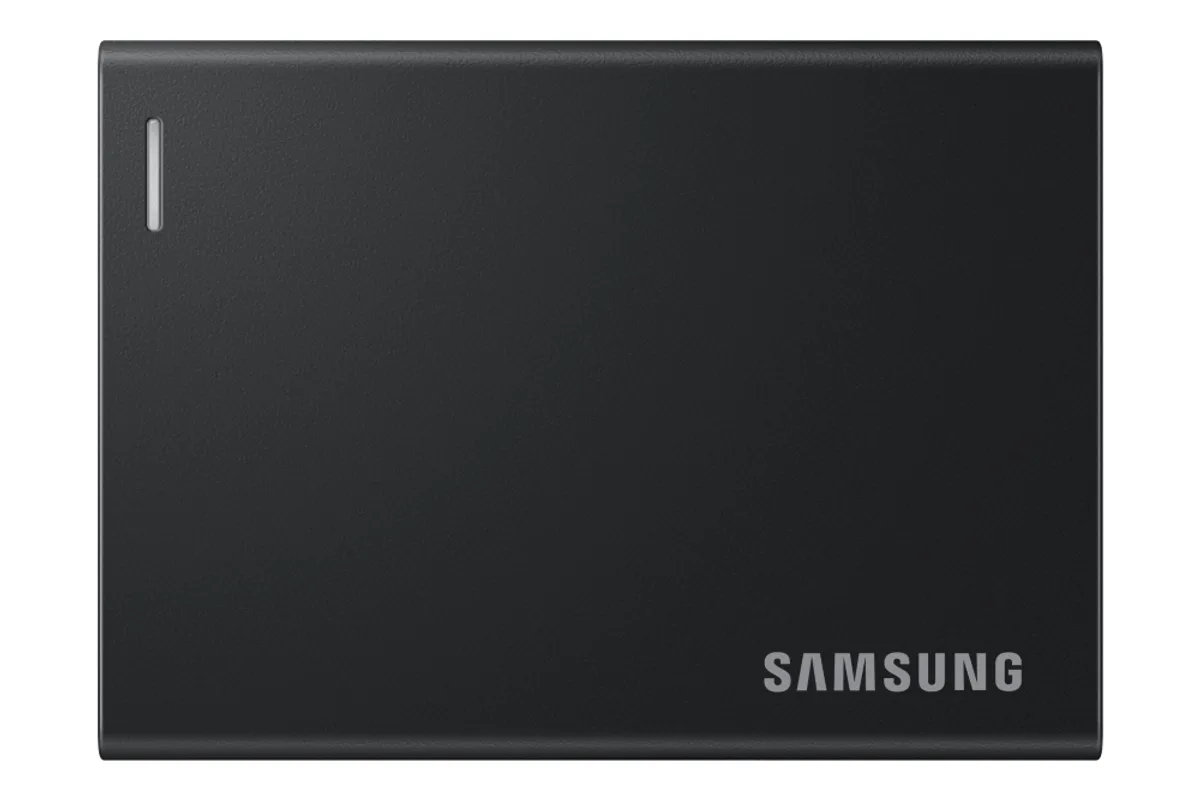
Samsung instead emphasizes P7's versatility and compatibility with desktops, laptops, smartphones, game consoles and cameras.
It is also planned in 1TB, 2TB, 4TB and 8TB capacities depending on market.
The travel-oriented model is tested for two-meter drops
Samsung says P7 completed drop testing from up to two meters along with shock and vibration testing.
Physical durability matters more on portable storage than on an SSD permanently mounted inside a PC.
The lack of moving parts helps, but controllers, NAND packages, connectors and solder joints still face mechanical stress.
The two-meter figure should still be understood as a manufacturer test result, not a promise that every possible two-meter fall is harmless.
P7 is still far from entry-level portable-storage pricing
Samsung's U.S. pricing starts at $289.99 for 1TB, then rises to $549.99 for 2TB, $1,149.99 for 4TB and $2,289.99 for 8TB.
The gap to P9 exists, but it is relatively small compared with the total purchase price.
That places the entire P Series well above conventional 10Gb/s or 20Gb/s portable SSDs.
P7 is not the cheap USB-C option in this lineup.
It is the less specialized member of an expensive family built around USB4 and very large capacities.
For games, four gigabytes per second does not mean four-times-faster loading
Samsung introduced the drives at Gamescom and naturally points to increasingly large games as one source of storage demand.
Transfer speed and game loading are still different workloads.
Moving a 150GB installation can directly benefit from higher sequential bandwidth.
Loading the game depends on random access, decompression, CPU performance, engine design and storage APIs as well.
A P9 that copies files several times faster than an older SSD will not automatically load every save several times faster.
External storage is mainly becoming less different from internal storage
That is the more important shift.
Users no longer have to choose quite as sharply between large removable capacity and genuinely fast local storage.
USB4 narrows the gap enough that some workflows can remain on the external device itself.
An editor can move one project between workstations. A photographer can work directly from a portable archive. A laptop with no spare NVMe slot can gain several terabytes of very fast storage without being opened.
The latency and random-performance differences remain meaningful.
For large sequential transfers, however, the distinction becomes much less obvious.
The next limit is less about USB and more about NAND, thermals and price
With 40Gb/s of USB4 bandwidth available, the interface finally gives the SSD itself much more room to become the limiting factor.
Controller behavior, NAND configuration, caching and cooling therefore matter more.
That brings portable SSDs back to a familiar internal-drive problem: hitting a peak number is relatively easy, maintaining it is harder.
P9 will therefore need to prove that it can preserve its advantage across long transfers.
But the existence of an 8TB external SSD advertising 4GB/s already shows how far the boundary has moved.
The cable is no longer automatically the slow part.