
 By Camille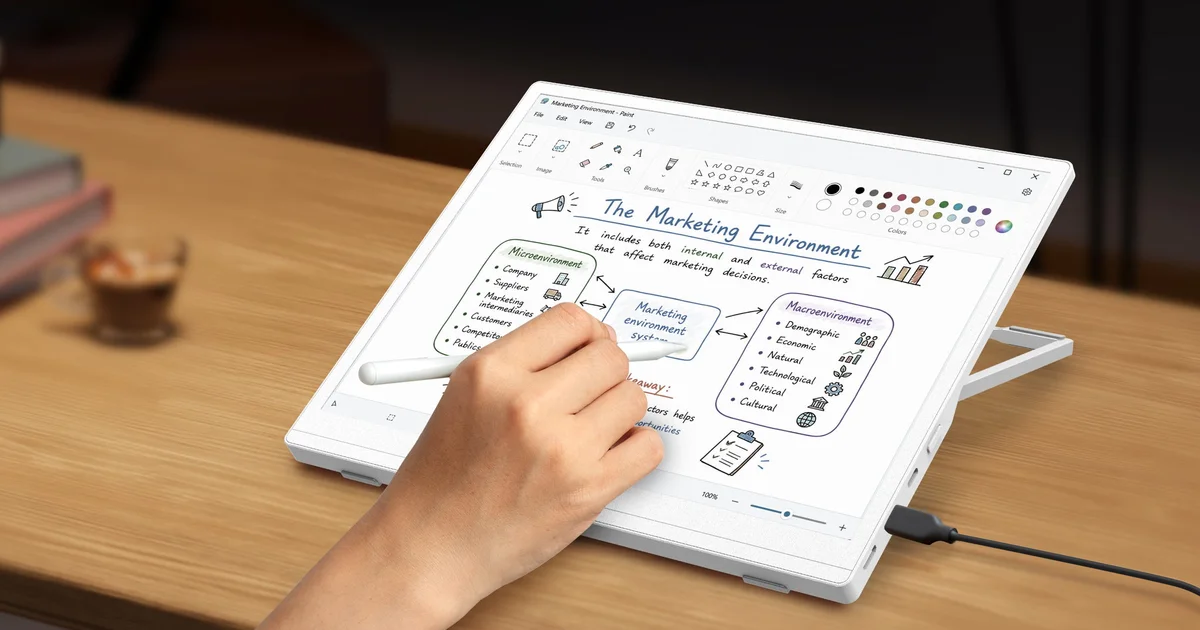
Color and monochrome are effectively two different display modes
In black and white, EP130K runs at up to 3200 × 2400 and 60Hz. On a 13.3-inch panel, that works out to roughly 301 pixels per inch.
Switching to color reduces maximum resolution to 1600 × 1200. Acer specifies 4096 displayable colors.
The refresh-rate ceiling remains 60Hz in both modes.
There is a 20ms response-time specification behind the 60Hz headline
A 60Hz refresh interval lasts around 16.7ms. Acer separately rates the panel at 20ms gray-to-gray response time.
Refresh rate and pixel response are not the same measurement, so those figures should not be combined into a simplistic performance verdict. They do show why the EP130K should not automatically be expected to behave like a conventional 60Hz LCD.
Independent testing will be needed to establish scrolling clarity, transition artifacts and how the display handles continuously changing content.
For reading, document work and relatively static interfaces, the appeal is easier to understand already.

Its most useful ePaper trick happens when the power disappears
EP130K uses bistability, allowing a static image to remain on screen after power has been removed.
The panel still needs energy whenever its content changes. What it avoids is continuous power simply to preserve an unchanged page.
That behavior fits the kinds of workloads Acer is targeting: documents, reference material, reading and focused office work.
It behaves like a monitor, not just a large reader
Connectivity includes one mini-HDMI input and two USB Type-C ports.
Acer says the panel can draw power from its host over USB-C, with the official specification listing 12V at 1.25A or 5V at 3A.
There is also audio output and a pair of built-in 1W speakers.
The integrated stand supports a 0-to-180-degree tilt range.
Touch and stylus support change how the second screen can be used
The matte ePaper surface accepts both finger input and a stylus.
Acer's own promotional material shows the monitor tilted down for handwritten annotation, making it closer to a large document surface than a passive second display.
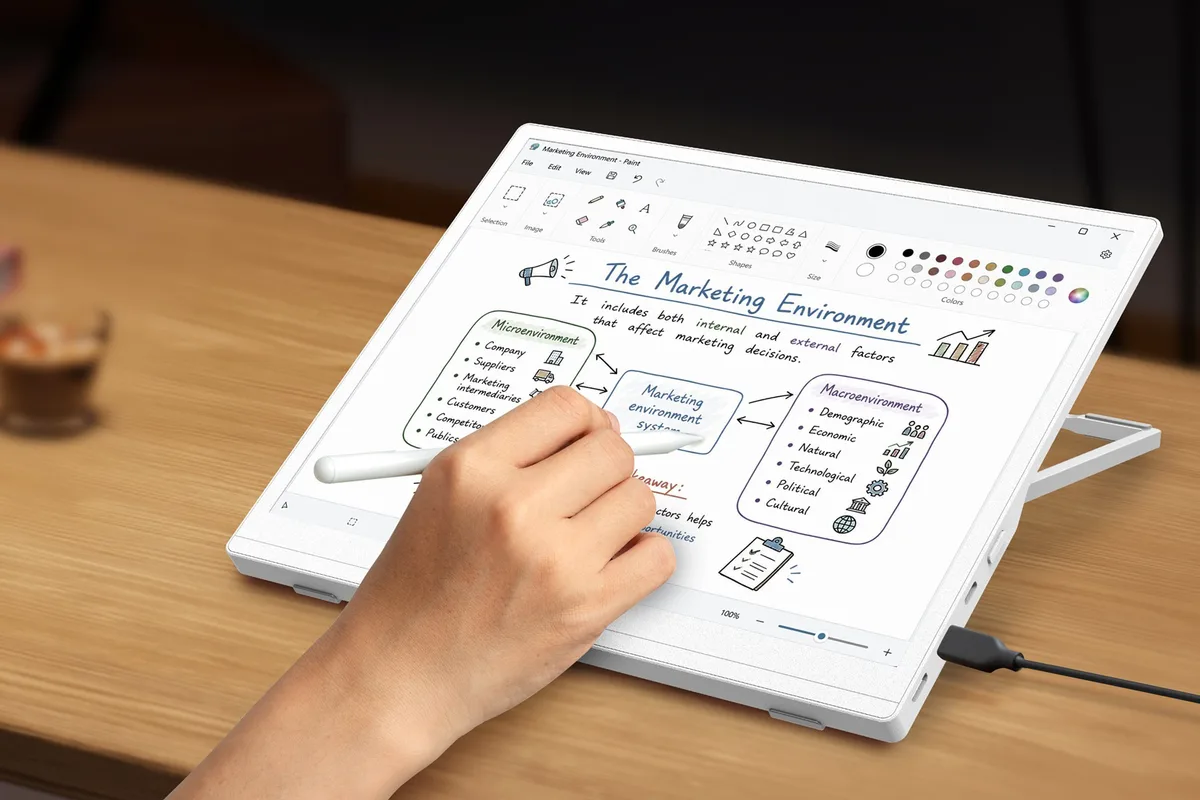
Viewing angles are specified at 178 degrees horizontally and vertically.
There is no conventional brightness figure
Acer does not provide a numeric brightness or contrast specification for the EP130K.
Instead, the company emphasizes the matte surface, glare-free use and the absence of a backlight.
That makes ambient lighting far more relevant than it would be on a self-illuminated LCD or OLED. Bright environments are part of the product's intended use case; a dark room is a different matter.
The price immediately makes this a specialist display
EP130K is scheduled to ship in Q1 2027.
Acer lists a €749 starting price in EMEA, $749.99 in North America and AUD 1,499 in Australia.
That places it far above ordinary USB-C portable monitors. Buyers are paying for ePaper behavior, high monochrome pixel density, touch input and the ability to keep static content visible without continuous display power.
The remaining question is not whether Acer can write 60Hz on the specification sheet. It is how that 60Hz looks when the content actually starts moving.