
 By Adri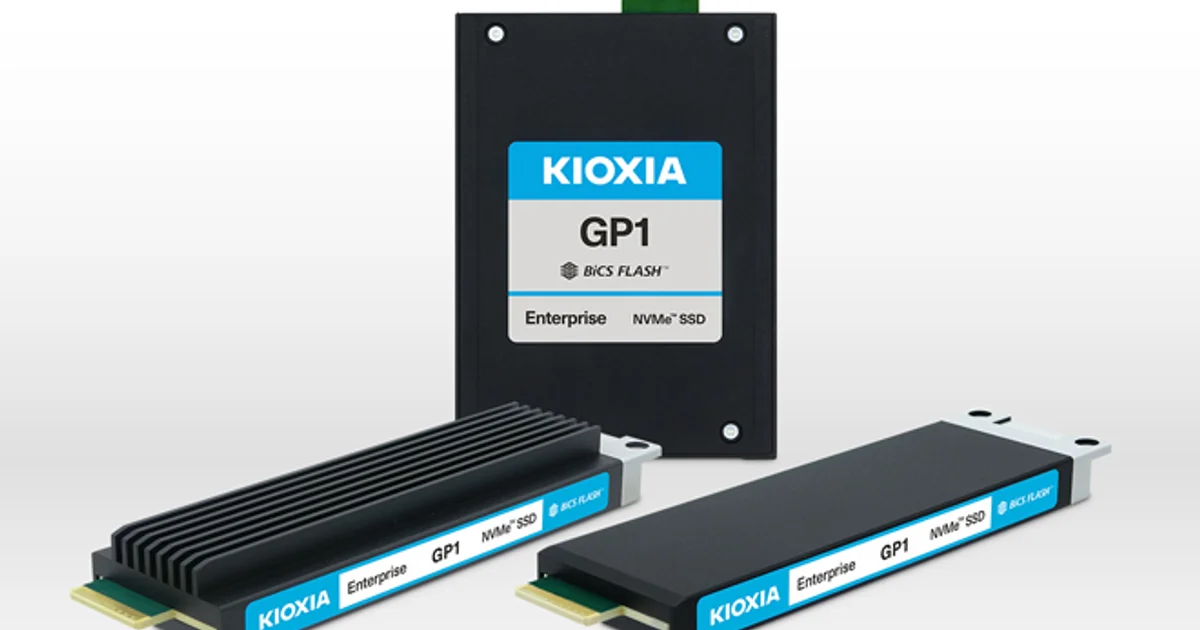
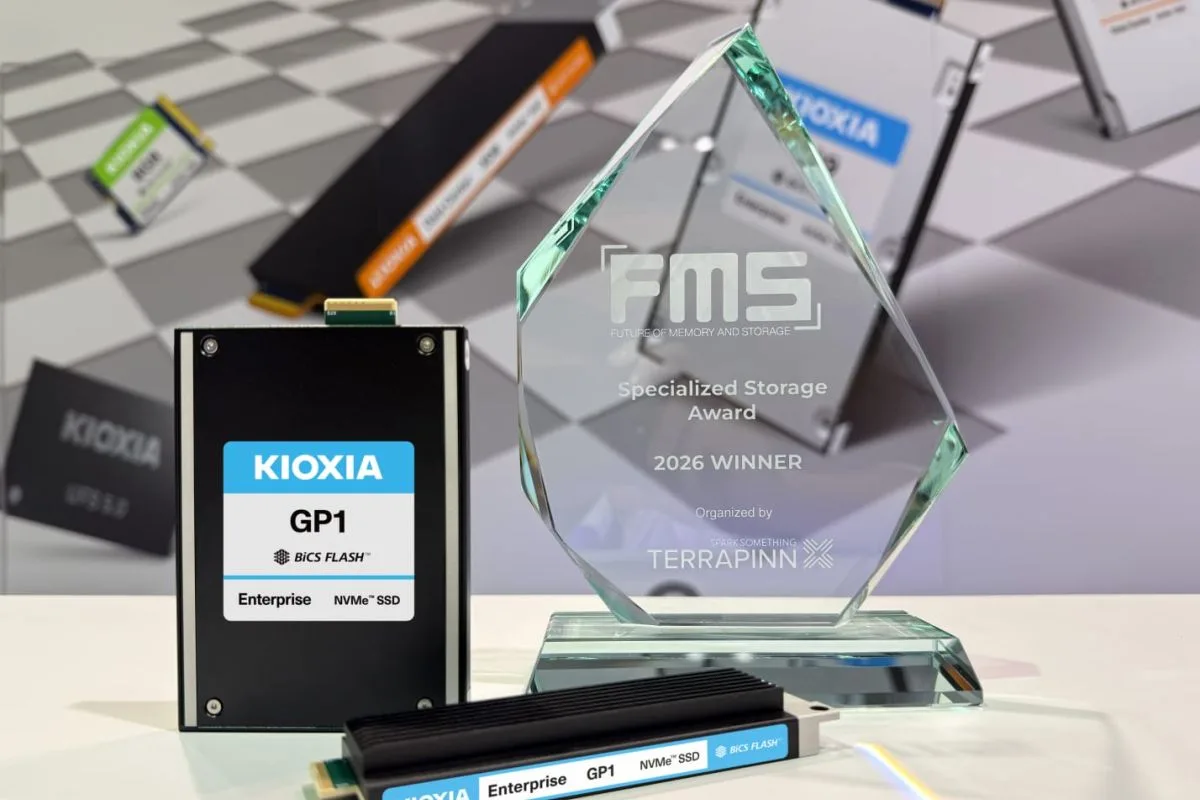
Kioxia formally announced the GP1 Series on August 4 at FMS 2026. It is the first named product in the company's new Super High IOPS SSD family, which was originally introduced around NVIDIA's Storage-Next initiative earlier in the year.
The specification list is unusual even for enterprise storage: PCIe 6.0, NVMe 2.2, second-generation XL-FLASH and up to 10 million random-read IOPS.
The more revealing number may be the block size. Kioxia measures that performance using 512-byte accesses.
512-byte reads make this a very different SSD benchmark
Consumer SSD random performance is commonly discussed using 4KB operations, a size that maps reasonably well to many traditional storage workloads.
GP1 goes down to 512 bytes because it is targeting something different: huge numbers of fine-grained reads initiated by GPU workloads.
The objective is not simply to stream one enormous sequential file at tens of gigabytes per second. The system needs to retrieve tiny, independent pieces of information quickly and in parallel.
That behavior is useful for AI workloads pulling embeddings, cache entries, model fragments or pieces of large datasets on demand.
The GPU can request data without an unnecessary trip through the CPU
GP1 is optimized for GPU direct access under NVIDIA's Storage-Next architecture.
The general goal is to avoid routing every piece of data through host memory before copying it again into GPU memory.
Every extra copy consumes bandwidth, uses CPU resources and adds latency. For workloads that are primarily waiting for data, improving the path can increase GPU utilization without adding any additional compute hardware.
That matters when the accelerator itself costs tens of thousands of dollars. An expensive GPU stalled on data is still an expensive GPU doing no useful math.
GP1 is not a replacement for HBM
The phrase “HBM extension” needs an important qualification.
Flash remains dramatically slower than HBM physically integrated next to an accelerator. HBM delivers terabytes per second of bandwidth and memory-class latency that an NVMe SSD cannot approach.
Kioxia is proposing another tier, not a substitute.
The hottest data stays in HBM. A much larger working set can sit in GP1 flash and remain closer to the accelerator than data stored on slower network or capacity-oriented storage.
The economics are the attraction. Adding HBM requires complex packaging, scarce interposer area and very expensive memory stacks. Flash can provide far more capacity at a radically lower cost per gigabyte.
XL-FLASH is what makes the concept plausible
GP1 is not based on the conventional TLC NAND used by most mainstream enterprise SSDs.
Kioxia uses second-generation XL-FLASH, a storage-class memory technology designed around lower latency and much greater internal parallelism.
The company says it provides higher IOPS, finer-grained access and lower power consumption per I/O than conventional TLC-based Kioxia SSDs for these workloads.
Endurance reaches up to 50 drive writes per day, depending on the final configuration and specified workload.
That figure is far beyond typical consumer SSD endurance and fits a device expected to operate as an active data tier rather than a passive archive.
PCIe 6.0 becomes useful before desktop PCs really need it
GP1 is designed around PCIe 6.0.
For an ordinary desktop SSD, the practical need for that interface would be debatable because few consumer applications can generate enough useful storage traffic to exploit it.
Millions of fine-grained operations per second create a different problem. The interface between storage, host and accelerator can genuinely become part of the bottleneck.
Kioxia plans E3.S and E1.S 9.5mm and 15mm versions. E3.S and 9.5mm E1.S models can support cold-plate liquid cooling, while all versions can operate in traditional air-cooled environments.
The existence of liquid cooling for an SSD says quite a lot about the machines Kioxia expects it to live in.
Ten million IOPS is only the first target
Kioxia says the GP architecture is intended to scale far beyond the first product.
Future generations are targeting up to 100 million random-read IOPS.
At that level, comparing the product with a conventional SSD becomes increasingly awkward. The device starts behaving more like a very large shared memory resource than a place where applications simply store files.
Kioxia had already demonstrated an emulator exceeding 100 million IOPS at GTC 2026 to show where it wants the architecture to go before production hardware reaches that level.
The real enemy is an idle GPU
One of the most expensive problems in large AI clusters is not merely buying enough compute. It is keeping that compute fed.
A large model, RAG system, vector database or agentic application can operate on much more data than fits inside the HBM attached to one accelerator.
Traditional answers include buying more memory, spreading work across additional accelerators, or repeatedly pulling data back from host DRAM and storage.
Every option adds cost, latency or power.
Storage-Next and GP1 create another compromise: vastly slower than HBM, vastly larger, but fast enough to avoid some of the most expensive trips farther down the storage hierarchy.
GP1 is still an evaluation product
Kioxia is not yet shipping GP1 broadly.
Evaluation samples are scheduled for selected customers by the end of 2026, and the company explicitly warns that sample specifications may differ from the eventual mass-production devices.
Commercial capacities, pricing and a general availability date have not been announced.
Those numbers will determine whether the architecture works economically. Flash-based memory extension only makes sense if capacity, price and recovered GPU utilization beat the alternatives of buying more memory, more accelerators or more conventional storage infrastructure.
The SSD is moving upward in the memory hierarchy
For decades, the categories were easy to understand: processors compute, RAM holds active data and storage keeps everything else.
AI is eroding that boundary because models and datasets are growing much faster than the amount of ultra-fast memory that can be economically attached to an accelerator.
Kioxia is trying to move flash one level closer to compute.
GP1 is still technically an NVMe SSD. But when a GPU directly requests tiny pieces of data from it millions of times per second to expand its active working set, calling it “storage” starts to undersell what the system is trying to do.